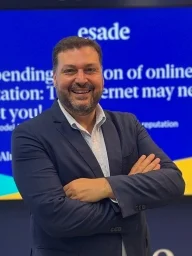
Mònica Reig (ESADE): 'The development of new health technologies entails a responsibility to create public value'
‘The new technologies developed in the health sector entail a responsibility to create public value. Many studies show that today countries are developing more in the areas of government, the market and citizen participation. Contrary to popular wisdom, the market and government are not at odds when it comes to development. Public-private partnerships, with the ultimate aim of improving services for citizens, are and will be necessary, especially in the area of health’, said Mònica Reig, associate director of the Center for Public Governance (ESADEgov) and director of the Partners Program at ESADE. She was speaking at the conference ‘Disruptive innovations in healthcare’, held within the context of the 6th La Unió Collaborating Partners Forum and organised by the Partners Program, an initiative of ESADEgov dedicated to research, development and dissemination of knowledge in the field of public-private partnerships.
Medicine in the age of social media
‘For 65% of people, the Internet is already the preferred means of getting information about health issues’, said Óscar Pierre, a board member of RTVE and president of Business Aggity. ‘If patients have embraced digital’, he continued, ‘then physicians need to have that digital culture too.’ In this regard, Pierre presented the tool Social Business, which brings together, in a single application, services such as instant messaging and video streaming for members of a medical organisation. The application, which is already being used in Mexico, allows patients to communicate with their doctors via IM, amongst other things. ‘Currently, 50% of physicians affiliated with centres that have implemented the tool have agreed to use the instant messaging feature offered in the app.’
Privacy: a key factor
‘We need to ensure security and confidentiality.’ In this regard, Pierre argued that it was necessary to develop ‘proprietary apps such as Social Business that give physicians and patients control over their data’ since traditional IM services do not guarantee that privacy.
In the same line, Pablo García, sales and pre-sales manager at Serban Biometrics, presented his company’s innovations in the field of biometric signatures, or digitised handwritten signatures, ‘which not only eliminate the need to print out a piece of paper to sign a document but also, unlike digital signatures based on certificates, identify features that make it possible to authenticate the signature and therefore increases security’. García also presented other innovations the company is developing in this field, such as facial and iris recognition technologies to enable secure access to information or places.
The benefits of digitising emergency medical services
Raimon Dalmau, director of the Organisation and Information Systems Area of the Medical Emergencies System (SEM) of the Catalan Health Service, presented the plan to digitise the patient-care report forms used in medical emergencies. ‘Each year, we issue about 900,000 patient-care reports that, printed out and stacked in a pile, would stand 135 metres high and which, moreover, do not facilitate access to information.’ This process is now being digitised through the use of tablets in ambulances and mobile emergency medical services. ‘We are already receiving some 2000 digital reports a day in Barcelona and we plan to expand the system to include the rest of Catalonia by the end of summer.’ Dalmau also noted that ‘work is being done to include the data generated by the systems integrated into ambulances in these reports and to ensure that these data reach the hospital even before the patient gets there’. With regard to the potential use of drones in emergency medical services, he stressed, ‘It is not science fiction. That integration could happen, but we need the legislation to support it. The protocol will have to be changed.’