Emerging systemic philanthropy understanding
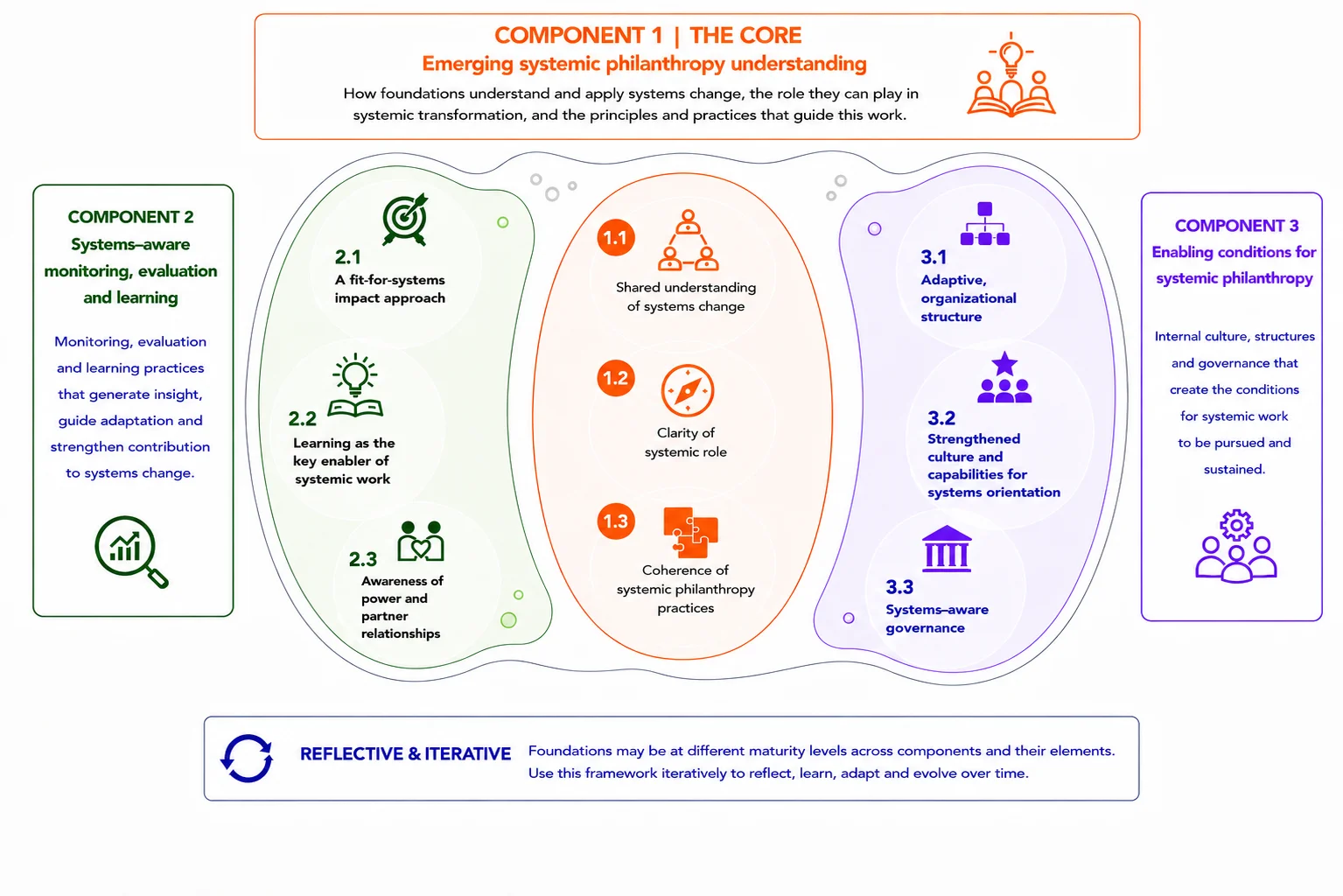
How foundations understand systems change, how they see their role within it and how far systemic principles are reflected in their practices.

Over the past decade, systems change has become an important part of the conversation in philanthropy. It reflects an ambition to look beyond isolated projects and short-term results, and to engage with the conditions that keep social and environmental problems in place. Moving from this ambition to practice, however, is difficult.
Many foundations are in transition between established ways of working and a more systemic approach. This raises practical questions: how can a foundation develop a shared understanding of systems change, define the system it seeks to influence and clarify its role as one actor among many? It also calls for a different approach to monitoring, evaluation and learning, as well as consideration of whether its organisational structures, culture, capabilities and governance support the adaptive, collaborative and long-term ways of working that systemic practice requires.
Read the research for a closer look at how foundations are navigating this transition, the approaches taking shape and the questions that remain.
Philanthropy in Transition examines how six foundations are working through these questions in practice. Drawing on interviews with foundation staff, their partners and external experts, it considers how systemic principles are reflected in strategy, funding, collaboration and organisational practice, as well as where ambitions and day-to-day realities do not yet fully align. It is the first research project developed by the Esade Chair in Social Impact.
The report does not present systemic philanthropy as a single path or model. It brings together findings and examples from practice across three connected areas: systemic understanding and role, systems-aware monitoring, evaluation and learning, and the organisational conditions that enable systemic work. The accompanying Systemic Philanthropy Spectrum is a reflection tool, not a scorecard. It can help foundations compare perspectives within their teams, identify gaps between their ambitions and current practices, and consider where further attention may be needed.
The research is available as a full report and as a shorter standalone publication combining the executive summary with the Systemic Philanthropy Spectrum.
In the full report you can find all details of the research: executive summary, methods, zooming in on the three component framework, practical recommendations and a self-reflection tool for each component. It also includes short case studies of the six participating foundations.
For a shorter introduction to the research, please download the executive summary. You can find the three component framework here as well directly followed by the self-reflection tool to help you navigate your own journey and start putting the findings of the research into practice.

The research began with a question about how European foundations were approaching monitoring, evaluation and learning in the context of systems change.
It soon became clear that this could not be separated from a foundation’s wider strategy or from its organisational readiness to work differently. The research therefore developed into a broader study of three connected aspects of systemic philanthropy.
How foundations understand systems change, how they see their role within it and how far systemic principles are reflected in their practices.
How foundations understand and learn about change in complex settings, where outcomes are shaped by many actors and cannot be attributed to one organisation alone.
How organisational structures, culture, capabilities and governance support, or sometimes constrain, systemic work.
The Systemic Philanthropy Spectrum is a reflection tool that foundations can use to examine their current practices across nine elements of systemic philanthropy.
It can help teams:
The Spectrum is not a scorecard, an accreditation system or a linear model of progress. A foundation may be at different points across its components, and there is no single destination that is right for every organisation.
Three longer case studies will be published separately following the main report. They will examine how Co-Impact, Laudes Foundation and Robert Bosch Stiftung are putting their systemic ambitions into practice.
The long case studies will be published in the upcoming months, so please stay tuned.
The Co-Impact case study examines the approach of a systems-born funder that supports locally rooted organisations through long-term and flexible funding. It considers how inclusion, partner agency and a clear systems framework shape its work.
The Laudes Foundation case study looks at its approach to systemic monitoring, evaluation and learning. It explores the use of systemic theories of change, evaluative rubrics and collaborative sensemaking.
The Robert Bosch Stiftung case study examines how a large hybrid foundation is working to create greater coherence across its programmes, systems change ambitions and monitoring, evaluation and learning practices.
The study is based on more than 50 qualitative interviews conducted with staff from six foundations, their partners and external experts.
The participating foundations are:
The emerging findings and tools were discussed with the participating foundations and validated with more than 60 foundations, as well as with the Esade Chair for Social Impact Advisory Committee.
The research primarily reflects a philanthropic perspective. This creates an important limitation, since systems change involves many actors and no foundation works in isolation. The perspectives of partners have been included to help balance this view, but further research will be needed to bring in more voices from across the systems in which foundations operate.
Philanthropy in Transition is the first research project developed through the Esade Chair in Social Impact, an initiative of the Esade Center for Social Impact.
The research grew out of ECSI’s work with its Community of Practice on Impact Measurement and Management for European Foundations, where systems change has been a recurring topic of discussion.
The Chair connects academic research with practice across the generation, financing, measurement and scaling of social impact.
This research would not have been possible without the openness and support of the people and organizations who contributed to it.
We are grateful to BBK Foundation, Co-Impact, the Daniel and Nina Carasso Foundation, IKEA Foundation, Laudes Foundation and Robert Bosch Stiftung for sharing their experiences, questions and challenges.
We also thank their partners and grantees, the external experts who contributed to the research, the foundations that helped test the findings and tools, and the members of the Esade Chair for Social Impact Advisory Committee.
We gratefully acknowledge Fundación Bancaria BBK, Robert Bosch Stiftung, Bertelsmann Stiftung and Impact Bridge Asset Management for their strategic and financial support as founding partners of the Esade Chair in Social Impact.