La educación en tiempo de IA: entre la tecnología, el criterio y la equidad
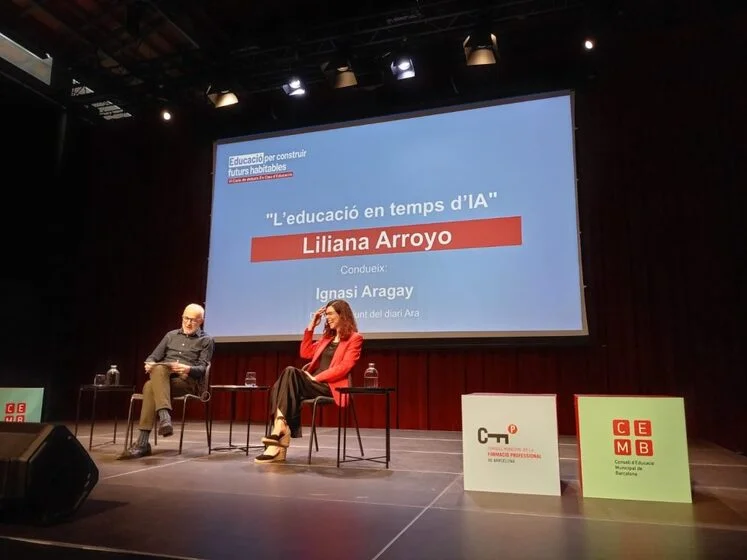
The director of the Chair for Socially Responsible Digital Innovation (SoReDI) of ESADE, Liliana Arroyo, participated in the debate “Education in AI time”, within the framework of the VI Cycle of Debates ‘En Clau d’Educació’, organized by the Municipal Education Council of Barcelona and the Municipal Vocational Training Council. The event, held in the Sala Moragues of the Born Museu d’Història de Barcelona and led by Ignasi Aragay, deputy director of the Diari Ara, brought together different voices to reflect on the challenges that artificial intelligence poses in the educational field.
During her speech, Liliana Arroyo raised the need to overcome the debate on whether or not technology should be present in the classroom and focus on how we want to use it and under what criteria. In this sense, she reflected on the prohibition of mobile phones in educational centers and pointed out that the debate should not be limited to the device, but should also address the design of digital technologies and the dynamics of attracting attention they incorporate. Faced with this scenario, she raised a central question: “What is the technology we want?”.
The session also focused on inequalities in access and digital accompaniment. Arroyo stressed that removing technology from educational spaces can have different impacts depending on the family and socio-economic context of the students. In this sense, she defended that the school must have an active role in digital education and must offer tools and criteria to understand and use technology, especially to ensure that all students can develop these skills in conditions of equity.
Regarding generative artificial intelligence, Arroyo invited to adopt a critical look at the functioning and design of tools such as ChatGPT, Gemini or Copilot. She remarked that, despite the anthropomorphic language with which these systems are often described, whether AI “thinks”, “reasons” or “feels”, these are systems that process information and calculate probabilities. She also emphasized certain characteristics of its design that can favor the link with the user and encourage the continuity of the interaction.
This critical look, however, does not imply rejecting AI. Arroyo stressed that it is “an incredible tool if you use it well” and defended the importance of learning to use it consciously, understanding its possibilities and limitations. In this process, he underlined the value of learning to ask, replicate and contrast information, developing a critical attitude and persevering with the results offered by these systems.
The debate was also attended by Nou Patufet, who shared their experience as a cooperative school and as a center recognized in the EdTech 2026 Awards for the project that promotes to integrate artificial intelligence in a pedagogical, ethical, critical and inclusive way. Their participation allowed the debate to incorporate the perspective of educational centers that are already exploring concrete ways of integrating AI into the teaching and learning processes.
From Nou Patufet it became clear that talking about artificial intelligence in school goes beyond talking about digital tools. Issues such as data sovereignty, equity, critical thinking, responsibility and teaching support are essential elements to move towards the incorporation of AI that is at the service of learning and the common good.
In this line, Arroyo also raised the possibility of exploring safer educational AI environments adapted to the needs of schools, such as models deployed in local and closed environments, with specific guidelines and oriented to specific educational purposes. These types of experiences would allow not only to use AI as a tool, but also to turn it into a learning object that students can explore, question and understand.
The session showed that the educational challenge is not simply to decide whether to incorporate or exclude artificial intelligence, but to define what role we want it to play in learning processes and under what principles. Both the reflections provided by Liliana Arroyo and the experience of Nou Patufet contributed to placing at the center of the debate the need for a critical, responsible and inclusive digital education, capable of accompanying children and young people in a technological environment in constant transformation.