Diversity as a key to building safer and more inclusive digital environments
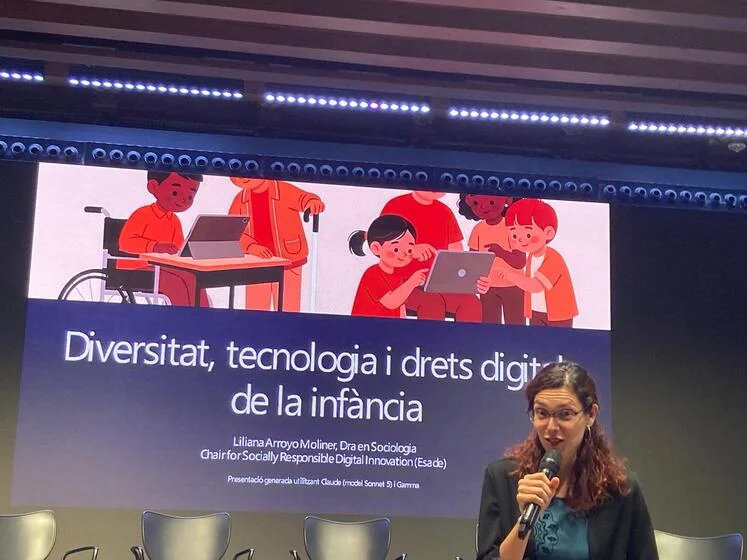
The director of the Chair for Socially Responsible Digital Innovation (SoReDI) at ESADE, Liliana Arroyo, participated in the session “Guaranteeing constructive digital environments. Diversity as a key”, within the framework of the cycle “Digital Rights of childhood and adolescence” of UNICEF Catalonia. The meeting, held on July 15, gave continuity to the presentation of the report Childhood, Adolescence and Digital Well-being, Results Catalonia and focused on the need to address the relationship between children, adolescents and technology from the diversity of realities, needs and contexts.
The session began with the welcome of Jaume Lanaspa Gatnau, president of UNICEF Catalonia and the Office of the Club of Rome in Barcelona, and had Liliana Arroyo as in charge of raising the starting point of the debate. His intervention placed diversity as a central element to think about the policies, environments and forms of digital accompaniment of childhood and adolescence. In this sense, the session started with a fundamental premise: there is no single prototype of a child or a standardized response to technology. Digital experiences are conditioned by different personal, social, family and educational factors, which configure in a different way the opportunities, risks and needs of each child and adolescent.
From this perspective, Arroyo contributed to raise the need to move towards more open, diverse and flexible digital environments, capable of taking into account this plurality of trajectories and circumstances. Guaranteeing the digital rights of children and adolescents does not only mean protecting them from risks, but also creating the conditions so that they can enjoy the opportunities offered by technology, develop their own criteria and participate in the digital world with autonomy and security.
The debate brought together complementary perspectives in the fields of mental health, audiovisual policies, digital inclusion, digital divides and the protection of children. Josep Lluís Matalí Costa, head of Psychology and coordinator of the Addictive Behaviour Unit of the Psychiatry and Child Psychology Service of Sant Joan de Déu de Barcelona and member of the SoReDI Advisory Council; Laura Pinyol Puig, vice-president of the Audiovisual Council of Catalonia; Mónica Acebo Pérez, head of the Digital Rights Secretariat of the Generalitat; Nuria Valls Carol, director of the Digital Breaches Observatory, Xavier Ibarz Quintana, corporal of the Central Area of Relations with the Community of the Proximity Division, Attention to Victims and Minors of the Mossos d'Esquadra, as well as two members representative of the Municipal Council of Children of Igualada, Iveth and Alexandra.
The conversation, moderated by Roger Garcia Rodoreda, responsible for Children's Policies of the UNICEF Committee Catalonia, allowed to address protection and digital well-being from different angles, highlighting the importance of combining prevention, inclusion and opportunities. The contributions agreed on the need to avoid simplifying approaches and move towards accompanying models that respond to the diverse reality of children and adolescents. The session also placed the digital divide as an issue that goes beyond access to devices and connectivity. Inequalities in skills, resources, support and the possibilities of taking advantage of technology also condition the way in which children and adolescents can exercise their rights in the digital environment. In this context, guaranteeing inclusion means ensuring that technology can become a source of opportunities and not a new factor of inequality.
The day concluded with the intervention of Quima Oliver i Ricart, coordinator of UNICEF Committee Catalonia, and highlighted the need to build digital environments that protect without limiting, offer opportunities without unnecessarily exposing risks and that start from the real diversity of children and adolescents.