Explaining the learning decline in PISA 2025 by socioeconomic quartiles through methodological changes
Lucía Cobreros Vicente, Marc Colomer, Eudald Correig-Fraga, Lucas Gortazar, Isaac Sayol
23 Sep, 2026
Working paper in collaboration with Innovamat Research Lab
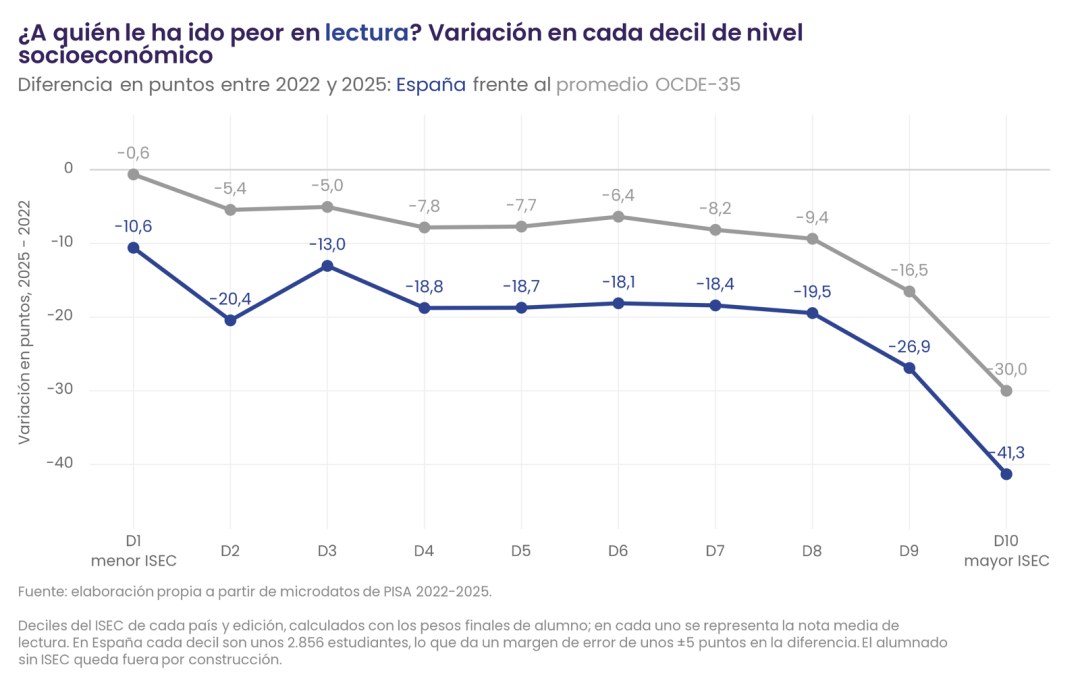
PISA 2025 Volume I (OECD 2026a) reports that the socioeconomic gap narrowed between 2022 and 2025 because advantaged students declined most — “a new phenomenon of affluent students who struggle academically”. However, this pattern is explained by the changes in how the index of economic, social and cultural status (ESCS) was computed in 2022 and 2025, not by changes in students’ performance: the home possessions index removed the book-type items most related to achievement in the 2025 edition and replaced them with living conditions items less correlated to learning achievement, thereby changing which students are classified in the top socioeconomic quartile. By computing an alternative harmonized ESCS index that ensures comparability across years, the top–bottom gap in mathematics increases by 1.6 points across 36 OECD systems, instead of the decline of 11 points reported in OECD (2026a). In practice, this reclassification implies that the number of countries with a statistically significant narrowing of the mathematics gap between the top and bottom ESCS quartiles falls from 19 to one. The published narrowing is also substantially attenuated in science and reading, and this attenuation is robust across specifications. When extended to the 2015–2025 period, we observe that the true ESCS learning gap remained broadly stable, if anything widening slightly over the last decade.

Economist focused on education, with interest in health, gender and competition. Degree in Economics from the University of Cantabria, Master in Industrial Economics and Markets (UC3M).
View profile