Eight proposals to keep the education system from falling behind in the data revolution
Lucas Gortazar, Álvaro Ferrer
10 May, 2023
The use of administrative education data is changing at great speed thanks to the greater availability of administrative data and also to methodological advances in economics and the social sciences. However, Spain is falling behind despite the efforts of some regional administrations and the Ministry of Education and Vocational Training over the last decade and a half. We see three reasons for this:
→ A culture of opacity (not justified by our regulations) in which data are a “monopoly” of the administrations.
→ A lack of ambition, reflected in the absence of available resources, to facilitate access to these data.
→ The fact that society’s demand for this type of research is low, especially from academic research, which has had a more theoretical orientation. This is surprising, given that the Spanish education system faces ever greater challenges that require a much more strategic use of the information available to us: these include the need to invest better, the lack of improvement in results, early school leaving and the falling birth rate.
These needs are growing more pressing, and it is time to relaunch the agenda for generating and using data in order to move from “islands” of innovation to the institutionalisation of education research, policies and practice based on the data held by the administrations. We therefore propose 8 measures:
- Reforming the State System of Education Indicators (SEIE) to incorporate new demands and greater disaggregation.
- Developing a strategic framework of objectives, indicators and targets for the education system between the Ministry of Education and the regions, inspired by the EU’s Open Method of Coordination.
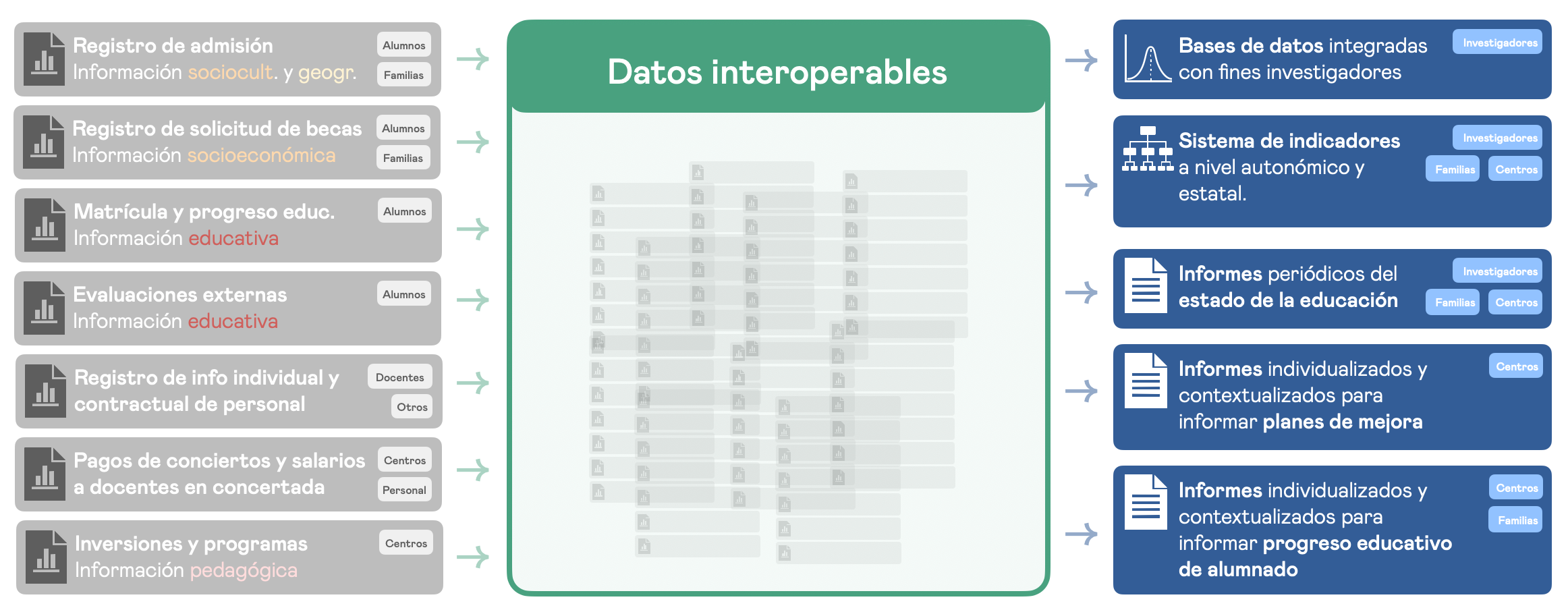
- Launching the Integrated Education Information System (SIIE), a national database available to researchers with individual and longitudinal information on students and teachers, funded by the new round of Next Generation EU funds.
- Developing precise mechanisms for the early detection of educational disadvantage and of students’ learning levels to inform schools’ decision-making, taking advantage of the potential of new real-time assessment tools.
- Strengthening and promoting the creation of regional education research and evaluation agencies and institutions and linking them to practice and innovation programmes, as they are best placed to support schools.
- Giving new impetus to the National Institute for Educational Evaluation in evaluating the education system (a Spanish PISA) and in the use of data from the new
diagnostic assessments. - Creating a Scientific Council for Education to advise and guide the Ministry of Education and Vocational Training.
- Developing a new national institution focused on promoting, funding and transferring education research into policy and practice, in line with the innovation and research Labs that many countries are developing.
Cite this content as:
Gortazar, L., & Ferrer, Á. (2023). Ocho propuestas para que el sistema educativo no se quede atrás en la revolución de los datos. https://doi.org/10.56269/20230510/LC