Evidence-Based Integration and effective use of ICT and Generative AI in K-12 schools in Spain
Jimena Contreras
16 June 2026
A new wave of AI-based tools is arriving on the heels of two decades of ICT in Spanish classrooms. Access, regulation, and investment are largely in place; whether this wave translates into improved learning depends on robust, evidence-based implementation.
Basic evidence on what would work
Lessons learned from the previous wave of ICT introduction. Personalization produces robust effects of 0.1–0.5 standard deviations, while programs that merely expand access tend to have near-zero effects. Access needs purpose, support, complementarity, and the right device.
Emerging evidence on AI converges on the same principle and opens up three promising directions: adaptive instruction with pedagogical safeguards that preserve students’ cognitive effort; teacher-oriented AI as a scaling technology for production, planning, assessment, and communication, with proportionally greater benefits for less experienced teachers; and large-scale educational analytics to identify critical windows for system-level intervention. Generative AI without safeguards and with minimal oversight would be counterproductive.
What is needed in Spain?
- Digital infrastructure and equity. The initial access phase is complete (100% of schools connected, 96.9% with Wi-Fi), but inequalities limit the viability of the most effective interventions: public schools lag 15 percentage points behind private schools in digital platforms, differences between autonomous communities exceed 30 percentage points in digital readiness, public spending per student varies by up to €3,700 per year between regions, and 23% of households in the lowest income quintile do not have a computer.
- Teachers with time, access, and capacity. Spanish teachers are 13–24 percentage points above the OECD average in administrative overload, curriculum adaptation, and deterioration of the classroom climate, spending 18 hours per week on non-teaching tasks (1.65 more than the EU average). These are the areas where AI offers the greatest value: reducing planning and administrative tasks (several hours a week for regular users), scaling feedback to students and to teaching practices themselves, and supporting a positive classroom climate. Adoption among secondary school teachers (35%) is in line with the European average; however, it is limited by a lack of training, cited by three out of four non-users as the main barrier. The MRCDD, approved before generative AI, does not include it as a specific competency.
- An enabling institutional framework without stifling. The basic elements are in place (LOMLOE, MRCDD, AI Act), but there are no operational guidelines for integrating generative AI or a binding teacher certification. What distinguishes successful programs is the quality of implementation, not regulatory ambition or spending: the $850 million South Korean program for AI-powered adaptive textbooks was reclassified as “supplementary material” after four months due to a lack of phased piloting and the exclusion of teachers. Singapore and Estonia developed their models over two to three decades, with teachers at the center.
- Integration into learning is differentiated by stages. Technology adds value when introduced gradually, with pedagogical safeguards, once basic skills are consolidated.
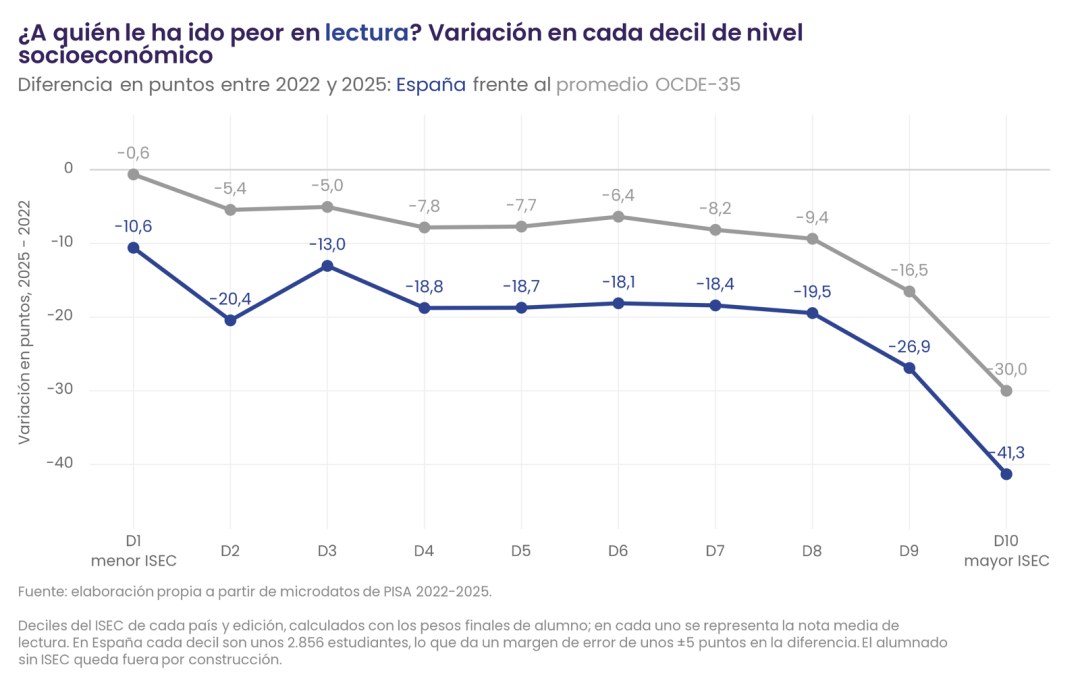
- In primary school —27 points below the OECD average in mathematics and 12 in reading—the priority is to consolidate fundamental skills, with technology introduced gradually and under teacher guidance: trajectory analytics to identify critical periods, and adaptive instruction in moderate doses to reinforce basic skills.
- In compulsory secondary education —where 22% of students have repeated at least one year by age 15—technology should support the most vulnerable students: early identification of at-risk students combined with personalized tutoring, and a focus, in any case, on guided use of PCs or laptops (differentiated from unsupervised devices).
- In post-compulsory education —with an early dropout rate of 12.8% and strong intergenerational transmission (75% versus 30%)—three areas of greatest value are: conversational assistants to reduce dropout rates during transitions, enhanced guidance to improve pathway choices, and skills mapping to align training with labor market demands.
Implementation must follow a pilot, evaluate, and scale-up cycle, because scaling interventions without evaluation yields insufficient results—a prerequisite for consolidating the levers in infrastructure, faculty, and institutional framework, and for this technological wave to unleash its full potential.

Economist focused on public policy, with a master’s degree from the Barcelona School of Economics and a bachelor’s degree in economics from Rafael Landívar University.
View profile