Perspectives on Aporophobia
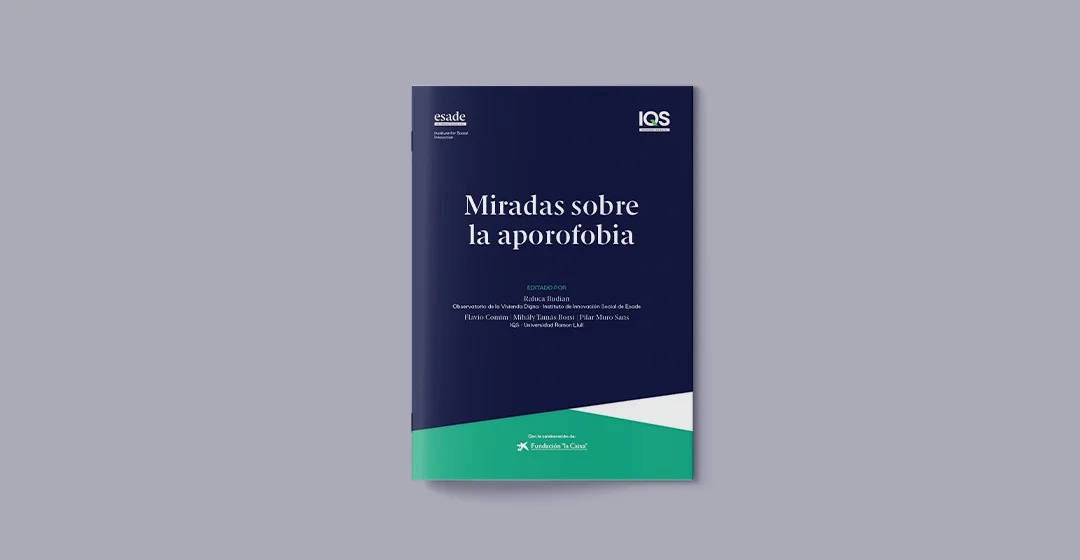
Perspectives on Aporophobia, edited by Raluca Budian of the Esade Institute for Social Innovation, together with Flavio Comim, Mihály Tamás Borsi and Pilar Muro Sans of IQS, Ramon Llull University, brings together a selection of presentations and essays originating from the first three International Congresses on Aporophobia, held in Barcelona between 2023 and 2025. The volume is the result of collaboration between Ramon Llull University and social organisations such as Cáritas, Arrels, Assís, Cristianisme i Justícia and Jesuïtes Social.
The volume takes the concept of aporophobia, coined by Adela Cortina, as its starting point to analyse the rejection of people living in poverty from philosophical, legal, sociological, economic and technological perspectives. The five main contributions trace a path from the ethical foundations of the phenomenon, addressed by Cortina and Pereira, to its structural dimension within political economy and elites, examined by Reeves; its legal treatment in Spain, discussed by Raimundo Rodríguez, and its cultural production through stigma, analysed by Tyler.
The remaining contributions broaden this perspective in several directions: institutional aporophobia within the Spanish criminal justice system, analysed by García Domínguez; its relationship with xenophobia in the EU-15, examined by Valerio Mendoza, Comim and Borsi; generational differences and meritocratic morality, addressed by Montañola et al.; the role of religion as a possible moderating factor, analysed by Casanovas et al.; its intersection with racism and Muslim identity, examined by Mora and de Lorenzo; the moral duty of companies in relation to poverty, discussed by Quintero Meza; the use of artificial intelligence to detect aporophobic discourse, analysed by Curto; the impact of housing insecurity on children and schools, examined by Navarro Rupérez; local perceptions of the phenomenon, addressed by Picado Valverde et al.; and a European project aimed at building trust between the police and the community, presented by Jameson et al.
The conclusions emphasise that aporophobia is not a marginal individual attitude, but a structural form of contempt sustained by narratives, institutions and policies that can be transformed, with homelessness representing one of its most serious manifestations. Combating aporophobia requires an interdisciplinary approach that combines academic rigour with social commitment.
Publication produced by the Observatory for Decent Housing and the Esade Institute for Social Innovation, together with IQS, Ramon Llull University, with the support of the “la Caixa” Foundation.