Which policies will work best to increase efficiency and moderate energy demand?
Pedro Linares Llamas, Jorge Galindo, Natalia Collado Van-Baumberghen, Diego Caminero Lorenzo
26 May, 2022
The need to align the goals of decarbonisation and energy independence from Russia increases the need for policies to rationalise our energy consumption. The most promising policies for doing so are those that affect the price of energy through taxes and similar instruments, especially for households, individuals and commercial establishments, for two reasons:
- They maintain the energy-saving signal for longer
- They avoid the risk of a ‘rebound effect’ associated with other policies by keeping energy prices higher in the long term, discouraging consumption
However,
→ In the short term they will be less effective than in the long term, given the low immediate flexibility of demand (which increases as it finds substitutes).
→ In their most basic form, they will be regressive policies, unless they are designed not to be or are complemented with transfers/subsidies
→ They are much more unpopular and therefore politically costly
It will therefore be essential to combine these price signals with other instruments that are more effective in the short term, more politically viable, and that correct regressivity.
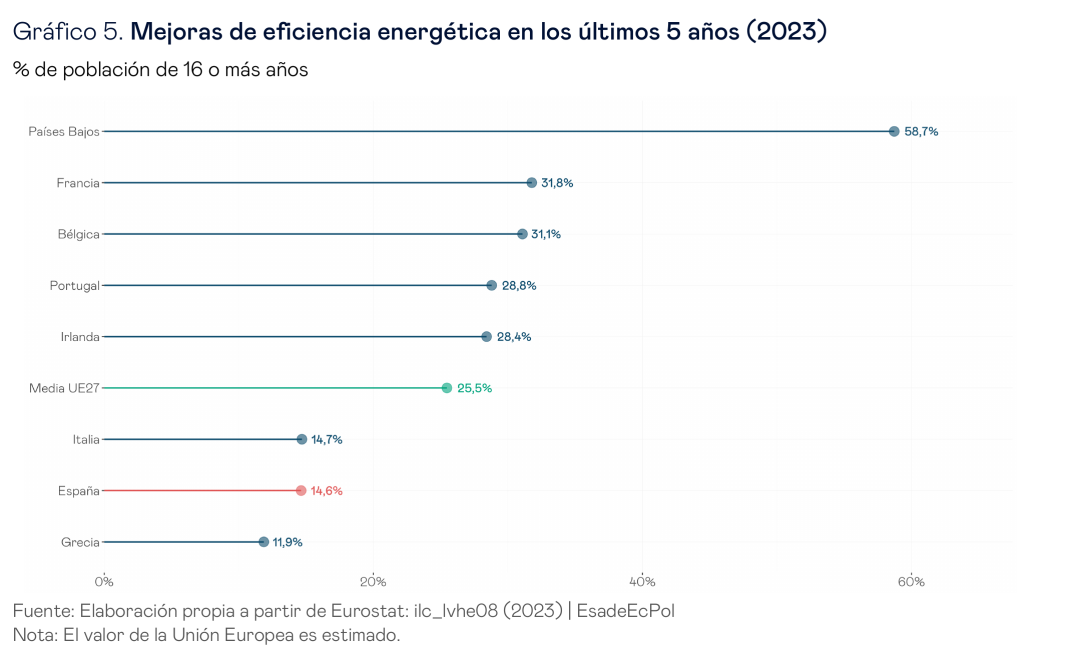
Setting standards and regulations is a useful instrument that has proven effective according to the available evidence, especially when applied to housing, an area in which Spain still has a considerable way to go. It is also more politically viable than acting on prices. However, on its own it may have a smaller saving effect than the above, and it can also produce regressive results.
To minimise the risks of regressivity, it is essential to combine mandatory minimums with public or private financial support. Transfers and subsidies have the dual advantage of being (1) progressive if properly designed and (2) very popular; but they carry the risk of a “rebound effect” in energy consumption: by subsidising a certain type of consumption, even if it is more efficient hour by hour than the alternative, the aggregate could be greater. In addition, if the design is not based on income levels, it could finance energy efficiency changes for households that were planning to make them anyway (“free riding”). Concentrating aid on the lowest-income population, in addition to reducing regressivity, also reduces these risks.
Improving the information available so that consumers make better decisions is also a promising area for action, with more modest but certainly significant effects and potential for growth, especially if measures are well designed and sustained over time. Specifically,
→ Information on consumption is backed by enough research to recommend it first. Within this area, peer comparison to encourage savings based on social norms is also supported by solid evidence.
→ Energy efficiency labelling and certificates are also supported by positive evidence, albeit less abundant and more mixed, and they require the information to be clear, accessible and complete. Otherwise, the risk of null or even regressive effects (whereby only higher-income households can access the information and make the best decisions) is high.
→ By contrast, the available evidence on setting explicit savings targets is promising but insufficiently detailed.
→ Finally, the evidence on energy audits is too inconclusive to recommend them clearly.
Beyond price, information and regulatory measures, other indirect measures could bring Spain considerable savings in demand, for example:
→ Reducing road speed limits to 110 km/h has an approximate potential saving of 5% a year in fuel demand
→ Cutting public transport fares could increase the replacement of fuel-intensive journeys in the long term
→ Specific energy-saving and adaptation plans for Public Administration infrastructure


Profesor en la Universidad Pontificia Comillas


Research Economist en EsadeEcPol. Máster en Economía Industrial y Mercados regulados por la Universidad Carlos III de Madrid
View profile
Related content