The VAT cut on basic foodstuffs: evaluation and recommendations
Miguel Almunia, Javier Martínez Santos, Ángel Martínez Jorge
30 Mar, 2023
Inflation is causing a severe loss of purchasing power for many families in Spain, especially those on lower incomes. In response to this problem, on 1 January 2023 the Spanish government decided to cut VAT on essential foodstuffs from 4% to 0%, while other basic foods (such as uncooked pasta or oil) went from 10% to 5%.
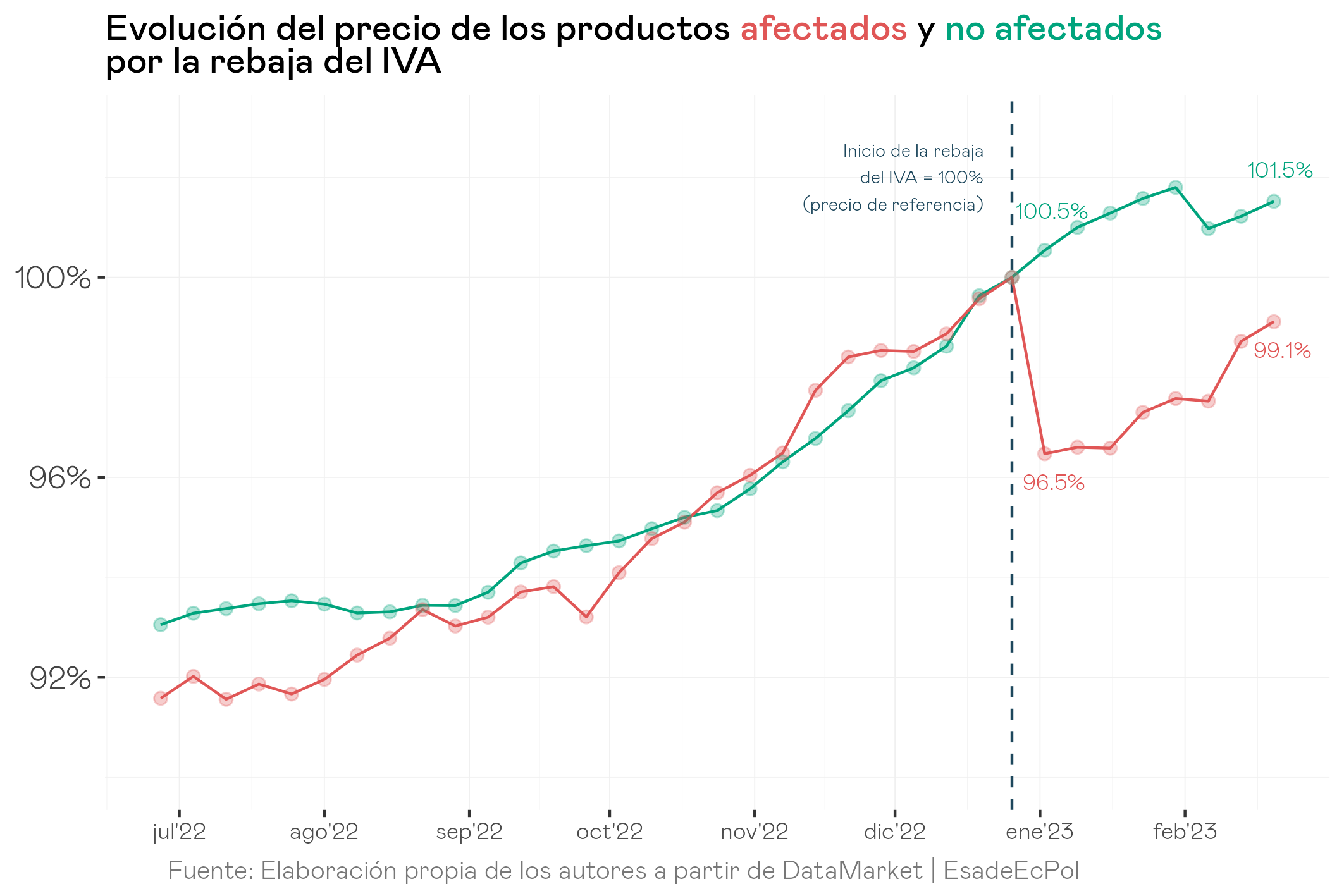
We present here the first causal evaluation of this policy. We analyse data compiled by the Datamarket platform, which include daily prices of all food products on the websites of large retailers accounting for 40% of the total market share. We compare the evolution of the average weekly price of a group of foods directly affected by the cut with a very similar group that was not affected.
We observe that:
→ During January and February, the VAT cut was passed on overwhelmingly (more than 90%) to final prices at large retailers.
→ The redistributive impact is progressive because it means greater savings for low-income households in proportion to their total spending.
→ However, as household economic capacity increases, spending on foods such as fruit, vegetables, bread and cheese also increases. As a result, the measure devotes more aggregate public spending (in euros of forgone VAT revenue) to higher-income families. Five out of every ten euros not collected as a result of the VAT cut went to the 40% of households with the greatest economic capacity.
→ Furthermore, the overall impact of this measure is modest compared with the size of the inflationary shock. Food prices rose by 16% in 2022 and this measure only means a 3.5% reduction in the prices of a specific subgroup of foods.
A targeted policy of income transfers to low-income households would therefore have been more effective from a distributional point of view, and cheaper from a budgetary point of view.
Cite this content as:
Almunia, M., Martinez, J., & Martinez, A. (2023). La reducción del IVA en los alimentos básicos: evaluación y recomendaciones. https://doi.org/10.56269/20230328/MA


Economista enfocado en el análisis y la visualización de datos. Grado en Administración de Empresas y Economía Laboral por la Universidad de A Coruña y Master en Economía por la Universidad de Santiago.
View profile