Innovation and supply-side levers as an opportunity for the growth of Spanish exports during the energy transition
Cristina Peñasco
18 Sep, 2025
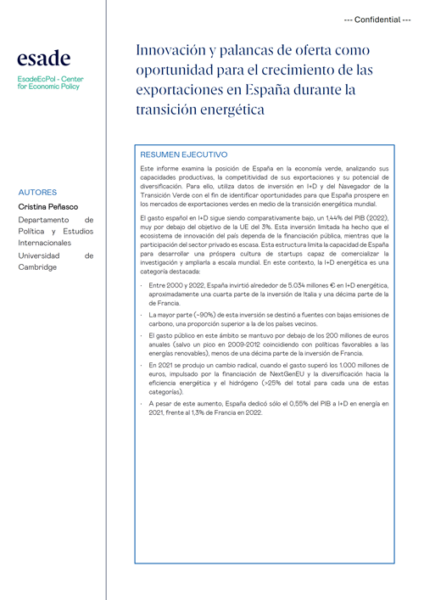
This report examines Spain’s position in the green economy, analysing its productive capabilities, the competitiveness of its exports and its diversification potential. To do so, it draws on R&D investment data and on the Green Transition Navigator to identify opportunities for Spain to thrive in green export markets amid the global energy transition.
Spanish R&D spending remains comparatively low, at 1.44% of GDP (2022), well below the EU target of 3%. This limited investment has left the country’s innovation ecosystem dependent on public funding, while private-sector participation is scarce. This structure constrains Spain’s ability to develop a thriving startup culture capable of commercialising research and scaling it globally. Within this context, energy R&D stands out as a notable category:
- Between 2000 and 2022, Spain invested around €5.034 billion in energy R&D, roughly one-quarter of Italy’s investment and one-tenth of France’s.
- Most (~90%) of this investment went to low-carbon sources, a higher share than that of neighbouring countries.
- Public spending in this area stayed below €200 million per year (except for a 2009–2012 peak coinciding with renewables-friendly policies), less than one-tenth of France’s investment.
- 2021 marked a dramatic shift: spending exceeded €1 billion, driven by NextGenEU funding and diversification towards energy efficiency and hydrogen (>25% of the total for each of these categories).
- Despite this surge, Spain devoted only 0.55% of GDP to energy R&D in 2021, compared with 1.3% for France in 2022.
These R&D investment patterns directly shape Spain’s positioning in global green export markets. Despite the constraints, the country shows promising signs of improvement on several key indicators:
- In global green-complexity rankings, Spain has held positions between 13th and 17th between 2000 and 2022, behind Germany (1st), Italy (3rd), the United Kingdom (9th) and France (10th).
- Spain shows a low but stable share of global green-product exports, with a slight increase in renewable-energy exports from 4% to 6%.
- The country improved on the Brown Lock-in Index, moving from 73rd (2000) to 91st (2022), indicating reduced reliance on environmentally harmful exports, though it still lags other major EU economies.
- In recent years, Spain has moved from sixth (1999) to third place, reflecting greater potential to develop complex green industries.
Analysis of Spain’s export competitiveness reveals both current strengths and future development opportunities in specific green product categories:
- Spain shows exceptional competitiveness in noise and vibration reduction products and in cleaner or more resource-efficient technologies.
- The country is already competitive in renewable energy, but high industrial energy costs and infrastructure bottlenecks constrain its international competitiveness. Moreover, Spain has focused largely on renewables at home, limiting its export potential compared with Germany and China in solar panels and wind turbines.
Two key policy recommendations emerge to strengthen Spain’s position in the green transition:
- Establish a coordinated policy framework to accelerate the diffusion of innovative technologies across industries, aligning decarbonisation investment with export opportunities: develop an adaptable and predictable regulatory environment; foster private investment in renewables through tax incentives and better financial conditions; modernise grid infrastructure to better integrate renewables and ensure energy security.
- Drive innovation investment to close the technology gap with leading nations: increase R&D funding in energy technologies; prioritise research on storage and grid-management technologies.

Cristina Peñasco es Associate Professor de Política Pública en POLIS (Universidad de Cambridge), Bye-Fellow en Queens’ College y Senior Research Economist en el Centro para el Clima y la Naturaleza del Banque de France. Su investigación se centra en economía medioambiental, política de innovación y economía energética, con énfasis en la evaluación de instrumentos de […]
View profileRelated content