brief Macro & fiscal policy
Evolution of Next-Gen EU Funds in Spain
Manuel Hidalgo Pérez, Jorge Galindo, Javier Martínez Santos
16 April 2026
With the execution deadline of August 2026 already in sight, EsadeEcPol presents the update of its NextGenEU Tracker with data as of 12 March 2026. The report examines a programme entering its final sprint: progress is substantial, but the gap between called and awarded funds, fund concentration, and administrative bottlenecks pose critical challenges in the home stretch.
Execution status
- A total of €90,718 M has been called in transfers (excluding loans) and €63,403 M awarded. The €27 billion gap between the two figures must be closed before August 2026. Moreover, “awarded” does not equal “budget-executed,” making the operational urgency even greater.
- In December 2025, the Government waived approximately €60 billion in European loans (73% of the credit tranche), reducing the programme to around €103 billion. The decision focuses all attention on the efficient execution of non-repayable transfers.
Territorial distribution
- In absolute terms, Catalonia (€3,722 M), Andalusia (€3,090 M) and the Community of Madrid (€2,475 M) lead. However, on a per-capita basis, the Basque Country (€732) and Aragon (€729) top the ranking, revealing that the scale effect of large regions masks a more nuanced distribution.
- Catalonia shows cross-sector dominance, leading in trade (€337 M), manufacturing (€185 M) and, most notably, in water and waste infrastructure (€626 M), where it quadruples the next region. Andalusia, however, is already contesting the lead in construction (€970 M vs. €961 M) and has overtaken in information and communications (€311 M vs. €231 M). Galicia continues to surprise by surpassing Madrid in professional and scientific activities (€142 M vs. €129 M) despite its smaller size, suggesting that digital funds are reaching further than expected.
Sectoral and beneficiary concentration
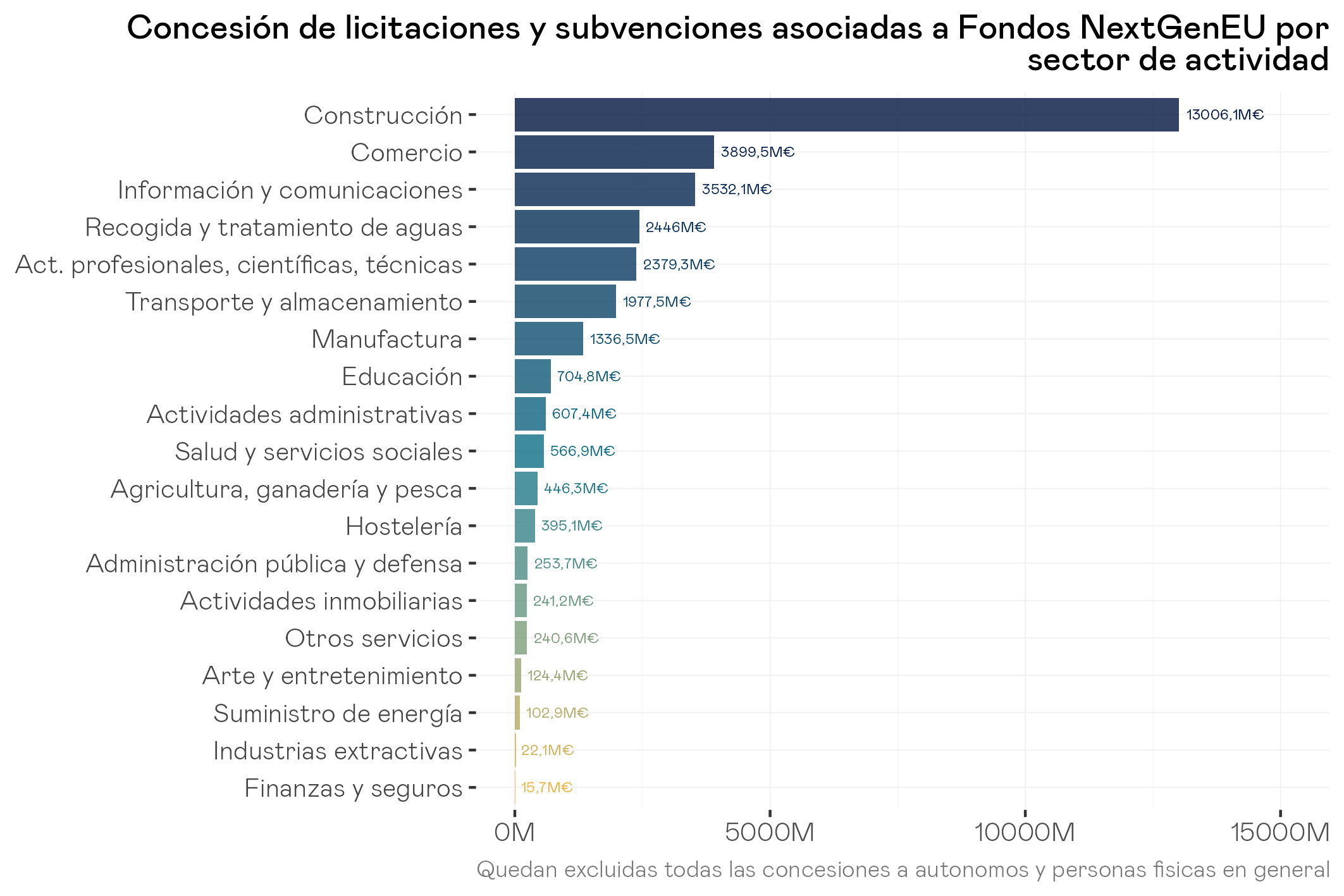
- Construction dominates with over €13,000 M, tripling trade (~€3,897 M). It is followed by water collection and treatment (~€2,446 M), information and communications (~€3,532 M), professional activities (over €2,300 M) and transport (~€1,977 M). In contrast, education (~€705 M) and health (~€567 M) together receive less than €1,300 M, raising doubts about whether the programme is prioritising physical capital stock over human capital.
- Execution proceeds at two speeds. The top 1% of beneficiaries by funding received captures 71.4% of the total awarded value —large infrastructure, PERTEs, strategic consortia— while the median firm receives an infinitesimal share. Private entities predominate as final recipients, but the limited participation of local entities raises questions about the long-term sustainability of the intended transformations.
Recommendations
- Emergency execution: prioritise the immediate resolution of open processes through drastic simplification of procedures and advance processing.
- Rapid-response technical support: deploy intervention teams in municipalities and entities with lower management capacity to overcome the “percentile gap.”
- Autonomous-community channel and territorial cohesion: eliminate duplication in multi-level oversight and apply corrective measures to prevent the programme from widening regional gaps.
- Impact auditing: shift from measuring “how much has been called” to evaluating “what has been transformed,” determining whether investment is generating new productive capacities before the August 2026 deadline expires.
Read the full article:



Javier Martínez Santos
Economista enfocado en el análisis y la visualización de datos. Grado en Administración de Empresas y Economía Laboral por la Universidad de A Coruña y Master en Economía por la Universidad de Santiago.
View profile