Cheatsheet | EU Measures to Increase Energy Independence and Affordability in 2026
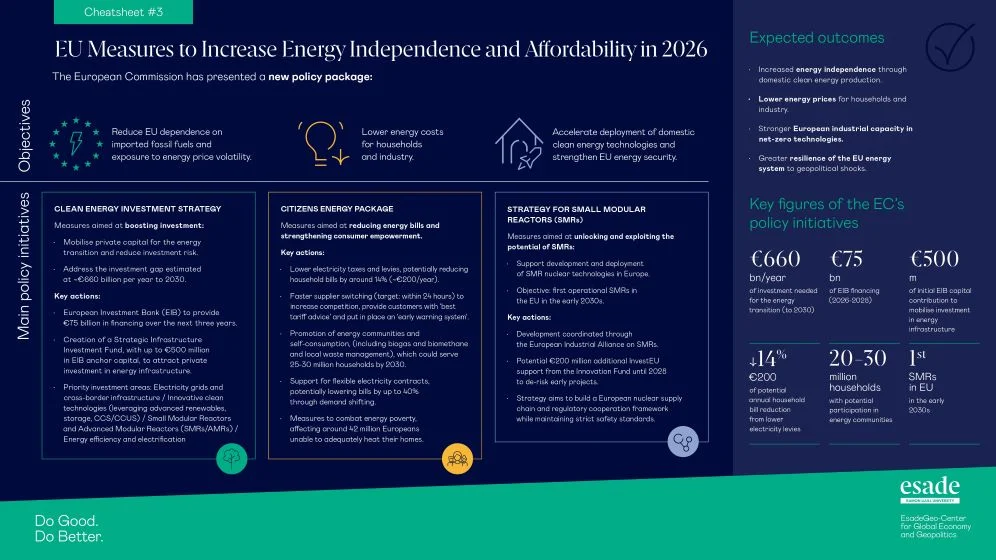
On 10 March 2026 the European Commission unveiled three policy initiatives setting out how Europe will reduce its dependence on imported fossil fuels, mobilise the investment needed to close the clean energy gap, and bring down energy costs for households and industry through a combination of financing tools, consumer protections, and a strategy for next-generation nuclear technology.
The initiatives constitute the Commission's first concrete policy response to the investment shortfall and affordability pressures that continue to weigh on European citizens and businesses in an increasingly volatile geopolitical environment. The three Communications and strategies unveiled on 10 March were the Clean Energy Investment Strategy (COM/2026/116) designed to leverage over €75 billion in EIB financing and crowd in private capital at scale; the Citizens Energy Package (COM/2026/115) that targets a 14% reduction in household electricity bills, faster supplier switching, and the empowerment of up to 25-30 million households through energy communities; and the Strategy for Small Modular Reactors that aims to see the first operational SMRs on European soil by the early 2030s, backed by a potential €200 million InvestEU de-risking top-up.
Taken together, the measures reflect a dual ambition that has come to define the Commission's second-term energy agenda: reinforcing strategic autonomy by reducing import dependency, while ensuring that the costs and benefits of the clean energy transition are distributed fairly. The initiatives build on the Affordable Energy Action Plan (COM/2025/79), adopted on 26 February 2025, and are explicitly framed as a first instalment of policy action, with further measures to follow.
To help policymakers, investors and analysts navigate the three initiatives, their flagship measures, and key figures, we have produced a concise cheatsheet that distils the main actions, their financial scale, and the actors responsible for delivery. The cheatsheet clarifies what the Commission and the EIB are committing to directly, what depends on Member State action, and what the initiatives mean in practice for households, industry, and the EU's broader clean energy industrial strategy.