The cost of child poverty in Spain
Ángel Martínez Jorge, Carlos Victoria
6 Mar, 2023
EsadeEcPol took part in the preparation of the study “The cost of child poverty in Spain”, presented today by the High Commissioner against Child Poverty, together with Romén Adán (KSNET), María Sánchez (KSNET/LSE), Luis Ayala (UNED), María Romaguera (UNED), Mariña Fernández (UAH), Judit Vall (UB) and Carlos Victoria (EsadeEcPol/UCM), under the direction of Libertad González (UPF) and Olga Cantó (UAH).
Within this study, EsadeEcPol focused on analysing labour market trajectories. To do so, we used microdata from the living conditions surveys since 1994 to estimate the effect that having lived in a poor household, defined as a household earning less than 60% of median income, has on future labour income.
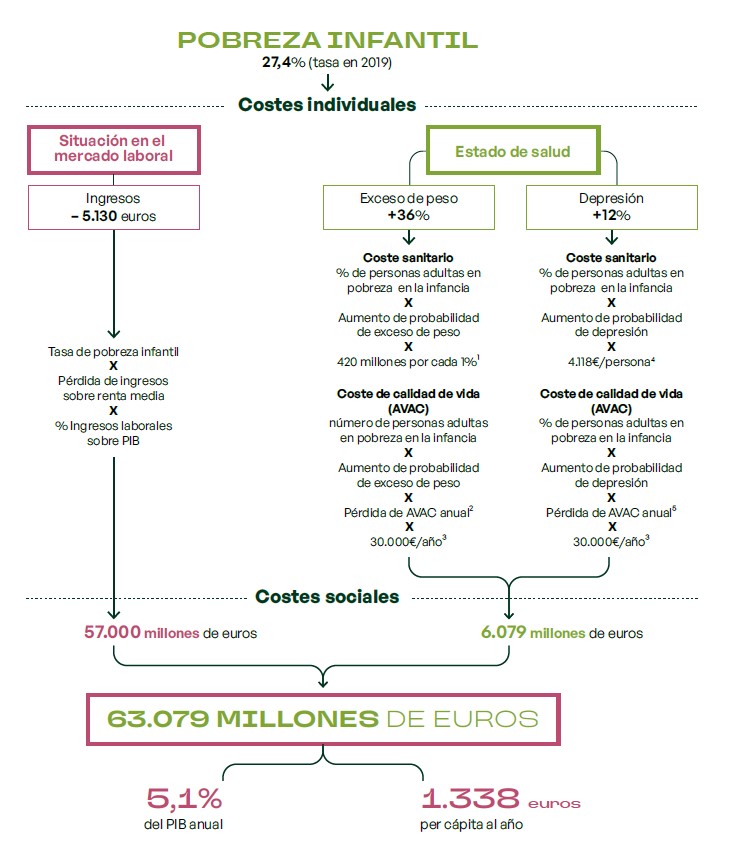
We find that poverty in adolescence is associated with a €5,130 drop in gross labour income in adulthood. Multiplying the average income loss by the child poverty rate in Spain (27.4% of households) and limiting it to the share of labour income in Gross Domestic Product, we calculate an economic cost of approximately 57 billion euros for Spanish society.
In addition, when considering the health dimension, which another part of the research team led by KSNET and Judit Vall worked on and estimated, a further 6 billion euros are added to the calculation, resulting in a total cost of 63 billion euros, that is, 5.1% of Spanish GDP.
We find that poverty in adolescence is associated with a €5,130 drop in gross labour income in adulthood. For men, this fall in income occurs mainly through lower wages, while for women the lower employment rate is more relevant.
This negative effect of poverty in adolescence can be explained, at least in part, by lower human capital accumulation. Specifically, poverty in adolescence is associated with a 28 percentage point lower probability of having higher education.
In short, the study shows that poverty in adolescence has a significant negative impact on future labour income, with different mechanisms for men and women, and with a common origin in the fact that it hinders access to higher education. This suggests that initial inequality has a more than considerable effect on equality of opportunity.


Related content