Retaining, recovering and attracting research talent to Spanish universities
Andreu Mas-Colell, Milagros Candela
30 Nov, 2023
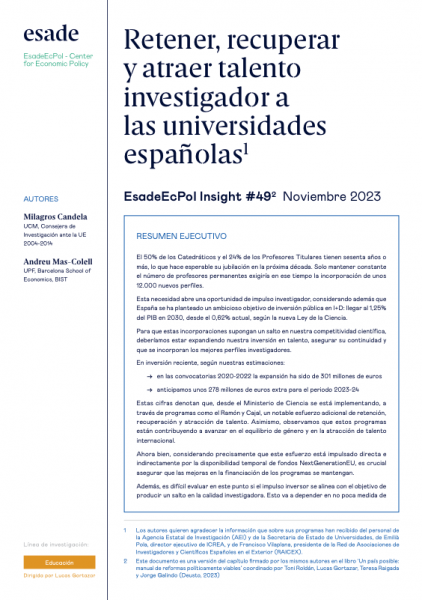
50% of Full Professors (Catedráticos) and 24% of Associate Professors (Profesores Titulares) are sixty or older, which means they can be expected to retire over the next decade. Merely keeping the number of permanent faculty constant would require hiring some 12,000 new profiles over that time.
This need opens up an opportunity to boost research, especially considering that Spain has set itself an ambitious public R&D investment target: reaching 1.25% of GDP by 2030, from the current 0.62%, according to the new Science Law.
For these new hires to represent a leap in our scientific competitiveness, we should be expanding our investment in talent, ensuring its continuity and making sure that the best research profiles are recruited.
In terms of recent investment, according to our estimates:
→ in the 2020-2022 calls the expansion has amounted to 301 million euros
→ we anticipate some 278 million euros extra for the 2023-24 period
These figures show that the Ministry of Science is making, through programmes such as Ramón y Cajal, a notable additional effort to retain, recover and attract talent. We also observe that these programmes are helping to advance gender balance and attract international talent.
However, precisely because this effort is driven directly and indirectly by the temporary availability of NextGenerationEU funds, it is crucial to ensure that the improvements in programme funding are maintained.
Moreover, it is difficult to assess at this point whether the investment drive is aligned with the goal of producing a leap in research quality. This will depend to no small extent on the new rules governing how universities operate, set by the recently approved Organic Law of the University System (LOSU):
- The LOSU leaves room for flexibility in universities’ structure and operating model regarding faculty policy, which allows them to align career incentives with research quality goals.
- The stabilisation of some 25,000 temporary contracts that will become permanent (reducing the temporary employment rate from 40% to around 8%) is also welcome.
- However, the LOSU has been less concerned with strengthening the research dimension than with stabilising current faculty. For faculty accreditation, the new law gives teaching the same weight as research, with a risk of discouraging research talent that will depend on how each university implements it.
- Reserving a minimum of 15% of new positions and permanent employment contracts for profiles of proven research merit is insufficient: it amounts to saying that for the remaining 85% research is not so important.
In light of all this, we propose:
→ Securing current investment in research talent regardless of one-off inflows of money, and increasing it in line with the objectives of the Science Law.
→ Maintaining and expanding talent attraction programmes, such as Ramón y Cajal among others, evaluated by the State Research Agency.
→ While maintaining thematic breadth, prioritising certain areas to further strengthen what we are good at and to cover vital fields where we lack sufficient strength (for example, data science or artificial intelligence).
→ Minimising barriers to entry, especially on the administrative front: avoiding the reintroduction through the back door of the requirement of accreditation by the National Agency for Quality Assessment and Accreditation (ANECA), or the introduction of spurious requirements related to teaching or management.
→ Recommending that universities raise the minimum reservation of positions for profiles of proven research merit from 15% to 30%. Likewise, recommending that public institutions implement incentive programmes with this goal.
UPF, Barcelona GSE, BIST

Investigadora en la Universidad Complutense de Madrid
Related content