
The effect of climate change and the energy transition on the financial sector and its response to the challenge
Ramón Amargant Arnau, Fernando Gutiérrez del Arroyo González
18 Jan, 2022
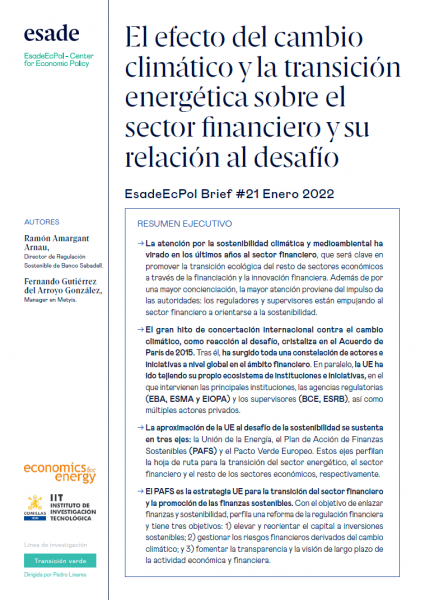
→ Attention to climate and environmental sustainability has shifted in recent years to the financial sector, which will be key in promoting the ecological transition of the rest of the economic sectors through financing and financial innovation. As well as greater awareness, this increased attention stems from the push by the authorities: regulators and supervisors are pushing the financial sector towards sustainability.
→ The great milestone of international cooperation against climate change, in response to the challenge, crystallised in the 2015 Paris Agreement. Since then, a whole constellation of global actors and initiatives has emerged in the financial sphere. In parallel, the EU has been building its own ecosystem of institutions and initiatives, involving the main institutions, the regulatory agencies (EBA, ESMA and EIOPA) and the supervisors (ECB, ESRB), as well as multiple private actors.
→ The EU’s approach to the sustainability challenge rests on three pillars: the Energy Union, the Sustainable Finance Action Plan (SFAP) and the European Green Deal. These pillars set out the roadmap for the transition of the energy sector, the financial sector and the rest of the economic sectors, respectively.
→ The SFAP is the EU strategy for the transition of the financial sector and the promotion of sustainable finance. With the aim of linking finance and sustainability, it outlines a reform of financial regulation and has three objectives: 1) raising and redirecting capital towards sustainable investments; 2) managing financial risks arising from climate change; and 3) fostering transparency and a long-term view in economic and financial activity.
→ The SFAP is ambitious and cross-cutting because it affects multiple agents and a variety of instruments. It seeks to create a single language or taxonomy defining which activities are sustainable or not (action 1), create green bonds and ecolabels (action 2), promote sustainable investment (action 3), incorporate sustainability criteria when providing financial advice (action 4), develop sustainable benchmarks (action 5), better integrate sustainability into credit ratings and market research (action 6), clarify the disclosure duties of asset managers, distributors and financial products (action 7), incorporate sustainability into prudential requirements (action 8), strengthen sustainability disclosure (action 9) and foster sustainable corporate governance and reduce short-termism in markets (action 10).
→ The Renewed Sustainable Finance Strategy (RSFS), published by the EC in July 2021, reviews and updates the SFAP. It simply regroups its 10 actions, whose development will be strengthened with a more defined timetable for adoption.
→ Among the main policy implications is the need for companies to design and implement ambitious mitigation and adaptation strategies. The steps each agent takes will be crucial for its future survival and profitability: mitigating and adapting to climate change will make it possible to prevent and mitigate risks, and can create numerous opportunities. To achieve this, they have a wide arsenal of tools at their disposal.
→ Sustainability strategies should not be adopted for reputational reasons, but for reasons of financial risk and strategic positioning. This is what regulators and supervisors have been seeking for some time now. The change is starting to become visible: financial institutions are not only beginning to respond to external pressure from regulators and supervisors to embrace sustainable behaviour, but are also recognising for themselves the market and strategic value of assessing and integrating sustainability or ESG (Environmental, Social and Governance) risks, which is allowing them to be better positioned to mitigate risks and seize the opportunities of climate change and the ecological transition.
→ Looking ahead, the challenges are significant: the development of the regulatory roadmap could transform the functioning, behaviour and shape of financial actors and markets, without whose orientation towards sustainability it will be impossible to meet climate and environmental goals. But it will require a great deal of attention and effort on their part, since the regulatory tsunami is hard to digest and complex and costly to apply.


Economista especializado en finanzas sostenibles, regulación ESG y análisis regulatorio. Actualmente, director de control interno ESG en Banco Sabadell. Ha trabajado en el Banco de España, en Solchaga Recio & Asociados y Metyis.
View profileRelated content

24 Mar, 2026