A snapshot of household spending on school supplies and the grants that help offset it
Lucía Cobreros Vicente, Ángel Martínez Jorge
25 Sep, 2023
Key ideas
→ At EsadeEcPol we have carried out a new analysis of household school spending that is more comprehensive and rigorous than existing ones.
→ Average spending per pupil on school supplies is €328 in Primary, €398 in Compulsory Secondary Education (ESO) and €474 in Bachillerato (upper secondary).
→ Textbooks and IT equipment are the main drivers of spending and of its increase by stage: from 50% of the total in Primary to 70% in Bachillerato.
→ Among the 20% of households with the lowest economic capacity, 1 in every €25 goes on school supplies.
→ Average spending on books falls by €24.4 when the pupil receives a grant, but this reduction is larger for middle-income (almost €40) and lower-middle-income families (€25), and close to €0 for those with the fewest resources.
→ Only 4 in 10 households among the 20% with the fewest resources receive any grant.
→ The differences in grant coverage by region and educational stage are very considerable, resulting in a system that is not progressive enough.
→ Average spending per pupil in the public network is €282, compared with €434 in the state-subsidised/private network.
→ To improve the system and make it more accessible and effective in helping the families that need the most support, we propose universal school supply lending schemes, and an effective nationwide minimum threshold for grant coverage and amounts through a benefit for low-income households.
Household spending on school supplies is a recurring topic every September. However, most existing studies use either biased samples or highly unrealistic assumptions. At EsadeEcPol we have estimated household spending on these goods (textbooks, IT equipment, uniforms, stationery and others) rigorously and in much greater depth, by merging the Household Education Spending Survey (EGEH) and the Household Budget Survey (EPF), both from the National Statistics Institute (INE).
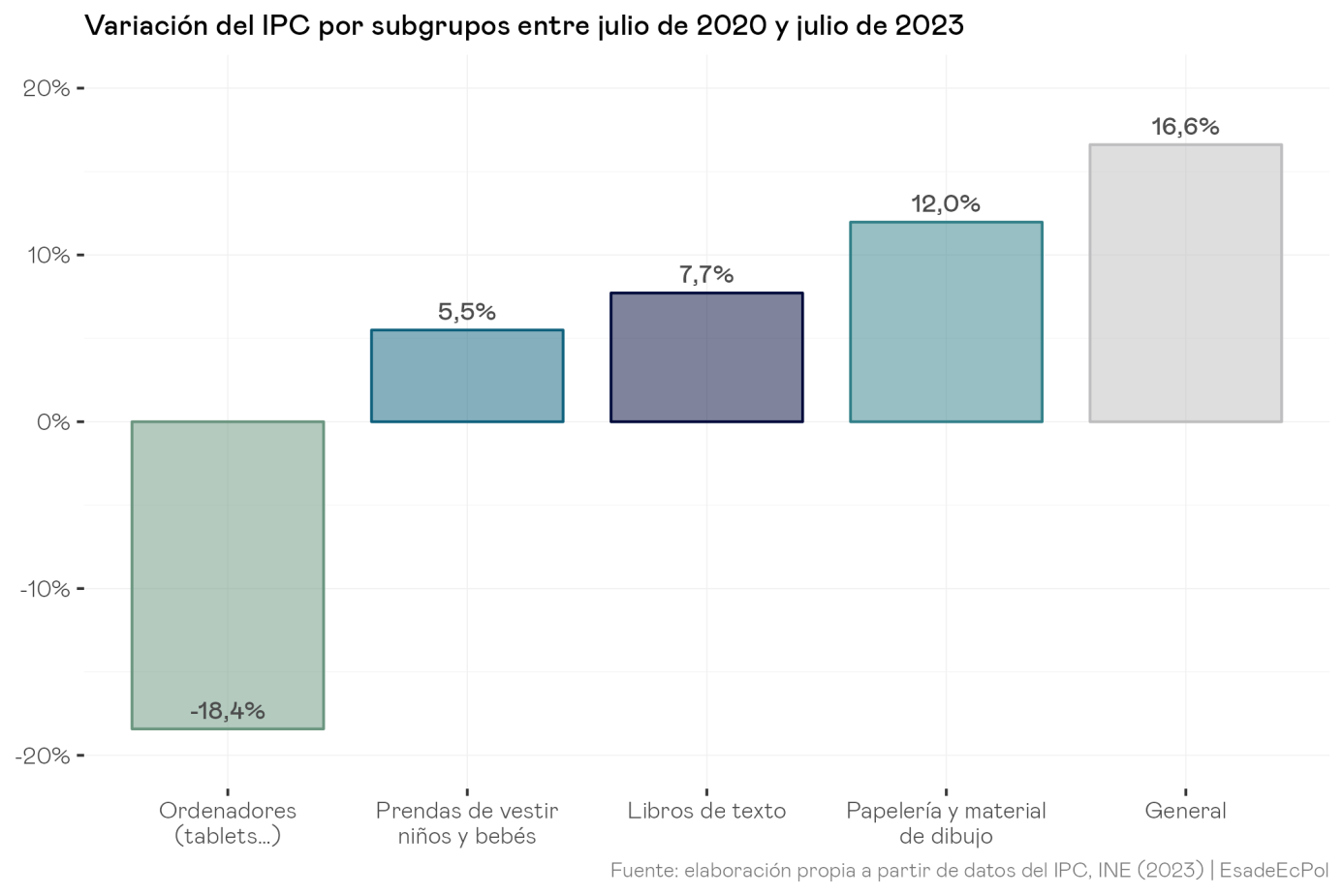
As is normal in an economy with inflation, every new back-to-school season is the “most expensive in history”. But that does not mean that the weight of spending on supplies in total household spending is at record highs. In fact, we find that, since the summer of 2020, the general CPI has grown well above most of the products that make up school supplies, so the weight of these materials in the total household budget has decreased.
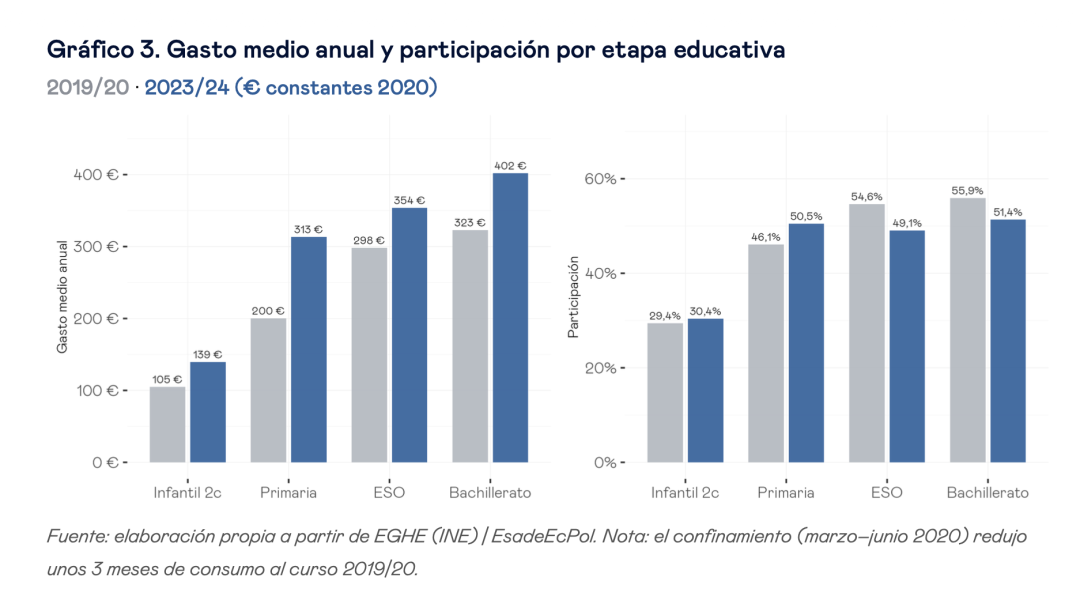
Average spending per pupil on school supplies varies enormously by educational stage, from €100 per pupil in the first cycle of Early Childhood Education to €328 in Primary, €398 in ESO, and peaking at €474 in Bachillerato.
The factor that contributes most to the increase in spending per pupil across educational stages is textbooks and IT products, which account for more than half of spending from Primary onwards and up to 70% in Bachillerato.
The differences between regions and school networks are smaller than the differences by educational level:
- Household spending per pupil peaks in the Community of Madrid, with an average of €396 per pupil, compared with €255 in Andalusia.
- Average spending per pupil in the public network is €282, compared with €434 in the state-subsidised/private network, a difference explained by higher spending on textbooks and school uniforms.
- Household economic capacity also has an influence, both on absolute spending and on its weight in total household spending. Among the 20% of households with the lowest economic capacity, 1 in every €25 goes on school supplies.
Grants and financial aid appear to be a good ally in covering these costs: we estimate that a pupil is 27% more likely to spend nothing on books if they receive a grant, and that average spending on books falls by €24.4 per pupil if the pupil receives a grant. Despite this, we find a system that does not cover the basic costs of the most vulnerable households in compulsory education and Bachillerato, since we estimate that only four in ten households with the lowest purchasing power (quintile 1) receive any grant. Moreover, we see that the effects are far from being as progressive as would be desirable: the spending reduction effect is highest among middle-income (around €40) and lower-middle-income families (€25), but is practically €0 among those with the lowest purchasing power.
According to our analysis of Ministry data, the system is also highly fragmented territorially, with coverage rates and systems varying widely between regions: some balance coverage through grants and practically universal supply lending schemes (Andalusia, Valencian Community); others rely much more on the latter (Cantabria); and others make everything conditional on income criteria that produce medium or low coverage (Aragon) because they are particularly restrictive.
Grants provide more coverage in Bachillerato than in Primary and, especially, than in ESO, where the coverage rate we estimate is 14%. This is offset by high coverage of book aid in Compulsory Secondary Education (54%), but it is worth asking whether this is ideal and sufficient for the stage after which Spain’s frequent school failure occurs.
To improve the grants and aid system, we need, first and foremost, to guarantee accessible, high-quality data that allow education policies to be evaluated. In order to make the system more accessible, effective and fair, we propose:
- Establishing universal school supply lending schemes in the compulsory stages in public and state-subsidised schools.
- For all expenses that do not fall into that category, greater grant coverage and higher amounts are needed for the most vulnerable families across the country, which can be achieved by establishing a mandatory minimum threshold that all regions must respect, implement and, if they so decide, expand. A good starting point for improving grant coverage among families with lower and low incomes would be to award grants automatically if they receive the Minimum Living Income (IMV), which would require coordination between administrations.
- Streamlining the remaining administrative processes and informing and supporting families with fewer resources, who are more likely to be affected by information asymmetries, in the application processes.