The Government’s pension reform will be fair, but insufficient
Ángel Martínez Jorge, Jorge Galindo
14 Oct, 2021
→ At present, early retirement in Spain is regressive: it benefits workers with the highest wages. Improving the design of the reduction coefficients, which currently make early retirement relatively more attractive to the best paid, is one of the objectives of the new pension reform proposed by the Government, an objective that we believe the proposal can indeed achieve.
→ However, the Government also expects the reform to be enough to contain pension spending to the same extent that indexing pensions to the CPI will increase it. We consider this expectation unrealistic: we anticipate that it will bring a 0.42% fall in spending, barely one sixth of the cost of re-indexing pensions to the CPI (3 points a year).
→ In short, although the reform of early retirement is appropriate and has a redistributive effect, we must not lose sight of the fundamental point: the cost of its redistributive effect is to further undermine the contributory nature of the system, and the amount of funds that can be expected to be saved with this reform is tiny compared with the spending challenges that lie ahead.
The retirement age is the intergenerational redistribution mechanism par excellence: as a society, we have decided that, beyond a certain age, everyone can stop contributing to prosperity and start enjoying it on a net basis. There is hardly any disagreement about the existence of a final limit, but a gap is opening up in public debate about where and how this limit should work. In recent weeks, this gap has become more evident than ever with the ongoing reform of the Spanish pension system.
Those who propose raising the retirement age consider that there is room to continue contributing to common prosperity through work thanks to longer life expectancy in rich societies, and that it is necessary because the proportion of people working is ever smaller as we have fewer children and, precisely, as we live longer.
According to this argument, the data for Spain would be as follows: over the coming decades, under optimistic macroeconomic and demographic assumptions, the country will face an increase in ageing-related spending of between 4 and 6 points of GDP a year, most of it from higher pension spending, but another part, roughly one point, from the growing need for more health spending. Can Spain, which already has a 2% structural deficit in the pension system, cope with this increase solely through productivity improvements and a fairer distribution of any gains?
Those who oppose it divide their answers into two types of arguments:
→ Greater and better-shared prosperity. Many argue that current and future improvements in aggregate prosperity per capita (that is, productivity, what each hour of work contributes to that prosperity) are enough for all of us to continue retiring at the current age, or even earlier. The problem is that they are not well distributed: a minority takes a disproportionate share of the pie of current and future prosperity.
→ The data are exaggerated (and raising the effective age would be enough). Other voices (particularly in Spain) do not deny the structural risk of ageing, nor do they see sufficient potential in productivity to offset it, but they do question the figures above. The Government’s current position, for example, seems to be that re-indexing pensions to the CPI and repealing the stillborn intergenerational equity factor entail costs that could be offset by bringing the effective retirement age closer to the legal age. The age at which Spaniards retire (effective age) differs from the legal age because of the negative effect of early retirement and, to a much lesser extent, the positive effect of deferred retirement.
We believe that the current early retirement system does indeed have regressive effects that need to be offset. Making it more progressive would, in fact, respond to the demand for a fairer distribution of prosperity. But contrary to what those calling for more redistribution suggest, doing so requires raising, not lowering, the effective retirement age. At least for higher-income groups.
The ongoing reform moves in that same direction, but probably not far enough. And in no case does it seem sufficient to meet the future demands posed by structural ageing.
Early retirement is regressive
In Spain, the effective retirement age differs from the legal age because, compared with the 9% of new entrants to the pension system who had passed their legal retirement age, almost 40% retired early, whether voluntarily or not. In 2019 the legal age was 65, so voluntary early retirement could start at 63, and involuntary early retirement at 61.
The current system penalises workers who wish to retire early and rewards those who extend their working lives beyond the legal age through coefficients that reduce (for those retiring early) or increase (for those who defer retirement) the final pension.
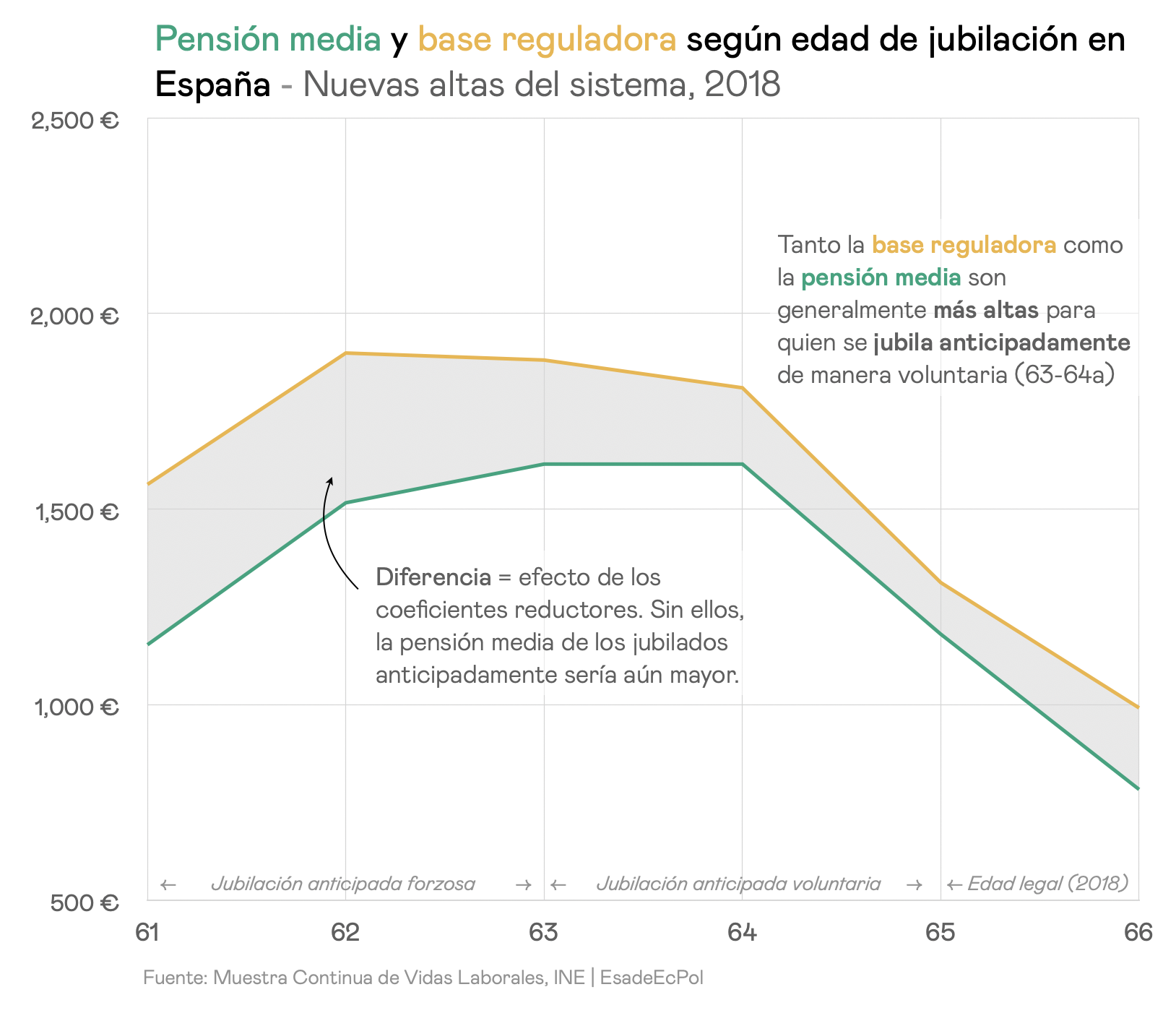
But this system, as it exists today, is strongly regressive: workers entitled to the maximum pension enjoyed significantly lower reduction coefficients than the rest, which made them more likely to take early retirement. This can be seen by looking at the average monthly pension of new entrants to the system in 2018, based on microdata from that year’s Continuous Sample of Working Lives.
Workers who retired in 2018 at 61 had a pension similar to those who retired that same year at the legal age (65), essentially because of the high penalty they suffered, as these were forced early retirements resulting from spells of unemployment. However, workers who retired early voluntarily, between 63 and 64, did show substantially better labour market outcomes, with a regulatory base almost 40% higher than that of workers who retired at the ordinary age; this base summarises the quality of a working life in wage terms. In other words: those who earn the most are retiring earlier.
Another way of looking at it is to consider the percentage of workers entitled to the maximum pension among all workers who retired early. These are workers who have contributed at the maximum base throughout their working lives or, in other words, who had gross monthly income above €4,000 in 2019 (the bases change every year). The weight of this group varies depending on the statistics used, but it is a very small group, especially when we consider only those who manage to contribute at the maximum base for most of their working lives. These best-paid workers at the top of the wage distribution accounted for almost 19% of the workers who retired early at 64 in 2018, according to data from that year’s Continuous Sample of Working Lives, almost four times their weight among all workers (5%).
Improving the design of the reduction coefficients, which currently make early retirement relatively more attractive to workers with higher wages, is one of the central motivations of the new pension reform, which aims to increase these coefficients from 2024 to 2034.
The aim of this reform, or of others in the same direction, is to ensure that high earners who withdraw from the labour market (that is, from contributing to common prosperity) while they still have room to continue bear the effective cost of doing so, or decide to delay their retirement. In both cases, the gains obtained by the system (through savings from the coefficients, or through additional contributions) should be used to build a redistributive cushion; that is, so that future adjustments to the system do not affect, or affect to a much lesser extent, those who have had worse working lives.
The other objective of the reform is to get more workers to voluntarily extend their working lives, that is, to retire beyond the legal age, which is currently almost 66 and will reach 67 in 2027. To this end, there are currently increasing coefficients, whose purpose is the reverse of those for early retirement: to reward workers for each year that they keep working instead of retiring. In light of the low number of retirements beyond the legal age, this system is not enough to achieve its goal, so the Government proposes complementing it with a lump-sum payment system in which, instead of an extra x% of pension each year, a single payment of up to €12,000 is received on retirement.
The reform will not be enough
Beyond redistributive considerations, the question remains whether the change in the effective age will be enough to contain pension spending to the same extent that indexing pensions to the CPI will increase it. The Government expects so, but we do not.
In its current form, this reform will affect, at most, 15% of workers who retire voluntarily, who account for approximately 20% of new entrants to the system. According to estimates by the Pensions and Social Protection Research Group at the University of Valencia, assuming these people do not change their behaviour, their average pension on entering the system would fall by 5%, which, weighted by their share of the system, would mean a 0.42% fall in pension spending. Re-indexing pensions to the CPI will have a long-term cost of 3 points of GDP a year, an amount that vastly exceeds the savings expected from the reform of early retirement proposed by the Government.
On top of all this is the risk that the reform already planned will not end up being fully implemented. This already happened with the sustainability factor: after it was approved, its implementation start date kept being postponed until, this year, its repeal and replacement ended up being proposed. While indexing pensions to the CPI is immediate, the reform of early retirement will begin in 2024, after the 2023 elections, and will have a long 10-year implementation period in which a lot can happen.
As for the effect of the lump-sum payment on delaying retirement, there is no reason for optimism either: the same University of Valencia researchers recently calculated that the value of this new payment was significantly lower than the rewards already offered by the system through the increasing coefficients. In a context of rapid gains in life expectancy (between 2010 and 2019 alone, a whole year of life expectancy at 65 was gained), the lump-sum payment will be an increasingly unattractive option.
Although the reform of early retirement is appropriate and has a redistributive effect, we must not lose sight of the fundamental point: the cost of its redistributive effect is to further undermine the contributory nature of the system, and the amount of funds that can be expected to be saved with this reform is tiny compared with the spending challenges that lie ahead.


Related content