What will and will not work in the new housing policy to improve access to rental housing
Jorge Galindo, Ángel Martínez Jorge, Javier Martínez Santos, Natalia Collado Van-Baumberghen
3 May, 2023
The new housing policy aims to solve the evident rental problems in Spanish cities through price controls in stressed areas and an effort to increase the supply of social rental housing. The effort on access is promising and goes in the right direction to solve the problem, while the controls could prove counterproductive.
The commitment to improving the accessibility of social rental housing and mobilising empty homes for this purpose is potentially very fruitful. To keep up with the challenge of bringing Spain to the levels of social housing of our neighbours (the European average is four times our levels), we recommend:
- Working with targets that set realistic medium-term expectations: for example, reaching 20% public housing in 20 years, as the government has suggested, would put us on a par
with the countries in the north of the continent, but in orders of magnitude it would require adding, every year from now until 2043, roughly as many homes to the social housing stock as we have managed to add in total to date, a pace that is hard to imagine. - Prioritising the conversion of homes in the short term to start easing pressure on the market as soon as possible. The conversion of 50,000 Sareb homes committed to by the government goes in this direction; on its own it would add a substantial 17% to the current social rental housing stock.
- Negotiating the purchase of homes from large owners at a discount to the reference price in order to convert them into social rental housing. To give a sense of scale, García Montalvo (2023) recently suggested acquiring up to 20,000 units at a 20% discount.
- When converting available homes, it is crucial to bear in mind that only those that match the demand to be met in terms of location and type of housing will be useful.
- For newly built social housing, urban planning would need to invest in basic services such as transport, health, education and green spaces to ensure that it is attractive to demand.
The law also proposes reserving 40% of developable land in new projects for public housing. To prevent this from ending up discouraging the creation of new homes, it would be
advisable to complement it with density bonuses: incentives that allow developers to build more in the areas where they obtain permits, increasing the number of homes or building height in exchange for including more social rental units, as implemented, for example, in California or New York.
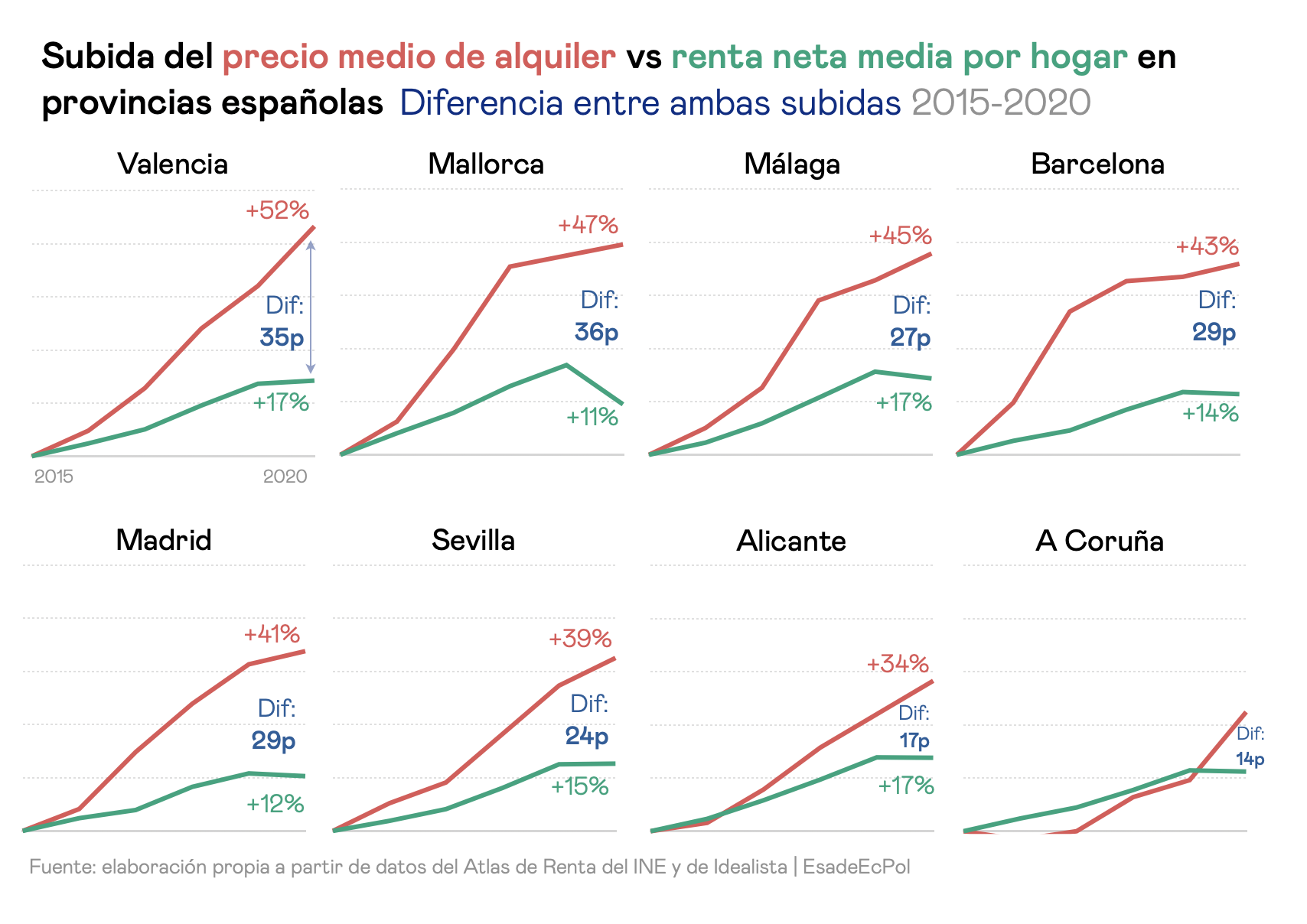
In contrast to policies that increase supply, according to the evidence gathered from the experience in Catalonia and elsewhere, price controls could have undesired effects:
- They could end up pushing up the lowest rents in stressed areas, since these would tend to “stick to the ceiling”, which would be visible to all tenants.
- Moreover, there are signs both in Catalonia and in other experiences around the world that suggest a negative effect on supply, especially at the higher quality or price end.
- The law sets geographical boundaries to define beneficiaries instead of household-level criteria, which may generate redistributive injustices in border areas: some who need it will be left out, while others who do not need it will benefit.
- The decision on the formula for defining a stressed area is assigned to the INE, which could politicise an autonomous body such as the INE.



Economista enfocado en el análisis y la visualización de datos. Grado en Administración de Empresas y Economía Laboral por la Universidad de A Coruña y Master en Economía por la Universidad de Santiago.
View profile
Research Economist en EsadeEcPol. Máster en Economía Industrial y Mercados regulados por la Universidad Carlos III de Madrid
View profile