A fairer proposal for pension indexation
Ángel Martínez Jorge, Jorge Galindo, Toni Roldán
10 October 2022
The initial draft of the 2023 General State Budget anticipates an increase of some 25 billion euros in social spending compared with 2022. Of this, around 19.5 billion will go to pensions, and 12.43 billion specifically to the general 8.5% indexation announced by the government. In other words: half of the new social spending goes on updating pensions in line with the CPI.
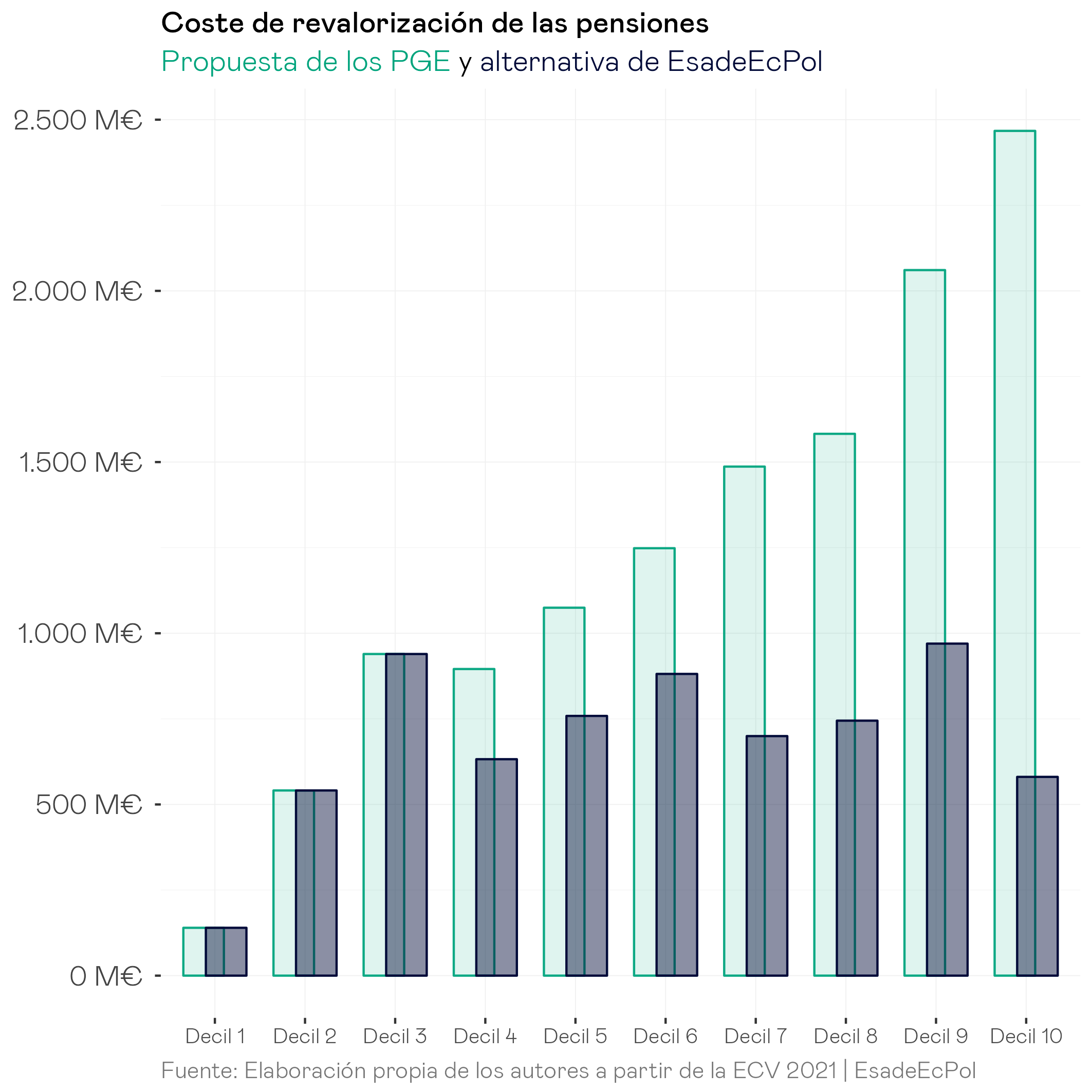
In this Policy Insight we divide the Spanish population into ten groups according to their income, using the Living Conditions Survey, to find out what share of the total cost of indexation will go to pensioners in each of these ten groups.
Pensioners among the 30% of the Spanish population with the lowest incomes will receive only 13% of the indexation, while pensioners among the 10% of Spaniards with the highest incomes would receive 21.2%, almost 2.5 billion euros.
Our extraordinary proposal for 2023 is to divide indexation into four brackets. We estimate here one of the many possible alternatives, under which pensioners in the first three income deciles would receive full indexation of 8.5%; for pensioners between deciles 4 and 6, indexation would be 6%, falling to 4% between deciles 7 and 9, and reaching its minimum level of 2% for those in the top 10% of earners.
This proposal has two advantages. The absolute cost falls from 12.43 billion to 6.89 billion euros. In addition to this 44.5% budget saving compared with universal indexation, our proposal has a substantially greater distributional impact.
Universal indexation would have a practically neutral distributional effect, reducing inequality by just 0.02%. Indexation by brackets, on the other hand, using just over half the resources, achieves a substantially greater distributional impact, equivalent to a 0.67% reduction in inequality (measured by the Gini index).