The gender gap in entrance exams: the case of the MIR, and what we can do to reduce it
Carlos Sunyer
7 Mar, 2023
Competitive exams are the subject of intense public and scientific debate, as they distribute opportunities based on the merit of the answers and may penalise certain profiles. This insight analyses in detail one of the most paradigmatic cases: the MIR in Spain, a highly competitive exam that determines the professional future of more than 10,000 doctors a year, and its effect on gender equality. To do so, we draw on three recent studies that examined individual data from MIR exams in recent years: Conde-Ruiz et al. (2020), Díez-Rituerto et al. (2023) and Sunyer (2023).
These studies show that, although at the bottom of the MIR results distribution women outperform men with the same academic record, at the top women obtain worse results. In the 2022 exam, the women with the highest scores obtained up to 3 points less than men with the same academic record. This difference is equivalent to between 500 and 600 places in the final ranking, which means that women obtained less sought-after specialities than men: the difference is equivalent to that between Cardiology (the 3rd speciality to fill up) and Ophthalmology (the 6th).
The studies make it possible to explain this phenomenon accurately. In particular, they found the following:
1. Part of this gap could be attributable to a greater propensity among women to leave questions blank: although in theory the scoring system is designed so that candidates are indifferent between leaving a question blank or answering it at random, when at least one of the available options in the test can be ruled out this equivalence breaks down, implicitly rewarding those who take a risk when they can rule out at least one of the alternatives. This is more common among men.
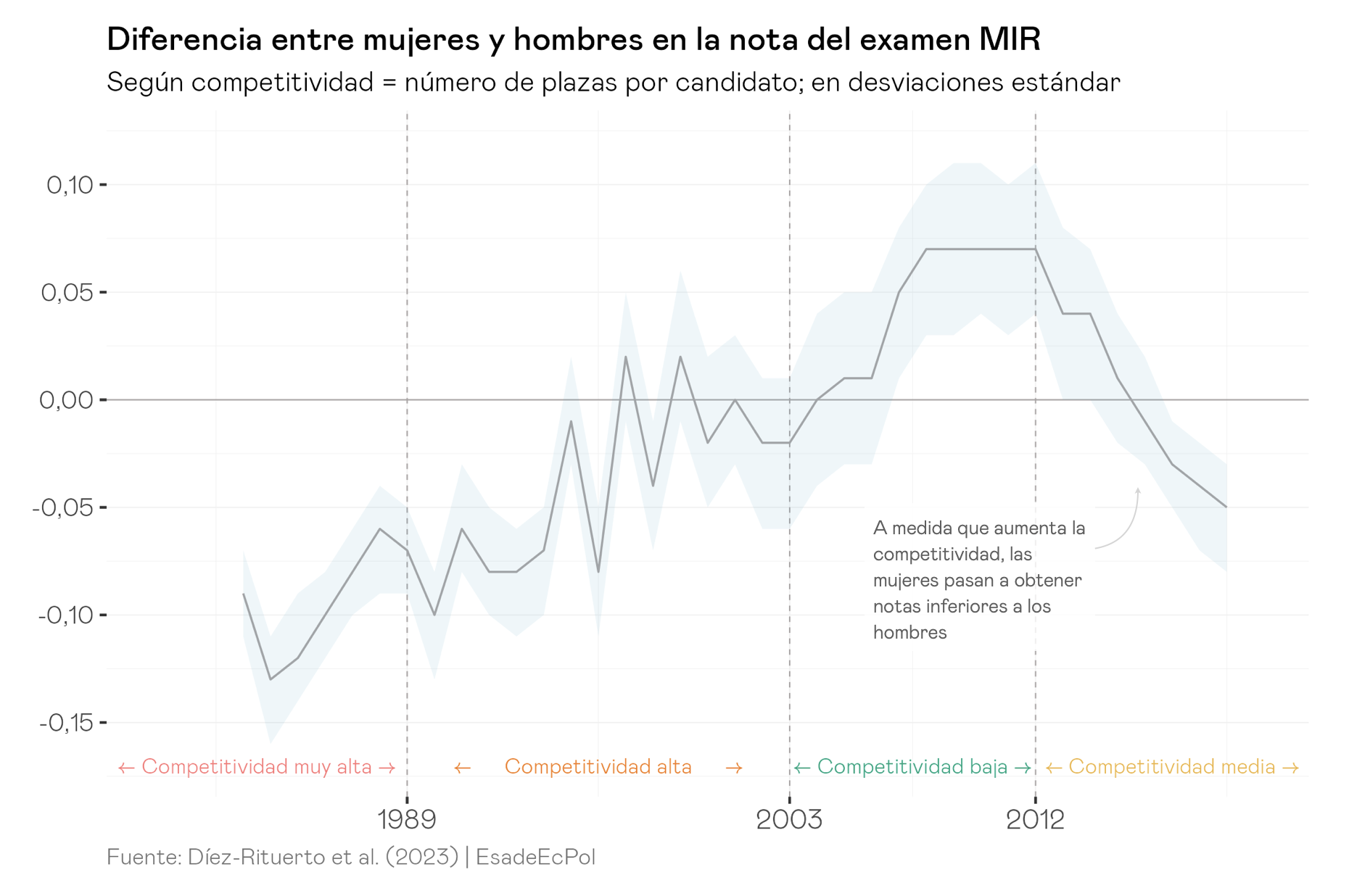
2. The external context also matters: the more competitive the exam (that is, the number of candidates compared with the number of places), the worse women perform compared with men. This is especially true among the best-performing candidates.
3. The two previous phenomena are clearly reproduced when analysing the case of repeat candidates (22% of all candidates), where it can be seen that women are indeed more likely to leave answers blank, which means they improve their scores less than male repeat candidates.
Given the results of these studies, which are echoed by comparable evidence for similar entrance exams, to address the gap resulting from the format we suggest reconsidering the penalty for errors in this type of exam in order to promote gender equality.
→ One solution that would still make it possible to measure differences between the highest-scoring candidates, and which could be extended to other exams, would be a points-loss system in which blank or incorrect answers are penalised, and candidates start with the maximum possible score.
Two additional measures that could help achieve this goal, related to the context in which this type of exam takes place, are:
1. Reducing the weight of this type of exam in the final selection score.
2. Improving coordination between the number of graduates (in Medicine, or in other
degrees) and the number of places created in the public sector.

Related content