The deterioration of primary care: factors explaining care pressure and proposals to reduce it
23 May, 2023
Spain is an international role model on many health indicators. However, in Primary Care (PC) in general medicine, the pillar and gateway to the system, numerous indicators point to a situation of progressive deterioration, albeit with significant variation between regions:
→ According to the Health Barometer conducted by the CIS, citizens’ rating of PC services has fallen from 7.38 to 6.19 out of 10 over the last decade.
→ The average waiting time between requesting and attending an appointment with a family doctor has risen from 4.14 days in 2017 to 8.8 days in 2022.
→ Pressure on emergency services has soared in recent years as a result of this deterioration: 29% of citizens stated in 2023 that they missed an appointment with their GP and went to the emergency department because of the waiting time to get an appointment.
→ More than 70% of professionals say that the PC budget allocation is not enough to provide a quality service.
→ Despite demographic changes and growing demand, according to the Public Health Expenditure Statistics (EGSP), the share of PC spending in public health spending has remained practically constant since records began, while spending on Specialised Care has increased steadily.
In this policy brief, using unique data from the CIVIO Foundation, we analyse the factors that explain the high care pressure in PC in Spain, measured as the average number of patients seen per day per family doctor. To do so, we carry out a cluster analysis that allows us to find socio-economic and demographic similarities between areas with different levels of pressure, as well as econometric analyses that allow us to quantify the magnitude of some of these relationships. We find that:
→ In 2018, the most recent year for which information is available for almost all regions, the regions with the highest pressure were Murcia, Melilla and the Community of Madrid, while Catalonia, Aragon and Castile and León were the regions with the lowest pressure.
→ There is considerable variation in pressure between Health Areas within each region, with Aragon standing out in particular according to our most precise statistical measures.
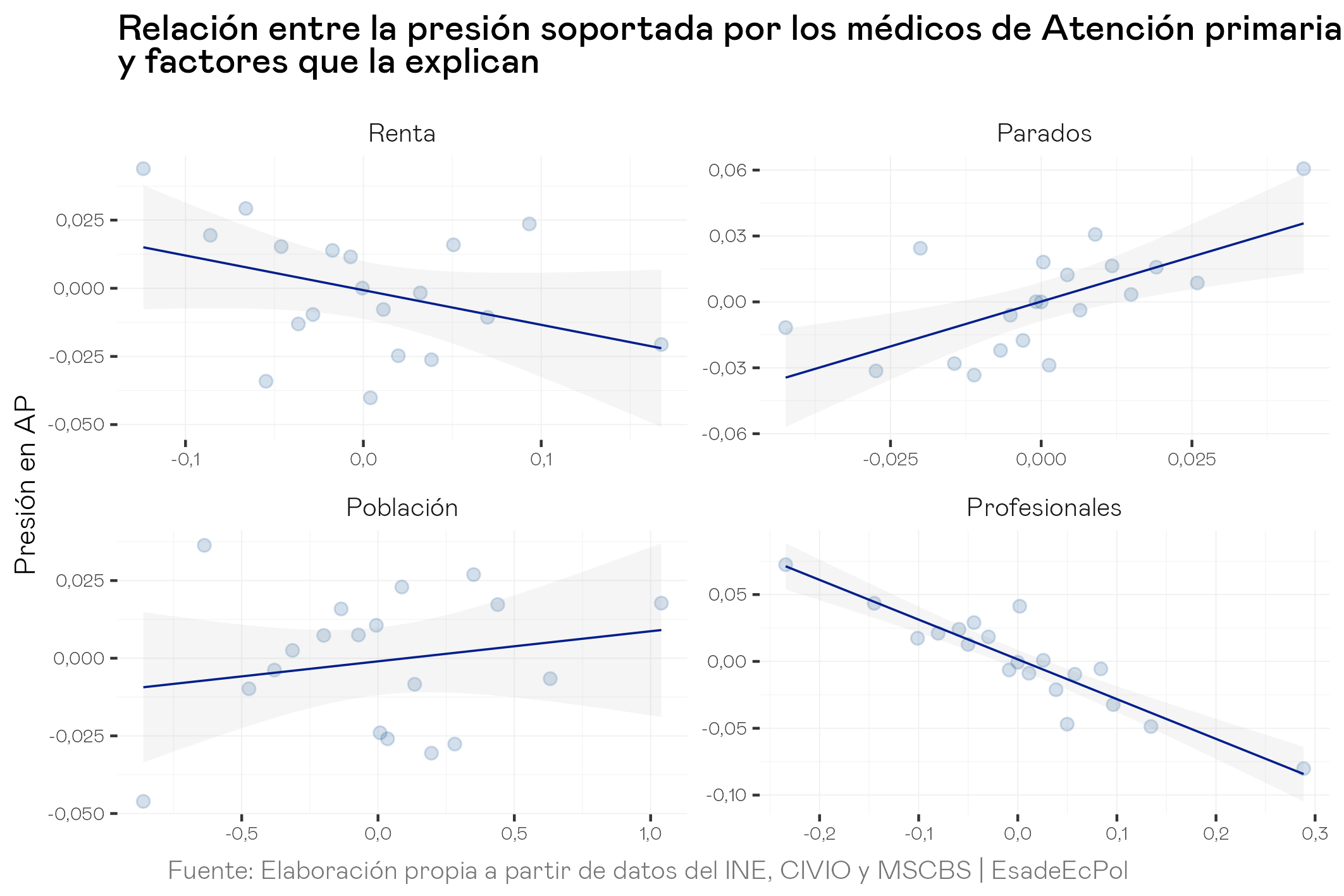
→ Health Areas with lower income, higher unemployment rates, larger populations and fewer doctors per capita have higher care pressure.
→ Specifically, for every 1% more income in a given Health Area, PC doctors see, on average, 0.20% fewer patients per day. We associate this relationship mainly with two potential causes:
(i) people with higher incomes generally have better health (for example, lower tobacco and alcohol consumption and lower obesity, as well as better results in self-perceived health and chronic diseases);
(ii) greater use of private health insurance since, at provincial level, a 1% increase in GDP per capita is associated, on average, with a 0.5% increase in the percentage of the population with private health insurance coverage.
We analyse the situation of PC in the Community of Madrid in detail and find that:
→ The centres under most pressure have worse health indicators: every 1% more care pressure in health centres is associated with between 0.11% and 0.16% fewer patients with good control of diabetes and hypertension.
→ The level of pressure varies significantly between centres.
→ The factors influencing pressure are similar to those in the rest of Spain.
In order to ease the current pressure and reduce heterogeneity between Health Areas and health centres, as well as to address the challenges facing our PC system in the
short and medium term, we put forward six proposals:
- Providing financial and career incentives, as is done in other countries, for professionals to work in positions that are hard to fill and demanding, taking into account, among other criteria, the care pressure of PC centres.
- Reducing temporary contracts in PC in order to guarantee continuity in the patient-doctor relationship, so that not only do working conditions improve, but excessive attendance is also reduced and health outcomes improve.
- Redistributing demand within Health Areas —particularly of new patients— taking into account criteria such as pressure and not only distance from home, especially where there is a single Area, and in Areas with lower population dispersion.
- Redistributing the workload among professionals so that, for example, temporary sick leave is processed by the doctors who carry out the medical examination, and reducing the bureaucratic burden on healthcare staff by hiring PC administrative staff.
- Committing to full digitalisation, so that patients’ medical records are shared not only between Primary and Hospital Care, but also between regions. Digitalisation should in turn enable agile, up-to-date information systems that make it possible to extract performance indicators, always accompanied by greater transparency in the publication of indicators at aggregate level.
- Guaranteeing sufficient and cross-cutting training in Family and Community Medicine at all Spanish medical schools (with compulsory subjects and rotations), in order to encourage students in this direction.
Cite this content as:
Cobreros, L.; Sunyer, C. (2023). El deterioro de la atención primaria: factores que explican la presión asistencial y propuestas para reducirla. EsadeEcPol Policy Brief, No.39, Esade. http://doi.org/10.56269/20230523/LCB
Related content