Rising university entrance exam (Selectividad) grades: inflation or competition?
Lucía Cobreros Vicente, Lucas Gortazar, Juan Manuel Moreno
14 Jun, 2023
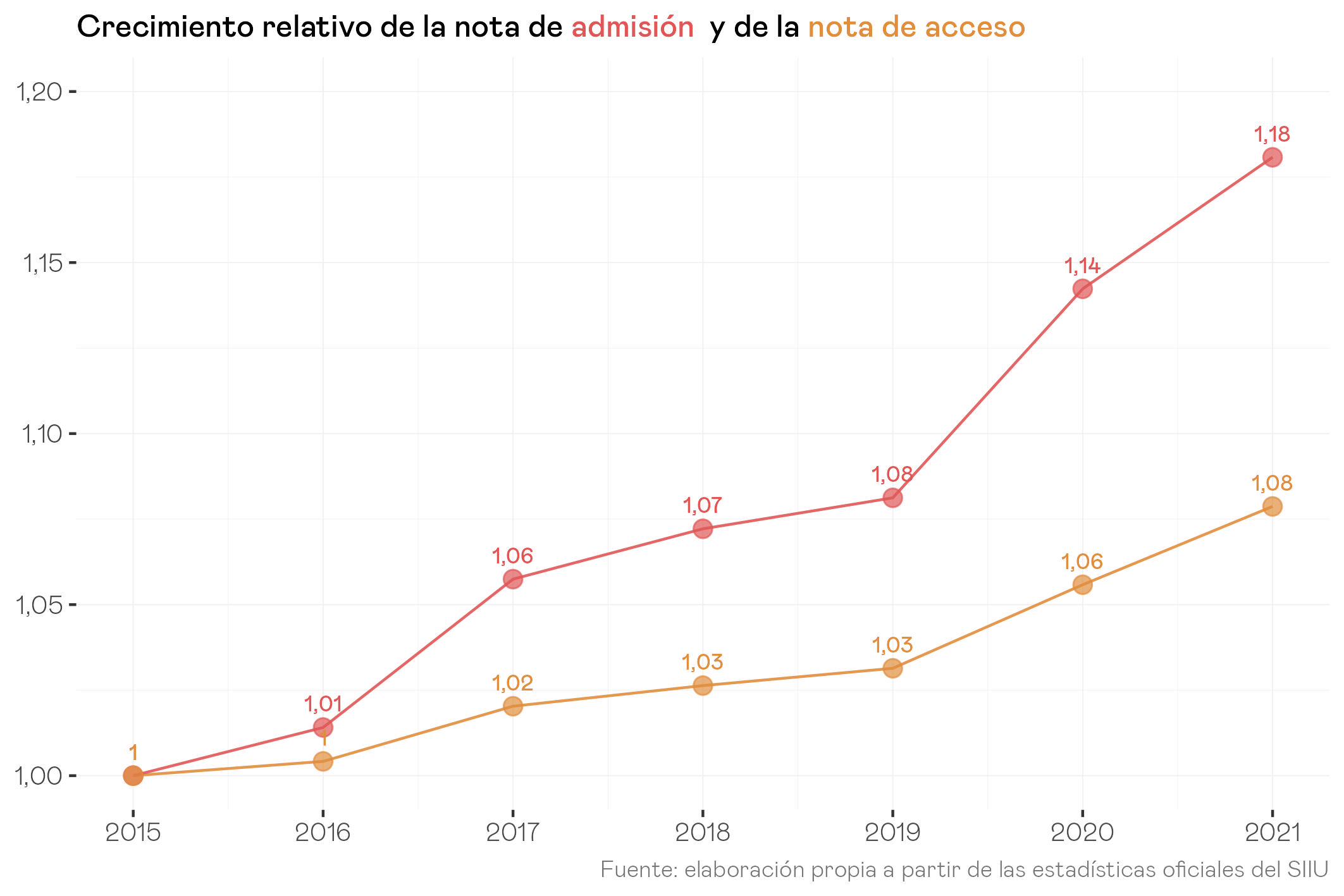
In recent years the average grade in Selectividad, Spain’s university entrance exam, has risen from 8.75 out of 14 in 2015/2016 to 10.34 in 2021/2022. This increase can be seen in all regions. The most common hypothesis in public debate to explain this rise is that it is artificial: students know less and less, and passes and top grades are being inflated.
In this report we explore the causes of the rise in Selectividad grades over the 2013-2020 period and try to determine whether this increase is due to an artificial push (what we will call the “inflation hypothesis”) or whether, on the contrary, it is also driven by real improvements resulting from greater competition, effort and learning by students (what we will call the “competition hypothesis”).
We use a unique and previously unexplored database (the Integrated University Information System of the Ministry of Universities), which includes all students who have taken Selectividad since 2013, and their results in the three components of the final Selectividad grade: the overall Bachillerato grade (6 points), the compulsory subjects for each Bachillerato track (general phase; 4 points), and the optional subjects (specific phase, in place since 2010; 4 extra points).
Analysing the data for the 2013-2019 period, we find arguments for both hypotheses. At least two indicators suggest that grades have improved due to greater competition among students:
- The improvement in the specific phase (optional subjects) explains most of the increase in the overall admission grade in this period. Since taking the specific phase is optional, this suggests that the competition hypothesis could explain part of the rise in grades.
- In the general phase, the rise in grades is more pronounced among students who go on to public universities than among those who attend private universities. Since private universities have their own entrance exams, and given that Selectividad examining boards do not know students’ aspirations regarding the university or degree they wish to enter, this suggests that the incentive to compete (to be able to enter the desired public university) has the effect of pushing grades upwards.
However, in 2017 a new reform reduced the options for choosing subjects in the general and specific phases. This produced a grade inflation effect through two channels:
- The regions and public universities responded to the regulatory change by allowing one of the compulsory subjects to be weighted twice, thereby artificially inflating the final Selectividad grade.
- Schools, seeing that the new regulation could negatively affect their students’ Selectividad results, may have chosen to compensate them by raising Bachillerato grades. We can see this thanks to a comparison with the previous year using a statistical model.
In addition, in 2020 measures were taken to compensate for the school closures caused by the pandemic, both in Bachillerato records and in the Selectividad exams, allowing students to discard questions in all subjects of the exam. We find that:
- There was a substantial increase in results, probably due to the greater leniency in Bachillerato and the exams, which meant an increase of half a point in the final admission grade.
- The bulk (58%) of this increase is explained by a higher grade in the specific phase, 26% by the increase in the general phase grade, and the remaining 16% by better results in Bachillerato.
- However, the competition effect is observed again, albeit to a lesser extent, when comparing students entering public universities (where results in the general phase grow more) with those entering private ones.
We also observe that students’ Bachillerato grade is on average higher than their general phase grade. The difference between the two is greater for girls (compared with boys), for students with the highest Bachillerato grades and for students attending private Bachillerato schools; however, in a statistical model controlling for student, region and school factors, these gaps are significantly reduced in magnitude.
To improve Selectividad by encouraging fair competition and avoiding grade inflation, we propose five measures:
- Increasing optionality again (the relative weight of optional subjects compared with common subjects in the final grade, as well as the variety and depth of the knowledge assessed) and repealing the 2017 reform, protecting the specific phase of the exam, which brought greater competitiveness and learning.
- Eliminating the exceptional measures taken in 2020 as a result of the pandemic, which have had an inflationary effect on grades.
- Reducing the weight of the Bachillerato academic record to 50 or 40 percent of the final admission grade (as is currently the case in France) and regularly monitoring the differences between Bachillerato and general phase grades by school and student.
- Increasing the consistency and objectivity of assessment through exams that are more comparable across regions and a more reliable marking system.
- Continuing to make progress in developing a “maturity test” that allows for greater consistency and brings about curricular changes and real learning improvements.
Cite this content as:
Cobreros, L.; Gortazar, L & Moreno, J. (2023). La subida de las notas de selectividad: ¿inflación o competición?. EsadeEcPol Policy Brief, No.41, Esade. http://doi.org/10.56269/202300614/LCB



Catedrático de la Facultad de Educación de la Universidad Nacional de Educación a Distancia (UNED) y Senior Policy Fellow de EsadeEcPol.
View profile