Analyzing the adoption of clean technologies in Spanish households
Jorge Galindo, Álvaro Fernández
28 Feb, 2025
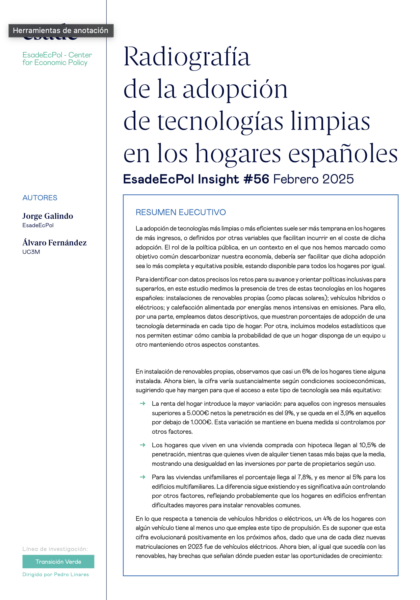
The adoption of cleaner or more efficient technologies usually occurs earlier in higher-income households or those defined by other variables facilitating the costs associated with such adoption. In a context where the shared objective is decarbonizing the economy, public policy should ensure that adoption is as comprehensive and equitable as possible, making these technologies equally accessible to all households.
To precisely identify challenges for advancement and guide inclusive policies to overcome them, this study measures the presence of three specific technologies in Spanish households: privately-owned renewable installations (such as solar panels), hybrid or electric vehicles, and heating systems powered by less emission-intensive energy sources. To achieve this, we first employ descriptive data showing adoption percentages of each technology across household types. Additionally, statistical models are included to estimate how the probability of a household possessing these technologies changes when other factors are held constant.
For privately-owned renewable installations, nearly 6% of households have at least one installed. However, this figure varies significantly by socioeconomic conditions, suggesting room for improving equitable access:
→ Household income creates the largest variation: 9% of households with monthly net incomes above €5,000 have renewable installations, compared to just 3.9% for those earning below €1,000. This variation largely persists even after controlling for other factors.
→ Households living in properties purchased with a mortgage reach 10.5% penetration, whereas rental households have rates below average, highlighting an inequality in investments by homeowners depending on property use.
→ Single-family homes have a penetration rate of 7.8%, while multifamily buildings are below 5%. This difference remains significant even when controlling for other factors, likely reflecting greater barriers to installing shared renewable technologies in multi-family buildings.
Regarding ownership of hybrid or electric vehicles, 4% of vehicle-owning households have at least one vehicle powered by these technologies. This number is expected to grow, considering that one in every ten new vehicle registrations in 2023 was electric. Yet, similar to renewable energy installations, existing gaps highlight opportunities for growth:
→ Monthly net income again strongly influences adoption: 11% of households with incomes above €5,000 own hybrid/electric vehicles, while less than 2% of those under €1,000 do. The gap decreases when controlling for other household characteristics but remains highly significant (x2.75).
→ Having a garage in the household’s building or single-family home increases the probability by a factor of x1.3, even after controlling for income and other factors.
→ Hybrid or electric vehicles are more common in households located in cities with populations exceeding 500,000 (6.2%), emphasizing the importance of infrastructure and local environment.
→ Geographically, the ratio of households with electric/hybrid vehicles versus combustion-only vehicles is especially high in the provinces of Madrid and Barcelona, with notable urban areas also including Santiago de Compostela, Ibiza, and Marbella.
Lastly, fixed heating systems powered by renewable energy (distinct from mobile solutions such as portable radiators) exhibit:
→ Significantly lower penetration rates compared to other technologies analyzed: 0.8% in households with collective heating systems, 0.6% in those with individual systems.
→ Penetration slightly increases with income level but does not exceed 1.1% and is not particularly prominent in any autonomous community.
→ In contrast, electric-powered heating reaches 9.7% in collective systems and 20.8% in individual systems. However, it must be noted that this figure includes both highly efficient and less efficient solutions.
This analysis suggests an opportunity to accelerate change through effective policies supported by significant public investment. It emphasizes the need to establish policies ensuring that the ongoing incorporation of clean technologies in Spanish households proceeds as efficiently, rapidly, and equitably as possible, leaving no one behind in the transition. This will simultaneously make the transition faster and fairer. We propose reinforcing three guiding principles for implementing measures that ensure a fairer and more efficient use of allocated resources:
→ Prioritize households facing the greatest barriers: Subsidies should target those unable to adopt clean technologies without assistance, focusing particularly on vulnerable households and cases where initial costs remain a significant obstacle.
→ Territorial equity: Incorporate criteria that reduce inequalities linked to physical surroundings and housing conditions. Firstly, ensure full territorial penetration of the infrastructure required for technology adoption, choosing the most efficient solutions per location. Secondly, facilitate adoption in environments where efficiency and decarbonization benefits are particularly high, such as medium-to-high-density urban areas.
→ Design policies balancing individual (electric vehicles, solar panels) and collective alternatives (public transport, shared energy networks), adapting to the specific conditions of each context rather than assuming a single approach suitable for all households and situations.


Graduado en ciencias políticas por la UC3M y máster de Análisis Político y Electoral (IC3JM-UC3M).
View profileRelated content

22 May, 2025