Quality of mathematics and science learning in Spain and France
Paul Cahu, Lucas Gortazar
11 Sep, 2019
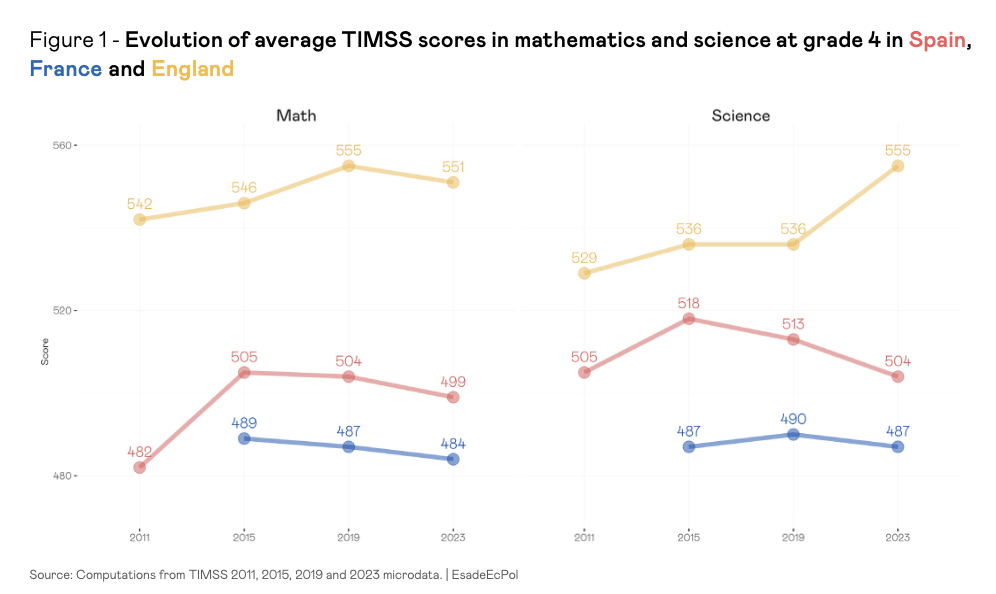
On the eve of a new technological revolution, mathematics and science skills will be increasingly essential for social and economic progress. Why are some countries better than others at teaching these skills? In 2023, the mathematics and science skills of fourth-grade pupils measured in Spain and France by the international TIMSS survey were still well below those of other developed countries. Moreover, pupil performance has deteriorated in both countries since the previous 2019 edition.
This note analyses these results in detail, using the individual TIMSS data published in February 2025. It examines the evolution of the main social factors that influence pupils’ learning and builds a new “learning quality index” (LQI). This index measures the net contribution of education systems after taking into account the social, economic and cultural background of pupils and families, including whether children were stimulated by their parents in early childhood. It also suggests possible explanations for why this index varies from one country to another. We find that:
-
The quality index at primary level, derived from TIMSS data, is strongly correlated with the quality index at secondary level, which can be calculated using PISA or TIMSS data (in the 8th grade). This primary-level quality index appears to be a good predictor of the quality of education systems.
-
The quality of learning measured by our index in Spain, and especially in France, is well below the OECD average in mathematics and science. According to our estimates, this gap leads to an economic loss of 44 billion euros in France and 7 billion euros in Spain for each cohort entering primary school.
-
The primary quality index has not changed much since 2019, when it was already low. Conversely, the quality index at secondary level is better in France and Spain than in most developed countries. In France and Spain, the good quality of lower secondary school allows pupils to make up part of the ground they lost in primary school.
-
The quality of learning is lower for socially advantaged pupils. The gap with children in other developed countries is larger for advantaged children. It is therefore society as a whole that suffers from insufficient quality at primary level, not just the most disadvantaged groups.
-
The decline in primary results between 2019 and 2023 is largely linked to a deterioration in the social conditions in which children grow up. More children report arriving at school hungry, with an increase of around 50% in Spain and France, where almost half of fourth-grade pupils report being hungry every day or almost every day. In Spain, the proportion of children who do not speak the language of instruction at home has increased, reaching 32%, which has a mechanical adverse effect on learning.
-
The analysis of explanatory factors shows that: (i) teachers’ academic skills are particularly high in France at primary and secondary levels and in Spain at secondary level; (ii) the disciplinary climate in class is close to the OECD average, but has deteriorated in many countries, particularly in Spain; (iii) indicators of sense of belonging and bullying are good in Spain, while France performs worse, against a backdrop of global decline; (iv) the number of instruction hours varies significantly between schools, which could partly explain the differences in learning quality.
To raise the quality of learning in both countries, which share clear historical similarities in education policy, we make four recommendations:
a) Improve learning conditions at school to respond to the social impoverishment of pupils, in particular through breakfasts and nutrition programmes, by investing in greater educational support, by reconsidering language policies in Spain and by developing other social programmes to improve children’s living conditions, such as book distribution.
b) Raise learning ambitions, set out skills objectives in detail in curricula and provide primary teachers with ready-to-use sample lessons.
c) Improve and promote effective in-service training, offering teachers large-scale practical training focused on teaching basic skills and managing classrooms in diverse contexts, with an emphasis on both academic rigour and managing emotions.
d) Invest early in remediation, prioritising small-group tutoring and targeting teaching resources at primary level, so that no pupil is left behind before entering secondary education.