Omicron: what we know today and keys to navigating the pandemic from now on
Jorge Galindo
4 Jan, 2022
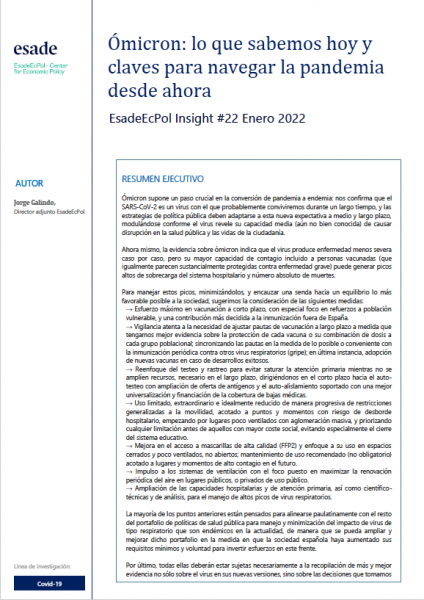
Omicron marks a crucial step in the shift from pandemic to endemic: it confirms that SARS-CoV-2 is a virus we will probably live with for a long time, and public policy strategies must adapt to this new medium- and long-term expectation, adjusting as the virus reveals its average capacity (not yet well known) to disrupt public health and people’s lives.
Right now, the evidence on omicron indicates that the virus causes less severe illness case by case, but its greater transmissibility, including among vaccinated people (who nonetheless appear to be substantially protected against severe illness), may generate high peaks of hospital overload and a high absolute number of deaths.
To manage and minimise these peaks, and to set a course towards an equilibrium that is as favourable as possible for society, we suggest considering the following measures:
→ Maximum short-term vaccination effort, with a special focus on boosters for vulnerable people, and a more decisive contribution to immunisation outside Spain.
→ Close monitoring of the need to adjust long-term vaccination schedules as we obtain better evidence on the protection provided by each vaccine or combination of doses for each population group; synchronising schedules as far as possible or advisable with periodic immunisation against other respiratory viruses (flu); and ultimately adopting new vaccines if successfully developed.
→ Refocusing testing and tracing to avoid overwhelming primary care, moving towards self-testing with a wider supply of antigen tests and supported self-isolation, with broader and better-funded sick leave coverage.
→ Limited, exceptional and ideally progressively reduced use of general mobility restrictions, confined to places and times at risk of hospital overload, starting with poorly ventilated places with mass gatherings, and prioritising any other limitation before those with the highest social cost, especially avoiding the closure of the education system.
→ Reconsideration of vaccine passports by gathering better evidence to identify the conditions under which this restriction does provide a sufficiently valuable or significant incentive.
→ Improved access to high-quality masks (FFP2) and a focus on their use in enclosed and poorly ventilated spaces, not outdoors; continued recommended (not mandatory) use limited to places and times of high transmission in the future.
→ Promotion of ventilation systems with a focus on maximising regular air renewal in public places, or private places open to the public.
→ Expansion of hospital and primary care capacity, as well as scientific, technical and analytical capacity, to manage high peaks of respiratory viruses.
Most of the above points are designed to gradually align with the rest of the portfolio of public health policies for managing and minimising the impact of respiratory viruses that are currently endemic, so that this portfolio can be expanded and improved to the extent that Spanish society has raised its minimum requirements and its willingness to invest efforts on this front.
Finally, all of them must necessarily be subject to the collection of more and better evidence not only on the virus in its new variants, but also on the decisions we take to fight it.