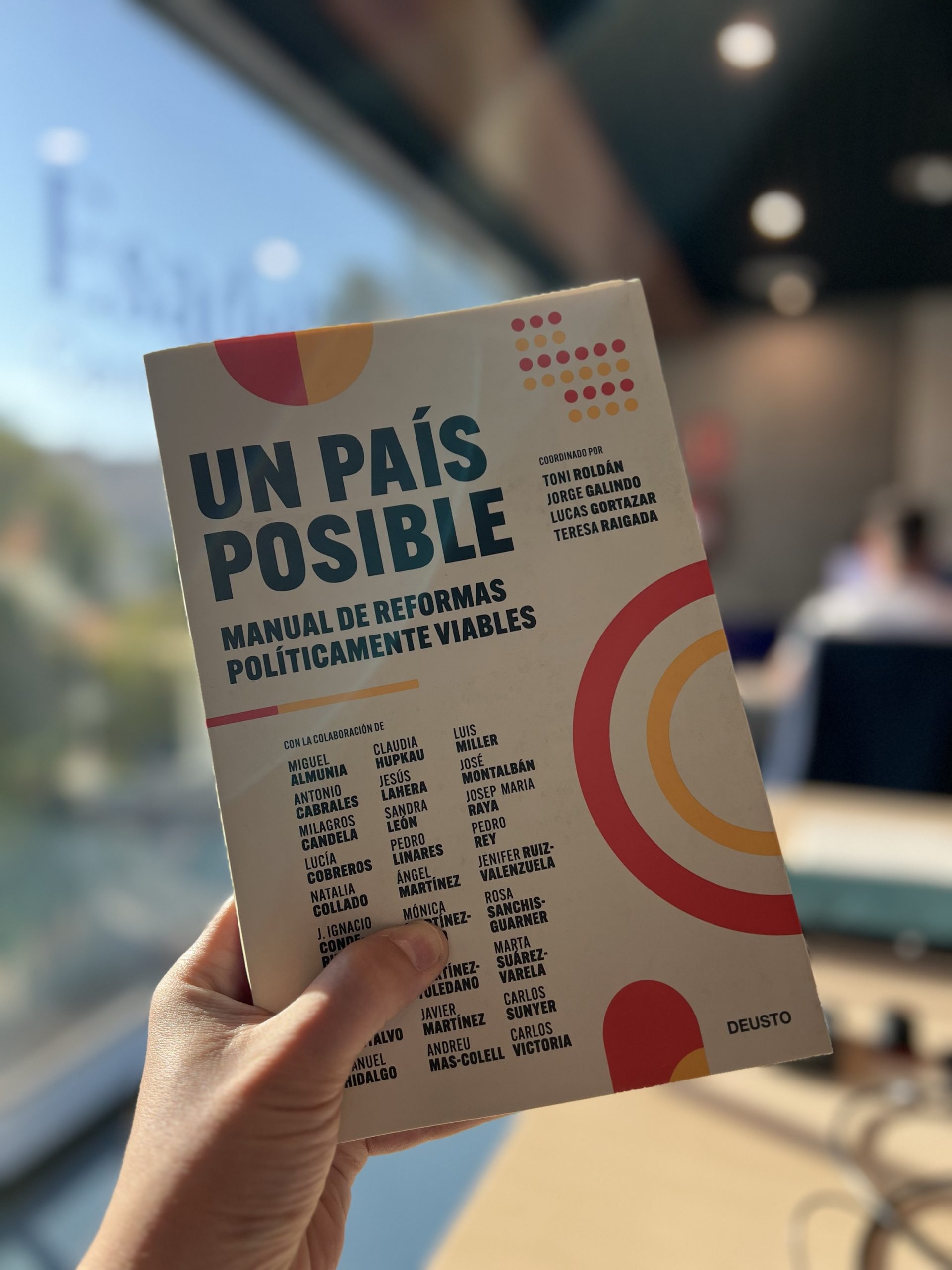
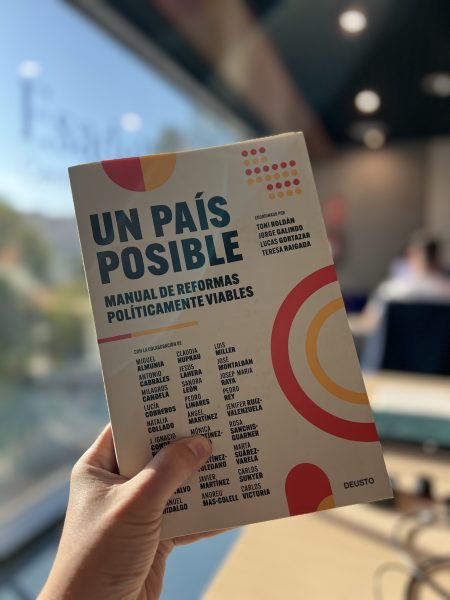
New book: ‘Un país posible’ (A Possible Country)
Toni Roldán, Teresa Raigada, Lucas Gortazar, Jorge Galindo
10 Oct, 2023
Spain has practically the same real per capita income as 15 years ago, while other countries around us are much richer than they were then. This means that over the last eighteen years we have not improved our average standard of living. We are therefore on the road to two lost decades. There are many reasons that explain how we got here, but one underlying structural challenge stands out as the most important: Spain is lagging behind in the knowledge race.
Regaining momentum in this race, and finding a sustained, robust, well-distributed and balanced growth model, is what has led us to publish ‘Un país posible‘ (A Possible Country). In it we bring together the best voices in Spanish economic and social research to propose, based on an up-to-date, rigorous and realistic diagnosis, concrete, well-defined, realistic, evidence-based and politically viable reforms to change this trajectory and help Spain become a leading country in the new economy. To achieve this, it is not enough to implement good reforms in training, education or universities, which are of course included in this book. It is also essential to transform the mechanisms that hinder equal opportunities, of which there are many in Spain.
Introduction. A possible country: reasons and policies · Toni Roldán
Part I A public framework for developing better policies
- Moving towards evidence-based public policy design · Mónica Martínez-Bravo (CEMFI)
- A modern, data-driven public administration · Pedro Rey (Esade), Miguel Almunia (CUNEF), Teresa Raigada
Part II An institutional architecture for knowledge-based growth
- Improving education while avoiding confrontation · Lucas Gortazar, Antonio Cabrales (UC3M)
- How to increase social mobility by promoting access to higher education · José Montalbán (SOFI, Stockholm University), Rosa Sanchís-Guarner (UB, IEB)
- Retaining, recovering and attracting research talent · Andreu Mas-Colell (emeritus UPF and president of BIST), Milagros Candela (UCM)
- Training and protection: measures to make the most of future transformations · Manuel Hidalgo (UPO and senior fellow at EsadeEcPol), Carlos Victoria
- How to decarbonise effectively and fairly · Natalia Collado, Marta Suárez-Varela (BdE), Pedro Linares (ICAI-Comillas and senior fellow at EsadeEcPol)
Part III A protection infrastructure adapted to new challenges
- Tax reforms to reduce inequality and drive inclusive growth · Clara Martínez-Toledano (Imperial College and senior fellow at EsadeEcPol)
- Future challenges for the labour market in Spain · José Ignacio Conde-Ruiz (UCM, Fedea), Jesús Lahera (UCM, Fedea)
- What more can we do to reduce the gender gap in the labour market? · Lucia Cobreros, Jenifer Ruiz-Valenzuela (UB, senior fellow EsadeEcPol), Claudia Hupkau (CUNEF)
- A proposal to reform the Spanish pension system · Juan Francisco Jimeno (BdE), Ángel Martínez, Javier Martínez
- Proposals to reduce care pressure on primary healthcare · Lucia Cobreros, Carlos Sunyer (UC3M)
- Sensible reforms for affordable housing · Josep Maria Raya (UPF), Jose Garcia Montalvo (UPF)
Epilogue. How to broaden the political space for reforms while navigating polarisation · Sandra León (UC3M, senior fellow EsadeEcPol), Luis Miller (CSIC)
You can pre-order the book at this link.

Project Manager & Content Curator, EsadeEcPol. Licenciada en Economía y Derecho por la UC3M, Master en Administración Pública por la London School of Economics.
View profile
Related content