MacroInsights #08
Fernando Gutiérrez del Arroyo González, Juan Pablo Riesgo, Manuel Hidalgo Pérez, Jorge Galindo, Teresa Raigada
20 Jun, 2024
Macro outlook, global focus and micro perspective for June 2024.
Macro outlook
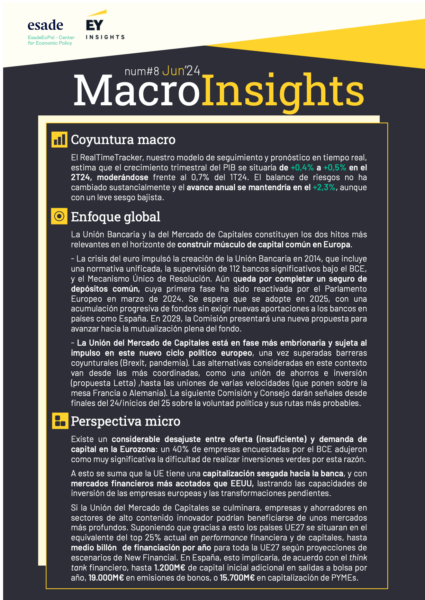
The RealTimeTracker, our real-time monitoring and forecasting model, estimates that quarterly GDP growth would stand between +0.4% and +0.5% in Q2 2024, easing from 0.7% in Q1 2024. The balance of risks has not changed substantially and annual growth would remain at +2.3%, albeit with a slight downside bias.
Global focus
The Banking Union and the Capital Markets Union are the two most important milestones on the path to building common capital muscle in Europe.
– The euro crisis spurred the creation of the Banking Union in 2014, which includes a single rulebook, the supervision of 112 significant banks by the ECB, and the Single Resolution Mechanism. A common deposit insurance scheme has yet to be completed; its first phase was revived by the European Parliament in March 2024. It is expected to be adopted in 2025, with a gradual build-up of funds without requiring new contributions from banks in countries such as Spain. In 2029, the Commission will present a new proposal to move towards full mutualisation of the fund.
– The Capital Markets Union is at a more embryonic stage and depends on momentum in this new European political cycle, now that short-term barriers (Brexit, the pandemic) have been overcome. The alternatives considered in this context range from the most coordinated, such as a savings and investments union (the Letta proposal), to multi-speed unions (put on the table by France or Germany). The next Commission and Council will signal their political will and most likely routes from late 2024/early 2025.
Micro perspective
There is a considerable mismatch between the (insufficient) supply of and demand for capital in the Eurozone: 40% of companies surveyed by the ECB cited this as a very significant obstacle to making green investments.
On top of this, the EU’s capitalisation is skewed towards banks, with more limited financial markets than the US, weighing on European companies’ investment capacity and the pending transformations.
If the Capital Markets Union were completed, companies and savers in highly innovative sectors could benefit from deeper markets. Assuming that, as a result, EU27 countries reached the equivalent of today’s top 25% in financial and capital market performance, this would mean up to half a trillion euros of financing per year for the EU27 as a whole, according to scenario projections by New Financial. In Spain, according to the financial think tank, this would mean up to €1.2 billion of additional initial capital in IPOs per year, €19 billion in bond issuance, or €15.7 billion in SME capitalisation.

Economista especializado en finanzas sostenibles, regulación ESG y análisis regulatorio. Actualmente, director de control interno ESG en Banco Sabadell. Ha trabajado en el Banco de España, en Solchaga Recio & Asociados y Metyis.
View profile



Project Manager & Content Curator, EsadeEcPol. Licenciada en Economía y Derecho por la UC3M, Master en Administración Pública por la London School of Economics.
View profileRelated content
2 Jul, 2026