MacroInsights #07
Fernando Gutiérrez del Arroyo González, Juan Pablo Riesgo, Manuel Hidalgo Pérez, Jorge Galindo, Teresa Raigada
10 May, 2024
Macro outlook, global focus and micro perspective for May 2024.
Macro outlook
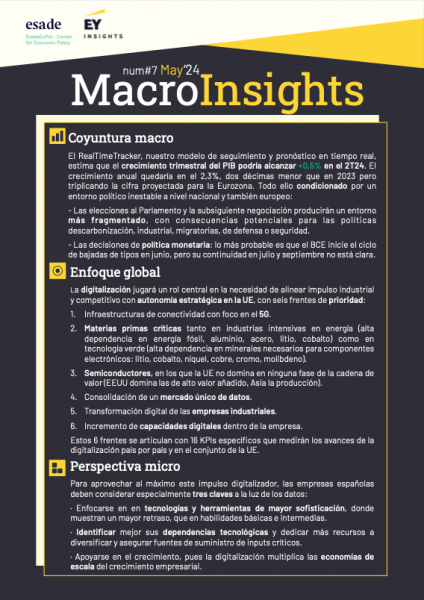
The RealTimeTracker, our real-time monitoring and forecasting model, estimates that quarterly GDP growth could reach +0.5% in Q2 2024. Annual growth would stand at 2.3%, two tenths lower than in 2023 but triple the figure projected for the Eurozone. All of this is conditioned by an unstable political environment both nationally and at European level:
– The European Parliament elections and the subsequent negotiations will produce a more fragmented environment, with potential consequences for decarbonisation, industrial, migration, defence or security policies.
– Monetary policy decisions: the ECB is most likely to start its rate-cutting cycle in June, but whether it will continue in July and September is unclear.
Global focus
Digitalisation will play a central role in the need to align industrial and competitive momentum with strategic autonomy in the EU, with six priority fronts:
- Connectivity infrastructure with a focus on 5G.
- Critical raw materials both in energy-intensive industries (high dependence on fossil energy, aluminium, steel, lithium, cobalt) and in green technology (high dependence on minerals needed for electronic components: lithium, cobalt, nickel, copper, chromium, molybdenum).
- Semiconductors, where the EU does not lead in any stage of the value chain (the US dominates the high value-added stages, Asia dominates production).
- Consolidation of a single data market.
- Digital transformation of industrial companies.
- Increasing digital skills within companies.
These 6 fronts are structured around 16 specific KPIs that will measure progress in digitalisation country by country and across the EU as a whole.
Micro perspective
To make the most of this digitalisation drive, Spanish companies should especially consider three keys in light of the data:
· Focus on more sophisticated technologies and tools, where they lag furthest behind, rather than on basic and intermediate skills.
· Better identify their technological dependencies and devote more resources to diversifying and securing supply sources of critical inputs.
· Leverage growth, since digitalisation multiplies the economies of scale of business growth.

Economista especializado en finanzas sostenibles, regulación ESG y análisis regulatorio. Actualmente, director de control interno ESG en Banco Sabadell. Ha trabajado en el Banco de España, en Solchaga Recio & Asociados y Metyis.
View profile



Project Manager & Content Curator, EsadeEcPol. Licenciada en Economía y Derecho por la UC3M, Master en Administración Pública por la London School of Economics.
View profileRelated content
2 Jul, 2026