MacroInsights #05
Fernando Gutiérrez del Arroyo González, Juan Pablo Riesgo, Manuel Hidalgo Pérez, Ignacio García López, Teresa Raigada, Jorge Galindo
25 Jan, 2024
Macro outlook, global focus and micro perspective for January 2024.
Macro outlook
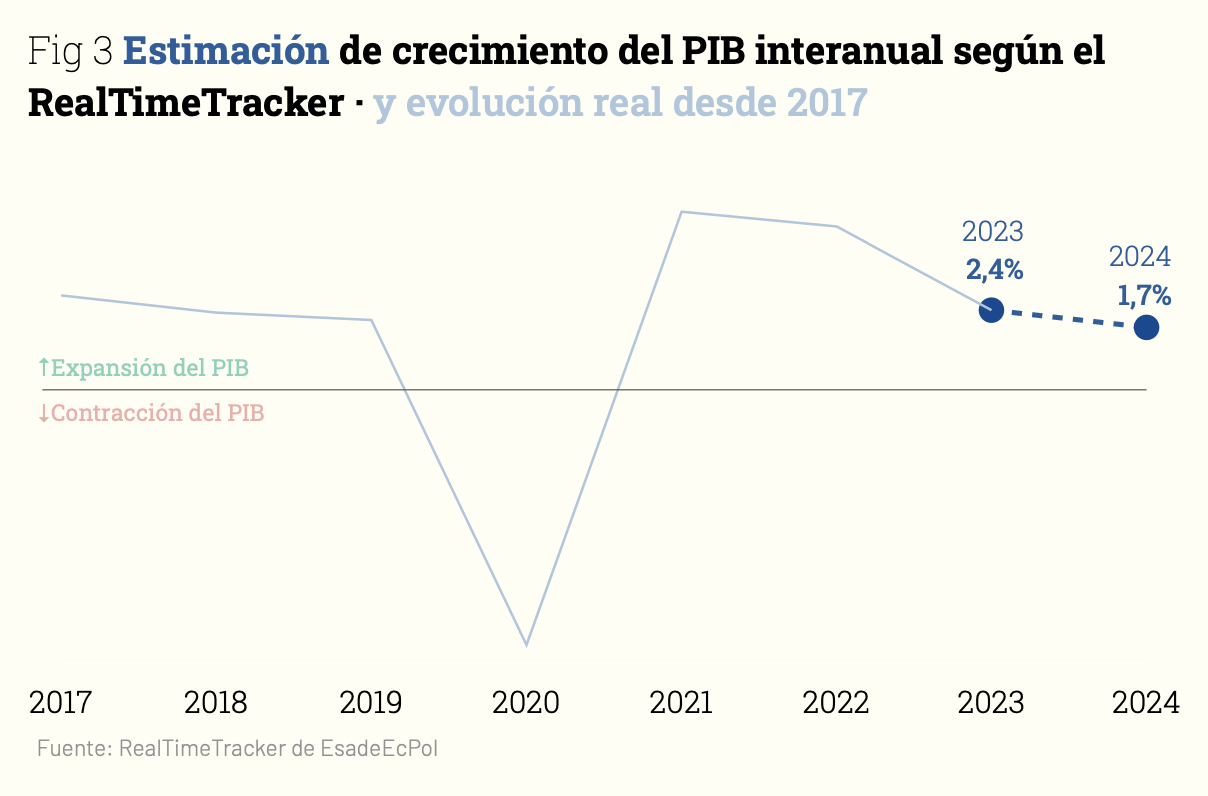
The RealTimeTracker, our real-time monitoring and forecasting model, estimates that Spanish GDP will close Q4 2023 with growth of +0.5%. We therefore estimate that 2023 would have ended with growth of +2.4%. On a preliminary basis, for Q1 2024 we anticipate growth similar to that of the last quarter.
The annual forecast points to growth of +1.7% for 2024, although the year begins with new risks that add extra uncertainty, especially geopolitical instability with a particular impact on international trade.
Global focus
Despite short-term uncertainty, the transition towards a net-zero economy, set out in corporate transition plans, remains a growing challenge to be tackled. To this end, the EU has just approved its CS3D Directive, which initially requires such plans for companies with >500 employees and turnover >€150M; covering the entire value chain except financial services, with five-yearly targets coinciding with the EU’s emissions goals for 2030 and 2050; including incentives in the form of variable remuneration for directors in companies with >1,000 employees; and with penalties for infringements of up to 5% of global net turnover.
The specific content is not yet standardised, but it is expected to require (1) a forward-looking pathway, (2) a broad scope, (3) consistent measures and (4) solid governance. It will be fleshed out (subject to the electoral cycle, with the European elections in June and the subsequent formation of a new Commission) in the development of the Directives focused on reporting and due diligence, or in the anti-greenwashing rules under negotiation, with a horizon of the second half of this year or 2025.
Micro perspective
Specifically regarding transition plans, and pending the regulatory uncertainty conditioned by the electoral cycle, drawing up a transition plan focused on aligning the company’s investments with the new green Taxonomy, which sets thresholds for classifying activities as sustainable, would make it possible to access financing through green loans or bonds, facilitating the convergence of interests between financial and non-financial companies.
Taking a broader view, in light of our analysis, both progress on decarbonisation and business decisions as a whole will necessarily have to incorporate:
- A review of trade routes and modes of transport, especially for those productive areas in which the availability of the goods needed to decarbonise supply chains is affected by emerging bottlenecks in shipping routes.
- Uncertainty about the room for financing investment (in the transition or in any other area), which depends on the monetary policy path and market expectations in this regard, which currently point to the rate-cutting cycle starting in the second half of the year.

Economista especializado en finanzas sostenibles, regulación ESG y análisis regulatorio. Actualmente, director de control interno ESG en Banco Sabadell. Ha trabajado en el Banco de España, en Solchaga Recio & Asociados y Metyis.
View profile



Project Manager & Content Curator, EsadeEcPol. Licenciada en Economía y Derecho por la UC3M, Master en Administración Pública por la London School of Economics.
View profile
Related content
2 Jul, 2026