The effects of the VAT increase on sugar-sweetened beverage consumption in Spain
Ángel Martínez Jorge, Javier Martínez Santos, Jorge Galindo
29 Nov, 2022
This policy brief is a summary of the academic working paper by Ángel Martínez Jorge and Javier Martínez Santos, which you can find here.
Sugar taxes have become the benchmark measure to discourage the consumption of a product considered to be strongly associated with obesity, especially childhood obesity. In 2021 Spain raised VAT from 10% to 21% on sugar-sweetened and artificially sweetened beverages, and surprisingly its effect has not been measured to date.
We present here the first methodologically rigorous evaluation of its impact: we use households in the three regions not subject to VAT (the Canary Islands, Ceuta and Melilla) as a control group and compare the purchasing habits recorded in the Household Budget Survey of families living in these areas and in the rest of Spain, where the VAT increase on sugar-sweetened and artificially sweetened beverages did take place.
→ More than 90% of this VAT increase was passed on to the final price. This corresponded to an average increase of approximately 12 cents per litre (+9.6% on the average price per litre).
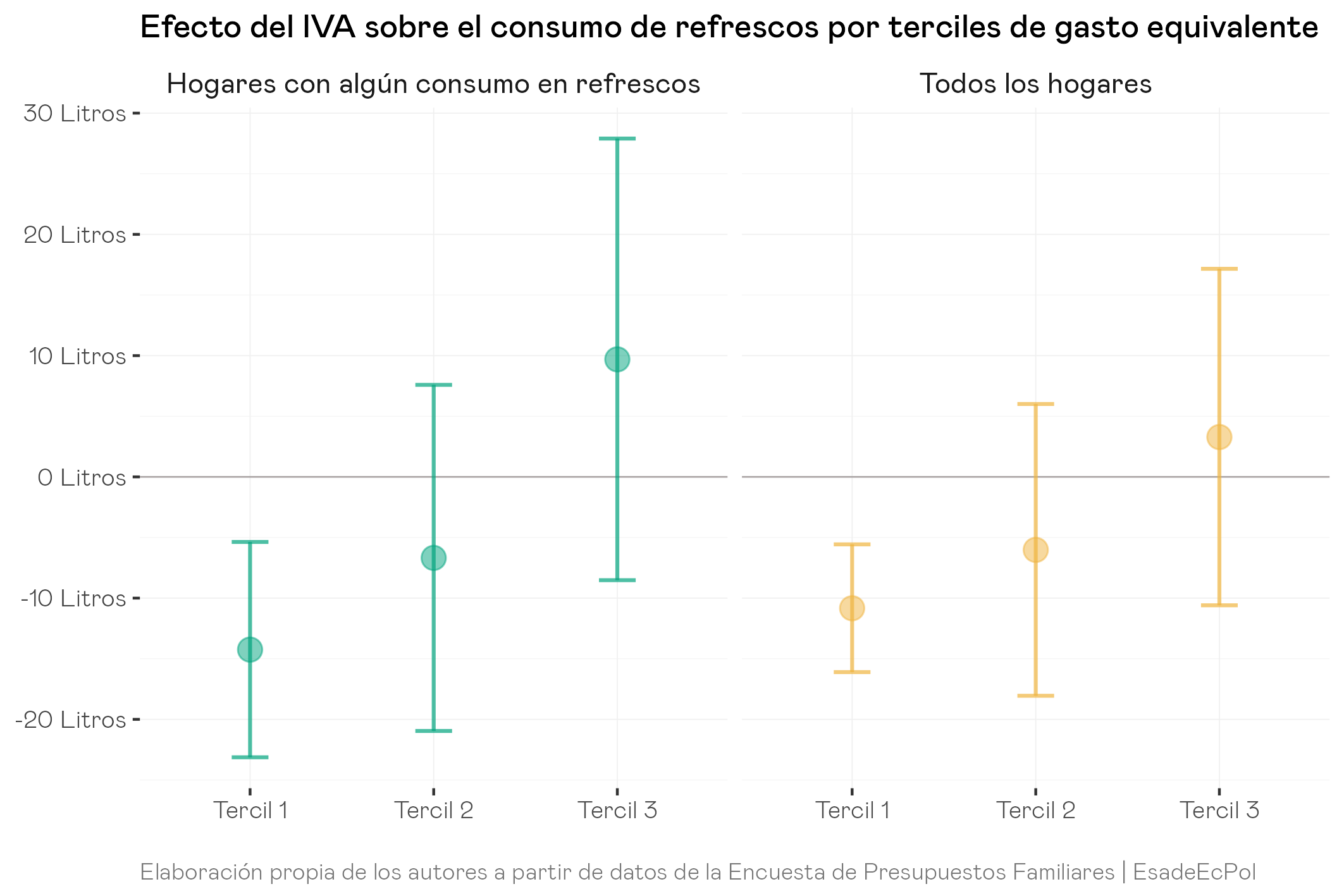
→ The effect of this price rise on the quantity of soft drinks consumed was concentrated in households with the lowest economic level: for the 33% of households with the lowest equivalent spending, the average decrease was 10.8 litres per year, equivalent to a 13% drop in consumption. However, for the rest of households the effect of the tax was not statistically significant.
→ This effect is four times larger for households with the lowest equivalent spending with children aged 5 to 16: for them, the estimated drop reaches 25 litres less per year. Among households with children the drop would be 20%, while for poor households without children it would be approximately 7%.
→ Among households with the lowest economic level, consumption of snacks, which we consider a complementary good to sugar-sweetened beverages, showed a decrease in spending of €5 per household per year, a 10.5% drop.
→ The relevance of this evidence for public policy lies in the fact that it specifically informs and delimits the effects on consumption and prices (although not directly on health) of the most important policy developed in the last decade regarding sugar consumption in Spain.


Economista enfocado en el análisis y la visualización de datos. Grado en Administración de Empresas y Economía Laboral por la Universidad de A Coruña y Master en Economía por la Universidad de Santiago.
View profile
Related content