How has the fuel discount affected prices at service stations?
Manuel Hidalgo Pérez, Ángel Martínez Jorge, Natalia Collado Van-Baumberghen
7 Jul, 2022
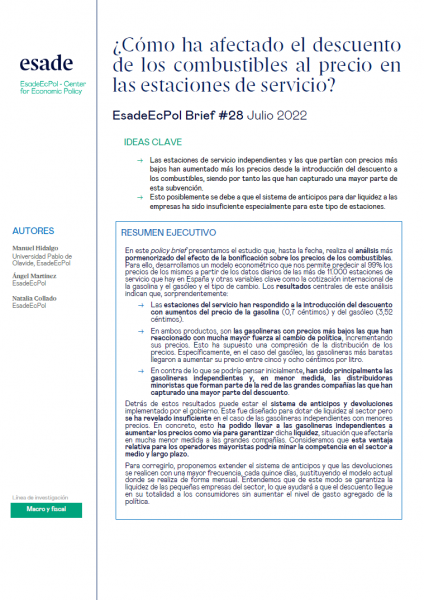
In this policy brief we present the study that, to date, offers the most detailed analysis of the effect of the discount on fuel prices. To do so, we develop an econometric model that allows us to predict fuel prices with 99% accuracy using daily data from the more than 11,000 service stations in Spain and other key variables such as international petrol and diesel prices and the exchange rate. The main results of this analysis indicate that, surprisingly:
→ Service stations responded to the introduction of the discount by raising the price of petrol (0.7 cents) and diesel (3.52 cents).
→ For both products, it was the service stations with the lowest prices that reacted much more strongly to the policy change, raising their prices. This has compressed the price distribution. Specifically, in the case of diesel, the cheapest service stations raised their price by between five and eight cents per litre.
→ Contrary to what might initially be thought, it has mainly been independent service stations and, to a lesser extent, retail distributors that are part of the large companies’ networks that have captured a larger share of the discount.
Behind these results may be the system of advance payments and refunds implemented by the government. It was designed to provide liquidity to the sector but has proved insufficient in the case of independent service stations with lower prices. Specifically, this may have led independent service stations to raise prices as a way to secure that liquidity, a situation that would affect large companies to a much lesser extent. We believe that this relative advantage for wholesale operators could undermine competition in the sector in the medium and long term.
To correct this, we propose extending the advance payment system and making refunds more frequent, every fortnight, replacing the current monthly model. We believe this would guarantee the liquidity of small companies in the sector, helping the discount to reach consumers in full without increasing the aggregate cost of the policy.



Research Economist en EsadeEcPol. Máster en Economía Industrial y Mercados regulados por la Universidad Carlos III de Madrid
View profile