Assessing the distributional implications of the National Fund for the Sustainability of the Electricity System
Pedro Linares Llamas, Marta Suárez-Varela, José Carlos Romero Mora
24 Sep, 2021
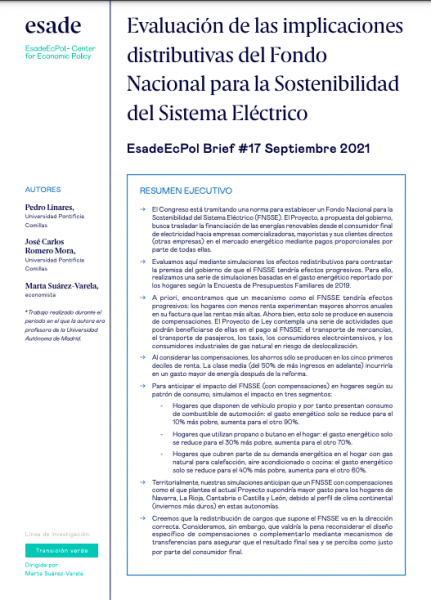
→ Parliament is processing a law to establish a National Fund for the Sustainability of the Electricity System (FNSSE). The bill, proposed by the government, seeks to shift the financing of renewable energy from the final electricity consumer to retailers, wholesalers and their direct customers (other companies) in the energy market through proportional payments by all of them.
→ Here we use simulations to assess the redistributive effects in order to test the government’s premise that the FNSSE would have progressive effects. To do so, we carry out a series of simulations based on the energy spending reported by households in the 2019 Household Budget Survey.
→ A priori, we find that a mechanism such as the FNSSE would have progressive effects: households with lower incomes see larger annual savings on their bills than higher-income households. However, this only happens in the absence of compensation. The bill provides for a series of activities that may benefit from compensation in their payments to the FNSSE: freight transport, passenger transport, taxis, electro-intensive consumers, and industrial consumers of natural gas at risk of relocation.
→ When compensation is taken into account, savings only occur in the first five income deciles. The middle class (from the top 50% of earners upwards) would face higher energy spending after the reform.
→ To anticipate the impact of the FNSSE (with compensation) on households according to their consumption patterns, we simulate the impact on three segments:
- Households that own a vehicle and therefore consume motor fuel: energy spending only falls for the poorest 10%, and rises for the other 90%.
- Households that use propane or butane at home: energy spending only falls for the poorest 30%, and rises for the other 70%.
- Households that meet part of their home energy demand with natural gas for heating, air conditioning or cooking: energy spending only falls for the poorest 40%, and rises for the other 60%.
→ Territorially, our simulations anticipate that an FNSSE with compensation such as the one proposed in the current bill would mean higher spending for households in Navarre, La Rioja, Cantabria or Castile and León, due to the continental climate profile (harsher winters) in these regions.
→ We believe that the redistribution of charges involved in the FNSSE goes in the right direction. However, we consider that it would be worth reconsidering the specific design of the compensation or complementing it with transfer mechanisms to ensure that the final outcome is, and is perceived as, fair by the final consumer.

Profesor en la Universidad Pontificia Comillas


Related content