European Sustainability Reporting Standards (ESRS): the new ESG disclosure requirements for European companies
Fernando Gutiérrez del Arroyo González
31 Aug, 2023
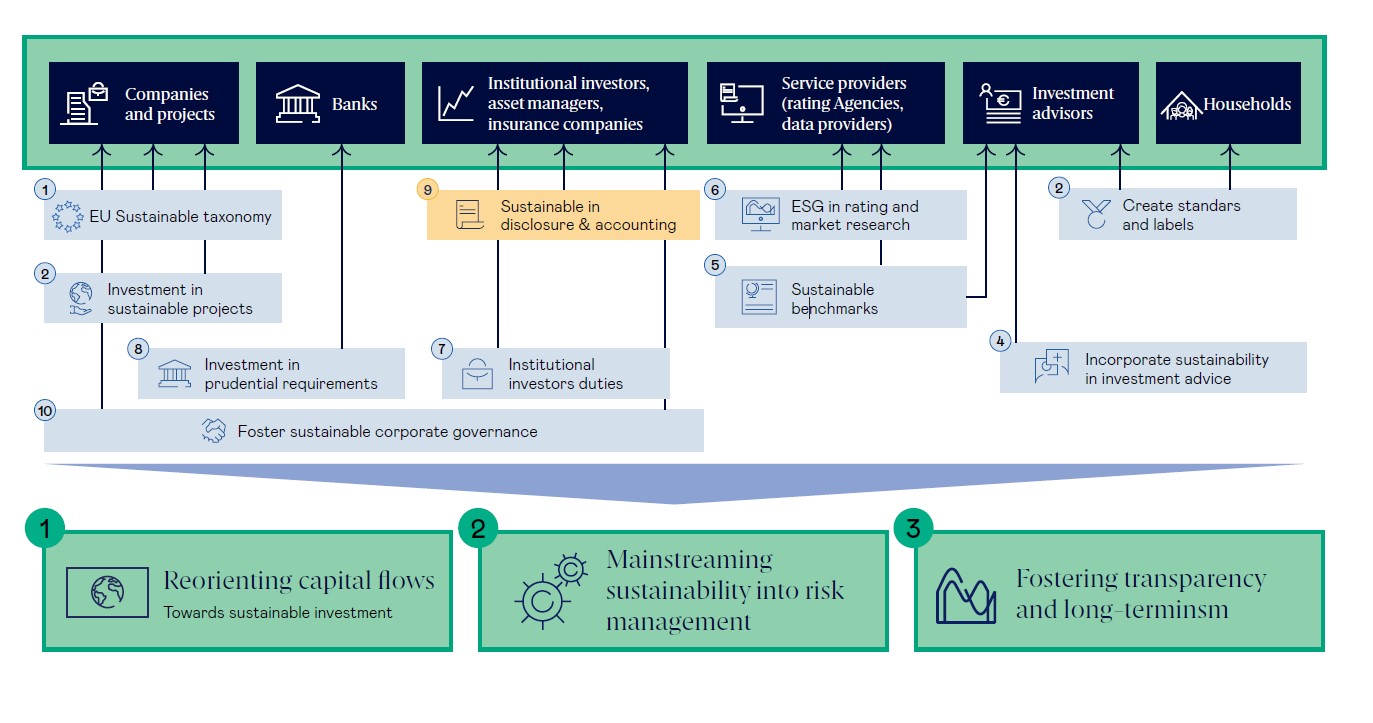
Disclosure of sustainability or ESG information is a prerequisite and a central element for the development of sustainable finance and the reorientation of the economic model towards sustainability. Without it, investors cannot distinguish between companies with more resilient and sustainable business models, or channel sufficient funds towards them.
The regulations that governed this disclosure in the EU (the NFRD and its transposition in Spain, Law 11/2018) have not achieved these objectives, since the information published annually
by companies is inadequate and insufficient in quantity, quality or comparability.
This led to the entry into force in early 2023 of a more ambitious and demanding standard: the Corporate Sustainability Reporting Directive (CSRD). In this brief we analyse this new regulation, and the accompanying European Sustainability Reporting Standards (ESRS), which will affect more organisations than the NFRD, as it includes medium-sized companies, listed companies (except micro-enterprises) and consolidated groups outside the EU with an annual turnover of more than 150 million euros, which amounts to more than 50,000 companies generating more than half of the value added of the EU economy. Its main objective is to improve companies’ disclosure of sustainability information through:
→ An increase in the amount of information provided. Organisations will have to share a wider range of ESG-related elements, which may affect companies not in principle subject to the CSRD but which are part of the reporting company’s value chain.
→ An improvement in the quality of information, through the establishment of clearer indicators and metrics so that the information can be backed up by supporting data.
→ An increase in the credibility of information through greater due diligence and the requirement of external assurance.
→ The promotion of consistency of information. The ESRS have been designed to be the same across the EU, with no possibility for countries to modify, expand or reduce them when implementing the CSRD.
→ Greater comparability of information, with the same order and thematic content for all organisations. In addition, rules are established to improve its connection with the financial accounts, and unified digital disclosure will be required through a centralised repository of accounts (European Single Access Point).
However, in adopting them, organisations will take on higher costs, controls and internal bureaucracy and will need to pay particular attention to the challenges arising from the standard.
First, they will have to plan how to report the required information in compliance with timing and format requirements, and decide whether to continue using other voluntary standards in addition to the mandatory ones. To do so, they will need to develop new capabilities in order to manage the new requirements.
Another important aspect will be to clearly establish the materiality assessment method, that is, to identify the positive and negative ESG impacts that the organisation generates and also the risks and opportunities in this area to which it is exposed. This is particularly relevant given that the regulation establishes what has to be identified, but not how to do it.
The CSRD will also require strategic adjustments to organisations’ business model and governance in order to integrate the impacts, risks and opportunities identified in their ESG reports, including the measures needed to generate positive effects and to prevent and correct negative ones.
Furthermore, with the new standards, organisations are expected to increase their level of oversight of the companies they contract with, customers and affected communities throughout their entire value chain, thereby including information on organisations that are not directly subject to the CSRD.
Finally, throughout the process it will be necessary to involve the different stakeholders and improve transparency with society and the market, making the work of supervisors easier.

Economista especializado en finanzas sostenibles, regulación ESG y análisis regulatorio. Actualmente, director de control interno ESG en Banco Sabadell. Ha trabajado en el Banco de España, en Solchaga Recio & Asociados y Metyis.
View profile