How to tackle energy poverty in Spain
Elisenda Jové Llopis, Elisa Trujillo Baute, María Teresa Costa Campi
12 Nov, 2021
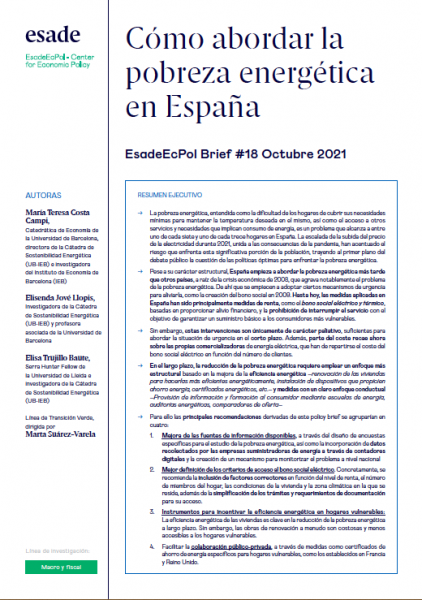
→ Energy poverty, understood as households’ difficulty in meeting their minimum needs to keep their homes at the desired temperature, as well as in accessing other services and needs that involve energy consumption, is a problem that affects between one in seven and one in thirteen households in Spain. The escalating rise in electricity prices during 2021, together with the consequences of the pandemic, have heightened the risk faced by this significant share of the population, bringing the question of the best policies to tackle energy poverty to the forefront of public debate.
→ Despite its structural nature, Spain began to address energy poverty later than other countries, following the 2008 economic crisis, which significantly worsened the problem of energy poverty. As a result, certain emergency mechanisms began to be adopted to alleviate it, such as the creation of the social bonus in 2009. To date, the measures applied in Spain have mainly been income measures, such as the electricity and heating social bonuses, based on providing financial relief, and the ban on disconnecting supply with the aim of guaranteeing a basic supply to the most vulnerable consumers.
→ However, these interventions are merely palliative, sufficient to address the emergency situation in the short term. In addition, part of the cost now falls on the electricity retailers themselves, which have to share the cost of the electricity social bonus according to their number of customers.
→ In the long term, reducing energy poverty requires a more structural approach based on improving energy efficiency –renovating homes to make them more energy efficient, installing energy-saving devices, energy certificates, etc.– and measures with a clear behavioural focus –providing information and training to consumers through energy schools, energy audits and offer comparison tools–
→ To this end, the main recommendations of this policy brief can be grouped into four:
1. Improving the available sources of information, by designing specific surveys to study energy poverty, incorporating data collected by energy suppliers through smart meters and creating a mechanism to monitor the problem nationwide.
2. Better definition of the eligibility criteria for the electricity social bonus. Specifically, we recommend including correction factors based on income level, the number of household members, housing conditions and the climate zone of residence, as well as simplifying the procedures and documentation required to access it.
3. Instruments to encourage energy efficiency in vulnerable households: the energy efficiency of homes is key to reducing energy poverty in the long term. However, renovation works are often expensive and less accessible to vulnerable households.
4. Facilitating public-private partnerships, through measures such as energy saving certificates specifically for vulnerable households, like those established in France and the United Kingdom.

Investigadora de la Cátedra de Sostenibilidad Energética (UB-IEB) y profesora asociada de la Universidad de Barcelona
View profile
Serra Hunter Fellow de la Universidad de Lleida e investigadora de la Cátedra de Sostenibilidad Energética (UB-IEB)
View profile
Catedrática de Economía de la Universidad de Barcelona, directora de la Cátedra de Sostenibilidad Energética (UB-IEB) e investigadora del Instituto de Economía de Barcelona (IEB)
View profileRelated content

24 Mar, 2026