A snapshot of grants from the European Recovery and Resilience Facility funds in Spain
Manuel Hidalgo Pérez
12 Dec, 2022
Based on data collected in real time by a scraping bot that stores, processes and analyses the results of all calls for grants linked to the European Recovery and Resilience Facility funds, the EsadeEcPol and EY Insights Next Generation EU Funds Observatory has identified the following key features that currently characterise both the calls and the grants already awarded:
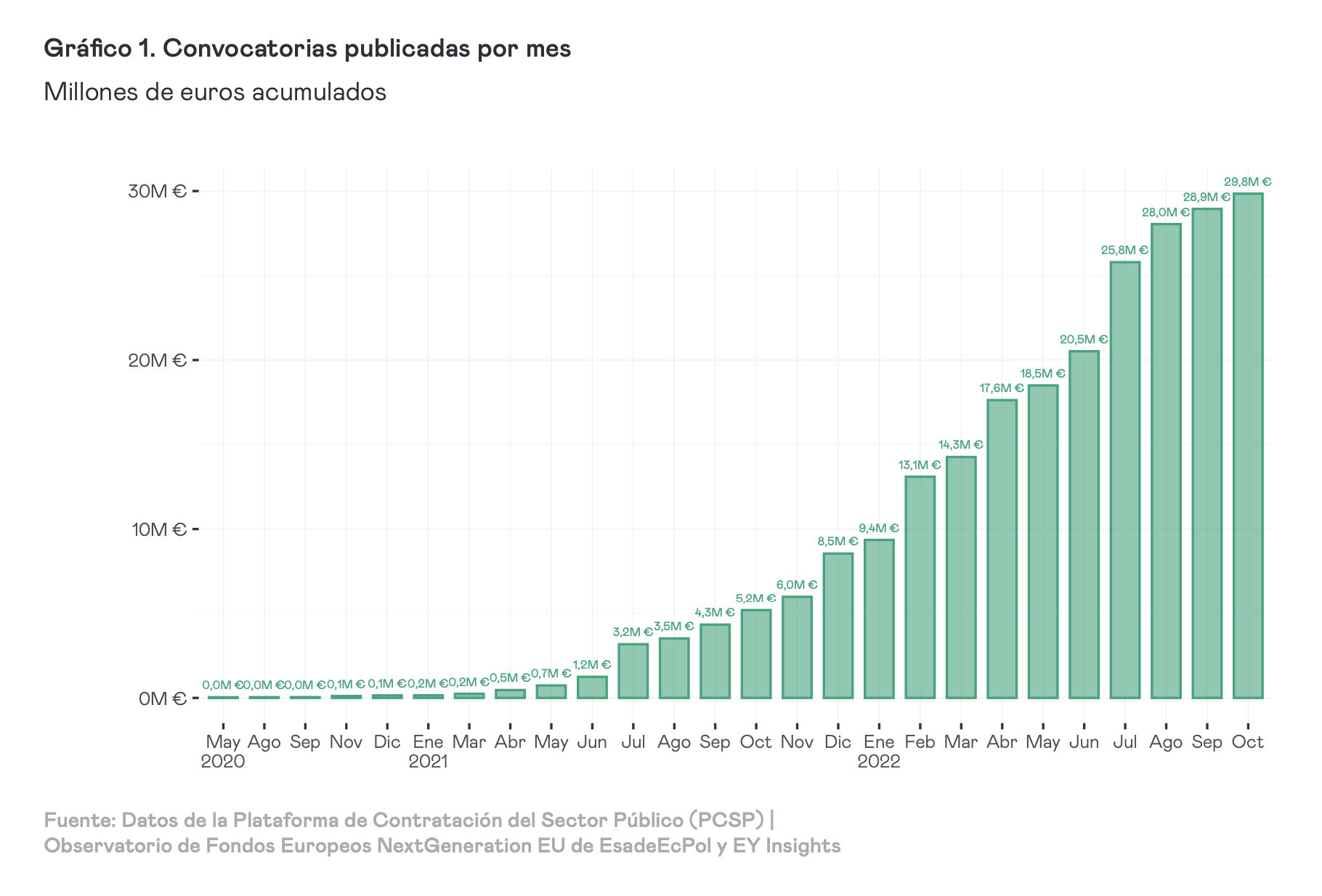
As of 15 November, €28.5 billion had been called in grants, showing a more dynamic pace than public tenders, especially during the first six months of 2022. At the same date, €9.3 billion in grants had already been awarded.
The General State Administration accounts for 80.2% of the amounts called, especially the Ministry of Industry, Trade and Tourism, with almost €7.13 billion, the Ministry for the Ecological Transition and the Demographic Challenge, with some €4.2 billion, and the Ministry of Economic Affairs and Digital Transformation, with just over €3.5 billion. Energy transition, digitalisation, employment promotion and the improvement of the productive fabric therefore emerge as the most prominent areas so far.
After the central administration, the Catalan Generalitat (€1.1 billion) and the Andalusian Regional Government (€713 million), together with the Valencian Community (€654 million), are the public bodies with the highest value of calls, excluding the State.
→ The Energy Foundation of the Community of Madrid has called 25% of the aggregate amount within this region, and the Catalan Energy Institute 20% in its own, underlining the focus on energy efforts given the current context.
*In any case, aggregate territorial dispersion is, a priori, high, given that a large share of the calls made have the whole of Spain as their area of impact.
SMEs and individuals are the recipients of approximately one third of grant calls (around €10 billion). Large companies, 11% (€3.3 billion). Most, however, have not yet been directed to the productive fabric, given that a large share of the calls are set up as vehicles for transferring funds between administrations themselves. Thus, just over a third of them, some €10.6 billion, are resources mobilised between the different administrations, in particular from the General State Administration (AGE) to the regions and local authorities.
As for the purpose of the total amount made available in the various calls, the central administration devotes a large share of its calls (€6.8 billion) to Industry and Energy, followed by Research and Development (€4.7 billion) and, in third place, Trade, Tourism and SMEs (€3.4 billion). The regions and local authorities allocate their funding mainly to employment promotion (€971 million) and industry and energy (€846 million). Finally, universities devote a large share of their calls to research, development and innovation.
→ The specific activities targeted are diverse, but consistent with the above. The main AGE call, linked to the Electric Vehicle PERTE, totals €2,950M. In second place are professional, scientific and technical activities, with €2.04 billion, and in third place various guarantees, with €1.9 billion.
Of the total called, some €9.3 billion had been awarded as of 15 November. These awards have gone to a multitude of public and private entities, as well as individuals. It should be noted that public entities linked to the administrations have taken €5 billion, or €5.8 billion if universities are included. Of the rest, the €1.1 billion awarded to limited companies (S.L.) stands out.
As for the purpose of the grants already awarded, just over one billion has gone to incentives linked to energy storage, another billion to transfers to municipalities for the implementation of low emission zones in Spanish municipalities, and €942 million to the MOVES programmes.
Madrid and Barcelona account for €2.9 billion of the total awarded to date by the central administration. Seville and Valencia add a further €1.1 billion.