Spain’s new regularisation of immigrants: what the evidence tells us
Joan Monras, Javier Vázquez-Grenno
14 April 2026
Key ideas
→ International evidence and the Spanish experience show that regularisations tend to improve the labour market integration of those affected, increase their fiscal contribution, and do not harm the labour market outcomes of native workers.
→ The 2005 regularisation in Spain (which legalised close to 600,000 people) did not generate a “pull effect”, significantly increased formal employment, raising revenue by around €4,000 a year per worker, and did so without a significant increase in public spending on services such as health or education.
→ The measure did not lead to a fall in the wages of native workers, but it did cause some low-skilled workers in the informal economy to lose their jobs, which underlines the importance of accompanying regularisations with labour inspections and programmes for the transition to formal employment.
→ The success of the new regularisation will depend on administrative capacity. Processing hundreds of thousands of applications requires strengthening the immigration offices, improving digital systems and ensuring coordination between administrations.
On 27 January 2026 the Council of Ministers approved the urgent processing of a Royal Decree to launch an extraordinary process to regularise immigrants who currently live and work in Spain with irregular administrative status. The measure will allow these people to obtain a residence and work permit, thereby recognising a social and economic reality that already exists. According to recent Funcas estimates of the total number of people in this situation, the process could affect more than 800,000 people who, in many cases, are already fully integrated into the labour market and the economic life of the country. Given this situation, it is relevant to set out the new evidence on this type of policy in order to anticipate what effects the present measure may have.
International evidence on the regularisation of immigrants suggests that regularisations tend to have favourable effects both for the people affected and for society as a whole. Among others, they tend to improve the socio-economic integration of the immigrants affected, since access to regular administrative status facilitates job mobility, access to formal jobs and greater stability in career paths (Amuedo-Dorantes and Bansak, 2011; Devillanova, Fasani and Frattini, 2018). In addition, by moving from the informal to the formal economy, regularised workers increase their contribution to the public accounts and gain easier access to social protection systems (Cascio and Lewis, 2019; Bahar et al., 2021). Thirdly, there is also evidence of effects in other areas, such as reducing the probability of committing crimes (Pinotti, 2017; Baker, 2015), and of generally small or non-existent effects on the labour market outcomes of workers in the formal market (Bahar et al., 2021).
Despite this evidence, and as happens every time a regularisation is proposed, the measure has generated intense public debate. Critics usually raise several concerns: that the policy will generate a “pull effect”, that it will reduce the wages or employment of native workers, or that it will increase pressure on the public finances and social services. These questions, although legitimate and proper to any reasonable discussion of migration policy, find no support in the empirical evidence, especially given how these programmes were implemented in past experiences. In the Spanish case we are not starting from scratch: there are previous experiences and solid empirical evidence that make it possible to assess the potential effects of the recently proposed policy with greater precision.
The lessons of the 2005 regularisation
Spain has resorted on several occasions to extraordinary regularisations as an instrument of migration policy. The most significant took place in 2005 during the first government of José Luis Rodríguez Zapatero, when close to 600,000 immigrants obtained residence and work permits. At the time the political debate was intense and was accompanied by warnings about possible negative effects on the economy in general and the labour market in particular.
Two decades later, economic research makes it possible to analyse the effects of that policy with greater perspective. In a recent study in which we took part, published in the Journal of Labor Economics, Elias et al. (2025) analyse the consequences of the 2005 regularisation using different data sources and comparing territories and groups with different degrees of exposure to the measure. Although the current context is not identical, among other things because the 2005 regularisation required applicants to have an employment contract when applying for regularisation, the results offer a valuable guide to understanding what can be expected.
One of the most frequent arguments against regularisations is the supposed “pull effect”. According to this idea, the possibility of obtaining regular status could encourage the arrival of new immigrants with irregular status. However, the empirical evidence for the Spanish case shows that this is not necessarily what happens. Analysing the evolution of migration flows before and after the regularisation, and comparing the countries whose citizens benefited from the policy with other countries that were not affected, the study finds no significant increase in immigration associated with the measure. In other words, migration flows continued to respond mainly to economic factors such as labour demand and the economic situation of the countries of origin and destination. Part of this may be due to the fact that, in the Spanish case, the regularisation was accompanied by an increase in labour inspections and by more resources for border control.
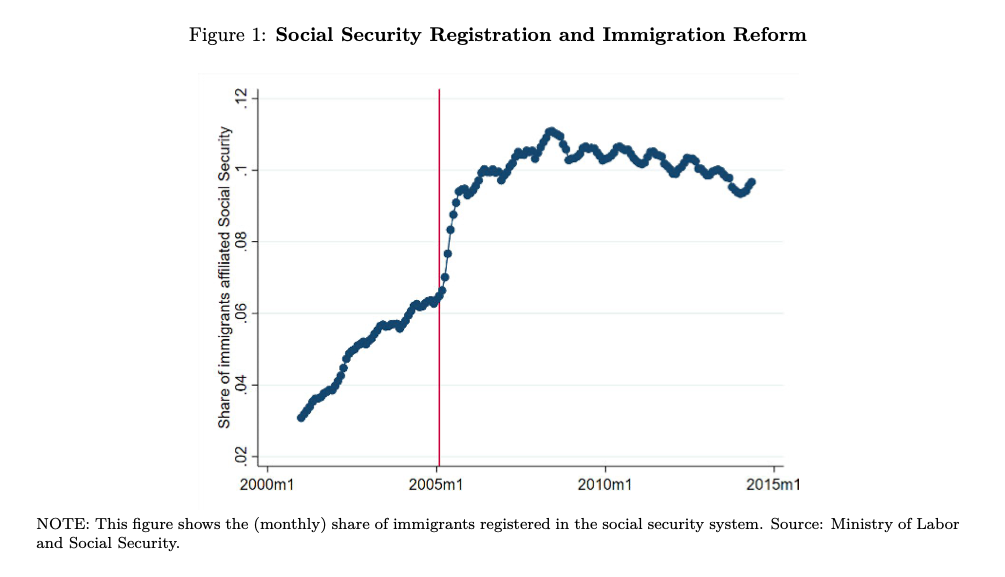
A second relevant result is that the regularisation significantly increased formal employment. Many immigrants who had previously worked in the informal economy went on to do so with legal contracts and began to pay Social Security contributions. This transition to formality had several positive consequences: it improved workers’ job stability, facilitated their mobility between sectors and regions and allowed a better match between workers and firms. Although over time some workers returned to informality, the process helped to reduce the segmentation of the labour market.
Furthermore, and contrary to another of the most widespread arguments in the public debate, the regularisation did not lead to a fall in the wages of native workers. In fact, the study finds that the formal wages of Spanish workers rose slightly, especially among those with a higher level of education. One explanation is that the regularisation reduced the ability of some firms to benefit from the vulnerability of undocumented workers, which contributed to a more transparent and competitive labour market.
This does not mean that the policy has no distributional effects. The evidence suggests that some specific groups may be affected by changes in the structure of the labour market. In particular, certain low-skilled workers who had previously worked in informal conditions may have experienced job losses as a result of the increase in controls and the transition to formality. This highlights the importance of accompanying regularisations with complementary policies, such as effective labour inspections and programmes that facilitate the transition to formal employment.
The fiscal impact of the regularisation was also positive. Each regularised immigrant began to contribute to the public purse through social contributions and income taxes. On average, the study estimates that each regularised worker generated around 4,000 euros a year in Social Security contributions, in addition to further, though smaller, revenue from other taxes (IRPF). At the same time, no significant increase was observed in public spending on services such as health or education, largely because these people already had access to many of these services before the regularisation.
The importance of implementation
These results are particularly relevant in the current context. Spain, like many other European economies, faces a rapid process of demographic ageing and growing difficulties in filling certain jobs. Sectors such as agriculture, construction, hospitality, transport and long-term care depend to a large extent on the work of immigrants. In many cases, a large share of these workers are already in the country carrying out these activities, although without a clear legal status.
For this reason, various business associations in sectors with labour shortages have expressed their support for the reform, regarding it as a pragmatic response to the needs of the labour market. Regularisation can help to reduce staff turnover, increase workforce stability and lessen legal uncertainty for both workers and firms.
However, the success of the measure will not depend solely on its economic foundations. Administrative implementation will be a key element. Processing potentially hundreds of thousands of applications requires strengthening the resources of the immigration offices, improving digital systems and ensuring effective coordination between administrations. If procedures are delayed or become excessively complex, the process could lose effectiveness and generate uncertainty for both applicants and employers.
In addition, the regularisation should be accompanied by a broader strategy to combat the informal economy. Experience shows that these policies work better when they are combined with labour inspections and with clear incentives for firms to formalise employment relationships.
In short, the available evidence suggests that regularisations, when properly designed and implemented, can have positive economic effects both for the people affected and for the economy as a whole. It is not a magic solution to all the challenges of migration policy, but it is an instrument that can improve the functioning of the labour market, increase public revenue and reduce the vulnerability of hundreds of thousands of people who are already part of our economy.
The new regularisation approved by the Government once again places this issue at the centre of the public debate. In the light of the accumulated evidence, the overall balance is reasonably favourable. Legally recognising those who already live and work in Spain is not only a matter of justice and dignity, but also an economically sensible decision.
——-
References
Amuedo-Dorantes, C., & Bansak, C. (2011). The impact of amnesty on labor market outcomes: A panel study using the Legalized Population Survey. Industrial Relations: A Journal of Economy and Society, 50(3), 443–471.
Baker, S. R. (2015). Effects of immigrant legalization on crime. American Economic Review, 105(5), 210–213. https://doi.org/10.1257/aer.p20151041
Bahar, D., Ibáñez, A. M., & Rozo, S. V. (2021). Give me your tired and your poor: Impact of a large-scale amnesty program for undocumented refugees. Journal of Development Economics, 151, 102652. https://doi.org/10.1016/j.jdeveco.2021.102652
Cascio, E. U., & Lewis, E. G. (2019). Distributing the Green (Cards): Permanent residency and personal income taxes after the Immigration Reform and Control Act of 1986. Journal of Public Economics, 172, 135–150. https://doi.org/10.1016/j.jpubeco.2018.11.005
Devillanova, C., Fasani, F., & Frattini, T. (2018). Employment of undocumented immigrants and the prospect of legal status: Evidence from an amnesty program. ILR Review, 71(4), 853–881. https://doi.org/10.1177/0019793917743246
Elias, F., Monras, J., & Vázquez-Grenno, J. (2025). Understanding the effects of granting work permits to undocumented immigrants. Journal of Labor Economics, 43(3), 763–802. https://doi.org/10.1086/730122
Pinotti, P. (2017). Clicking on heaven’s door: The effect of immigrant legalization on crime. American Economic Review, 107(1), 138–168. https://doi.org/10.1257/aer.20150355


Professor Agregat, Departament d'Economia, Universitat de Barcelona e IEB
View profileRelated content