Relative poverty among young people in Spain: emancipated vs. living in their parents’ home
Jorge Galindo
10 February 2026
The final results of the ECV 2025, published by the INE on 5 February, confirm a general improvement in poverty indicators in Spain. The relative at-risk-of-poverty rate fell to 19.5%, its lowest level since 2008.
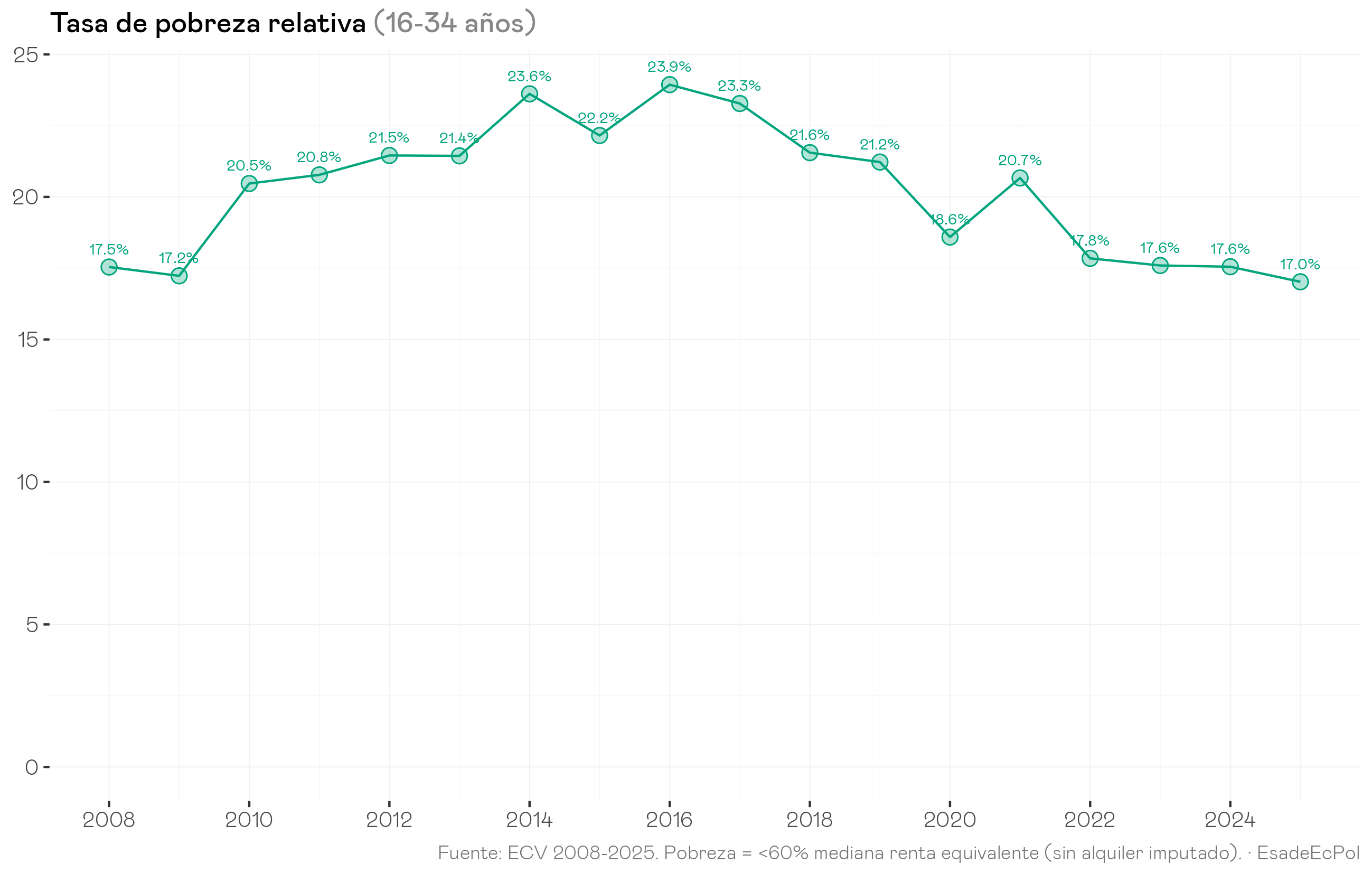
Among the young population (16-34 years) the trend is also downward: from 22.2% in 2015 to 17.0% in 2025, a cumulative fall of just over 5 points in a decade. But the decline is uneven and has yet to consolidate. After a notable drop between 2016 and 2020, the pandemic interrupted the trajectory (a rebound to 20.7% in 2021), and since 2022 the rate has stabilised at around 17-18%, with no clear progress in the last three years.
One dimension that has changed substantially for young people over this period is who they live with. Rising housing costs have made emancipation a decision increasingly conditioned by cost, and this has direct consequences for how poverty is distributed within this age group.
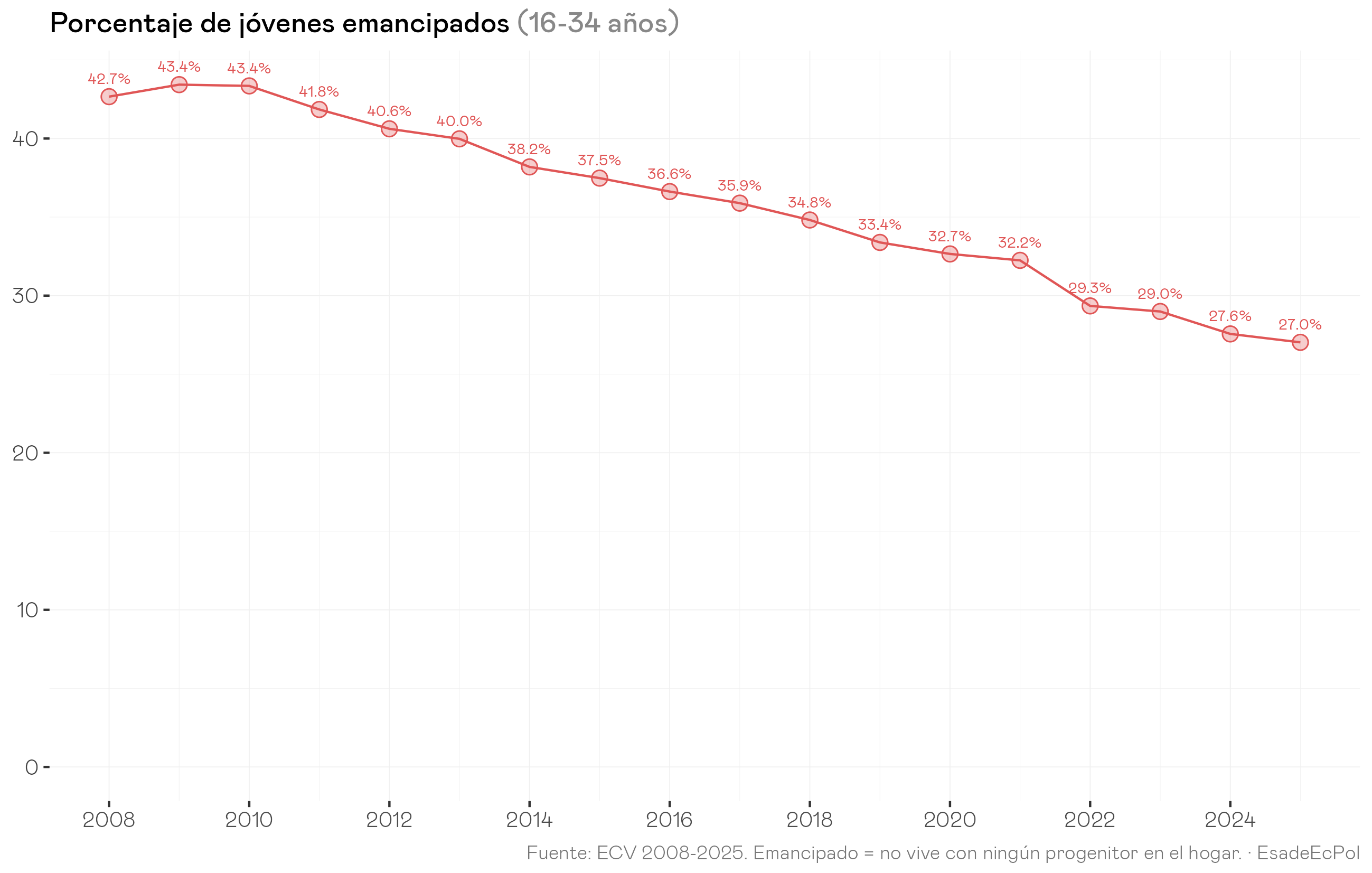
The proportion of emancipated young people – defined as those who do not live with any parent in the household – has fallen from 37.5% in 2015 to 27.0% in 2025. Almost three out of four young people aged 16 to 34 now live with at least one of their parents. What implications does this have for youth poverty? Young people who live with their parents have access to the income of the family household, which by definition raises their equivalised income. That they show lower poverty rates is to be expected. What matters is the size of the gap, its persistence over time and, above all, the fact that one group has improved steadily while the other has not.
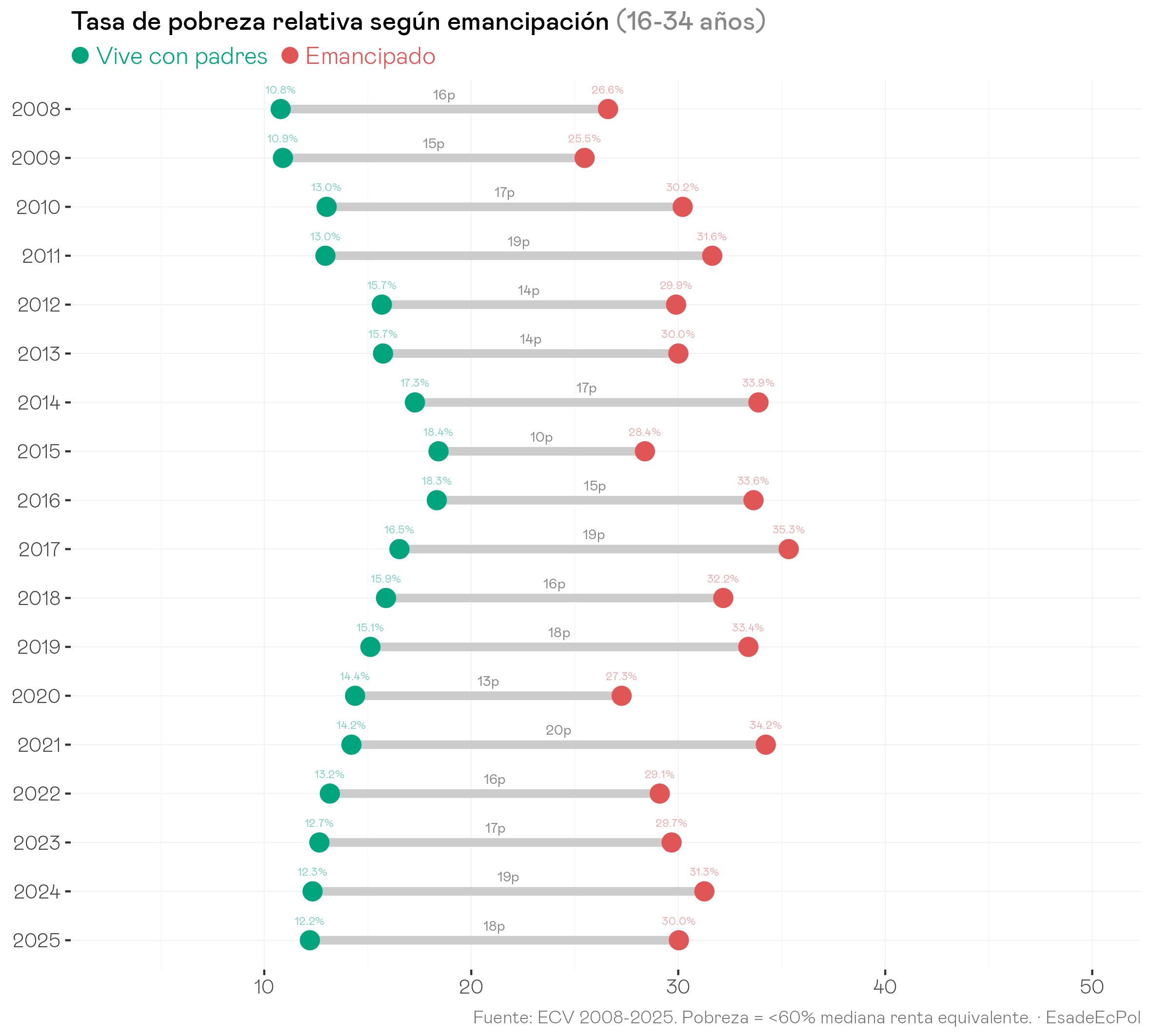
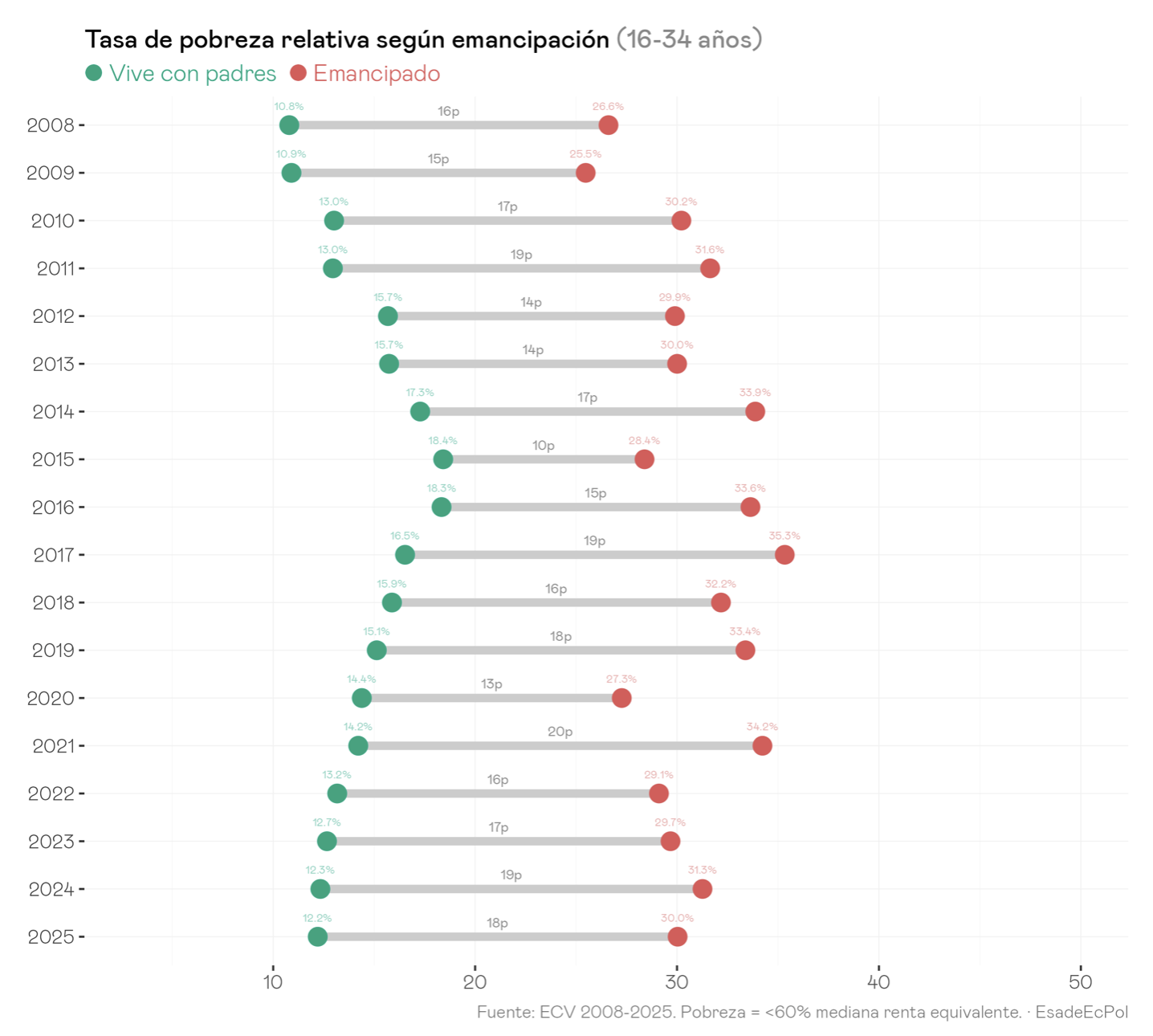
In 2025, the relative poverty rate of emancipated young people stands at 30%. Among those living with their parents, it is 12.2%. This gap is mechanical, but what matters alongside it is that poverty among young people living with their parents has fallen steadily, from 18.4% to 12.2%, 6 points lower, while that of emancipated young people has fluctuated between 28% and 35% with no clear downward trend, with a peak in 2021 (34.2%) that probably reflects the differential impact of the (post-)pandemic. In 2025 it stands below that peak, but at levels similar to those of a decade ago.
A shift-share decomposition makes it possible to break down the reduction in aggregate youth poverty into two components: a composition effect, which captures how much of the change is due to changes in the relative weight of each group (emancipated and non-emancipated), and a rate effect, which reflects how much is due to changes in poverty within each group. The results indicate that approximately two thirds of the reduction is explained by the fall in poverty among those living with their parents, whose rate has gone from 18% to 12%. Only a fifth is due to the composition effect: that proportion of emancipated young people which has fallen by 10 points. Since emancipated young people are systematically poorer, their lower statistical weight reduces the average. In fact, as we have seen, the poverty rate of emancipated young people has barely changed and remains at around 30%. In other words: the aggregate improvement in youth poverty does not reflect an improvement in the material conditions of young people who live independently, but rather the combination of parental households with higher income and a generation which, unable to emancipate, remains under the economic umbrella of its families (which is improving).
That said, the decline in emancipation coincides with a rise in educational attainment among young people. The fact that more young people study for longer is in itself positive, especially if it means that those who remain in the family home do so in order to study and that those who emancipate do so increasingly well prepared.
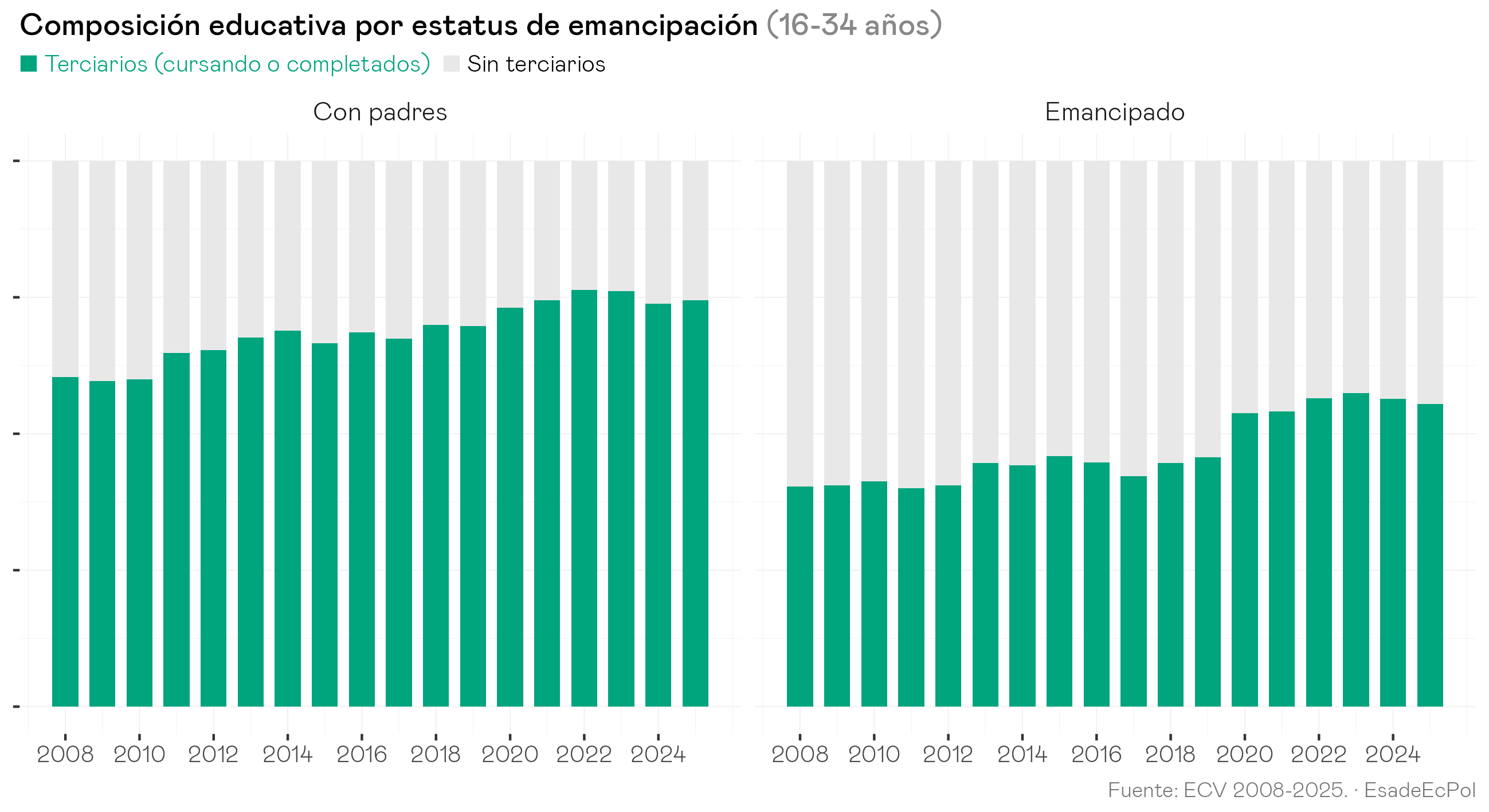
The data on educational composition show that in both groups the proportion of young people with tertiary education (in progress or completed) has grown. Among those living with their parents it has gone from just over half to close to two thirds. Among emancipated young people, the increase has also been notable. Today’s young people are better educated than those of 2015 regardless of their emancipation status. And one question, returning to our central concern, is whether that greater education translates into a lower risk of poverty from the start of adult life.
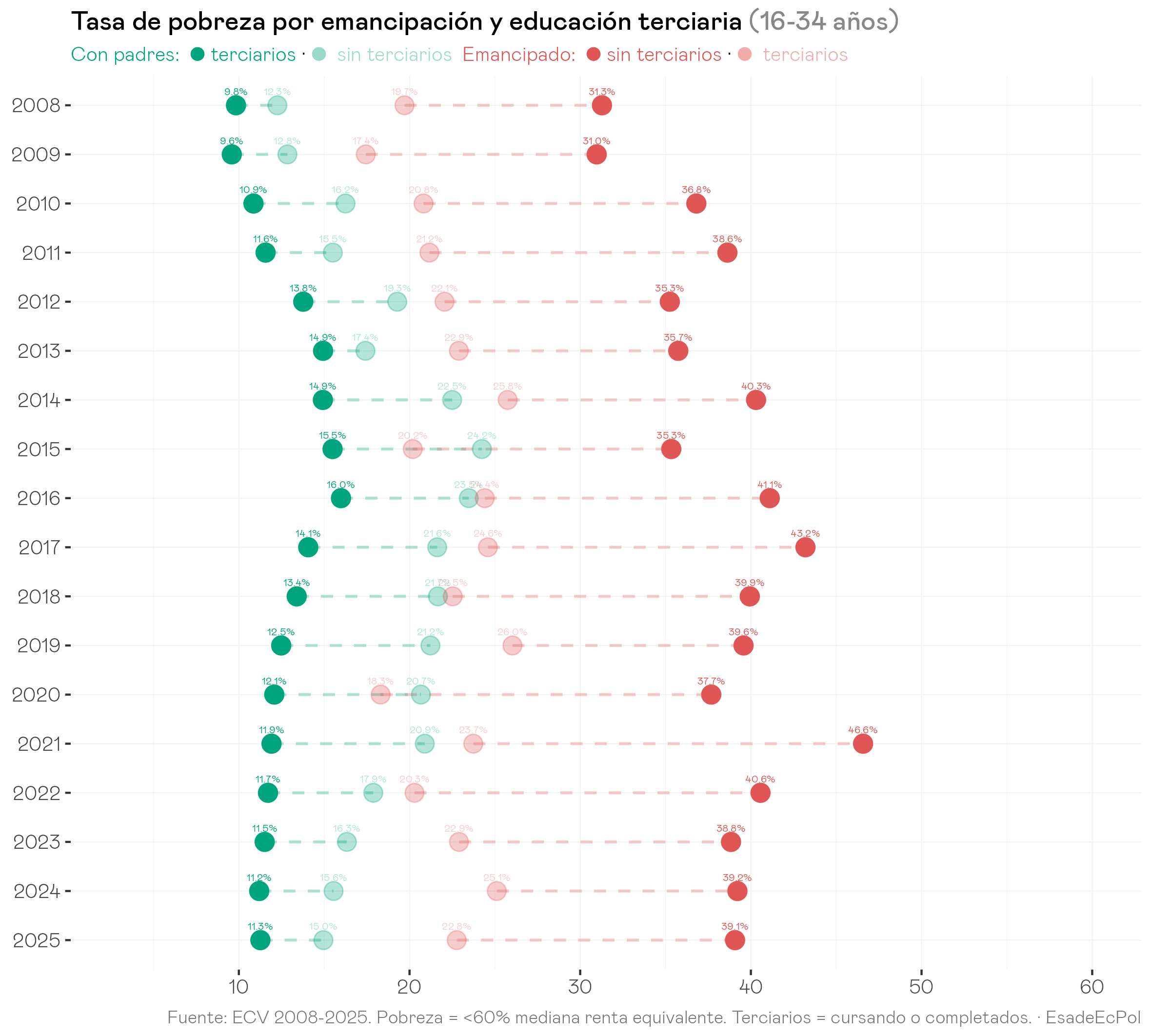
If we break down chart 3 by level of education in progress or attained, we see that the reduction in poverty from not emancipating is more intense for those without tertiary education: in 2025, their poverty rate is approximately 14% if they live with their parents, compared with 40% if they are emancipated. However, emancipating with tertiary education is no better today than a decade ago: the poverty rate of emancipated young people with higher education has remained at around 23-25% throughout the period, with no appreciable improvement. More education has not meant substantially less risk for those who take the step of becoming independent.
All the poverty data presented so far are calculated without including imputed rent, that is, measuring only the monetary income of the household. There is a way of approximating the economic value of living in a dwelling for which no market rent is paid: imputed rent estimates how much the dwelling the household occupies without paying would cost on the market, whether because it is owned, because a relative provides it, or because the person lives in their parents’ home.
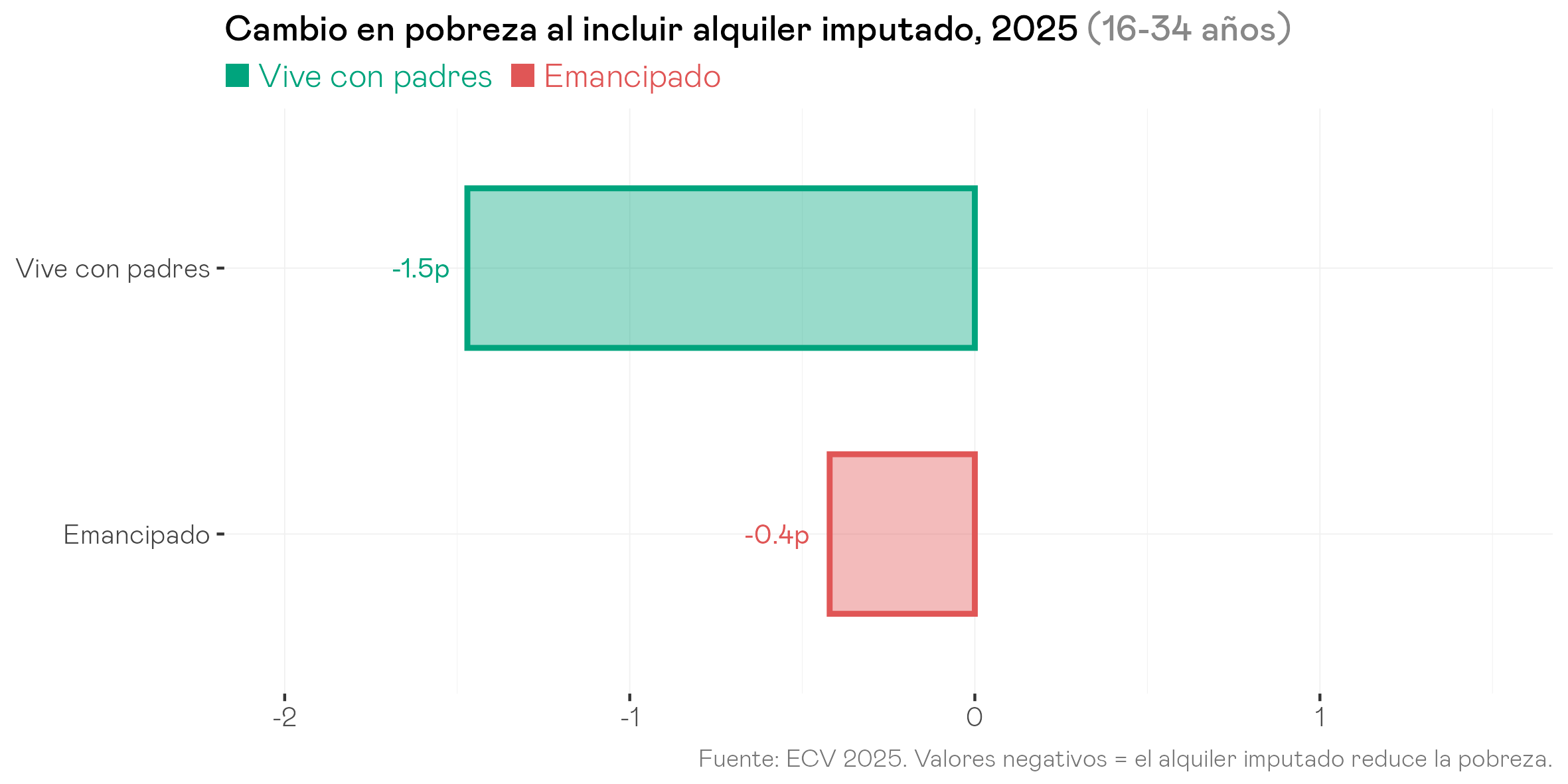
When this component is added to household income, poverty falls more for those living with their parents (−1.5 points) than for emancipated young people (−0.4 points). It is another indication that the family home protects against poverty largely because it absorbs the cost of housing.
Methodological note. The breakdowns by emancipation and level of education are based on analysis of the ECV microdata. In some subgroups the samples are of 700-800 observations, which introduces year-on-year volatility. The data are also sensitive to the definition of the categories: “emancipated” is defined as not living with any parent in the household; “tertiary education” includes both those who are currently studying and those who have completed higher education. Despite these limitations, the direction of the results is consistent throughout the series and the magnitudes are large enough for the main conclusions to be robust.