The weight of territory in positions on the green transition
Jorge Galindo
13 Jul, 2023
Key ideas
→ The differences between inhabitants of cities and small municipalities regarding green transition policies are limited to specific policies, rather than general attitudes, values or emotions
→ Significant differences are observed between people in large and small municipalities regarding vehicles, the installation of renewables and, to a lesser extent, farming operations.
→ These differences even divide voters of the same party, who differ on these specific policies depending on the size of the municipality they live in, especially on private vehicle policies.
Climate change and the consequent need to move towards a decarbonised economy are having a significant influence on current policies. However, this impact need not be perceived, or distributed, uniformly across territories: positions on the transition may vary depending on whether the person holding them lives in a more populated area or in a small town.
To address these differences and guide future action so that it is effective, fair and politically sustainable at the same time, it is essential to collect and analyse data that measure them precisely and concretely.
To do so, we use a survey representative of Spanish society conducted in 2022 and 2023 that analyses differences in perspectives and attitudes towards the green transition, complementing our previous analyses of green polarisation based on the same survey.
Our analyses show that there is no significant territorial gap in Spain between inhabitants of large and small municipalities regarding affect, values or the importance attached to climate change.
Where there is significant variation is in attitudes towards policies across municipalities of different sizes. We look at the different probability of being strongly in favour of or strongly against these measures depending on the size of the municipality where the individual lives. We focus on three specific dimensions that have captured a large share of the attention on green transition policies in recent years, and in which potential territorial divides have become particularly important: transport policy, agricultural policy and policy on the installation of renewable energy projects.
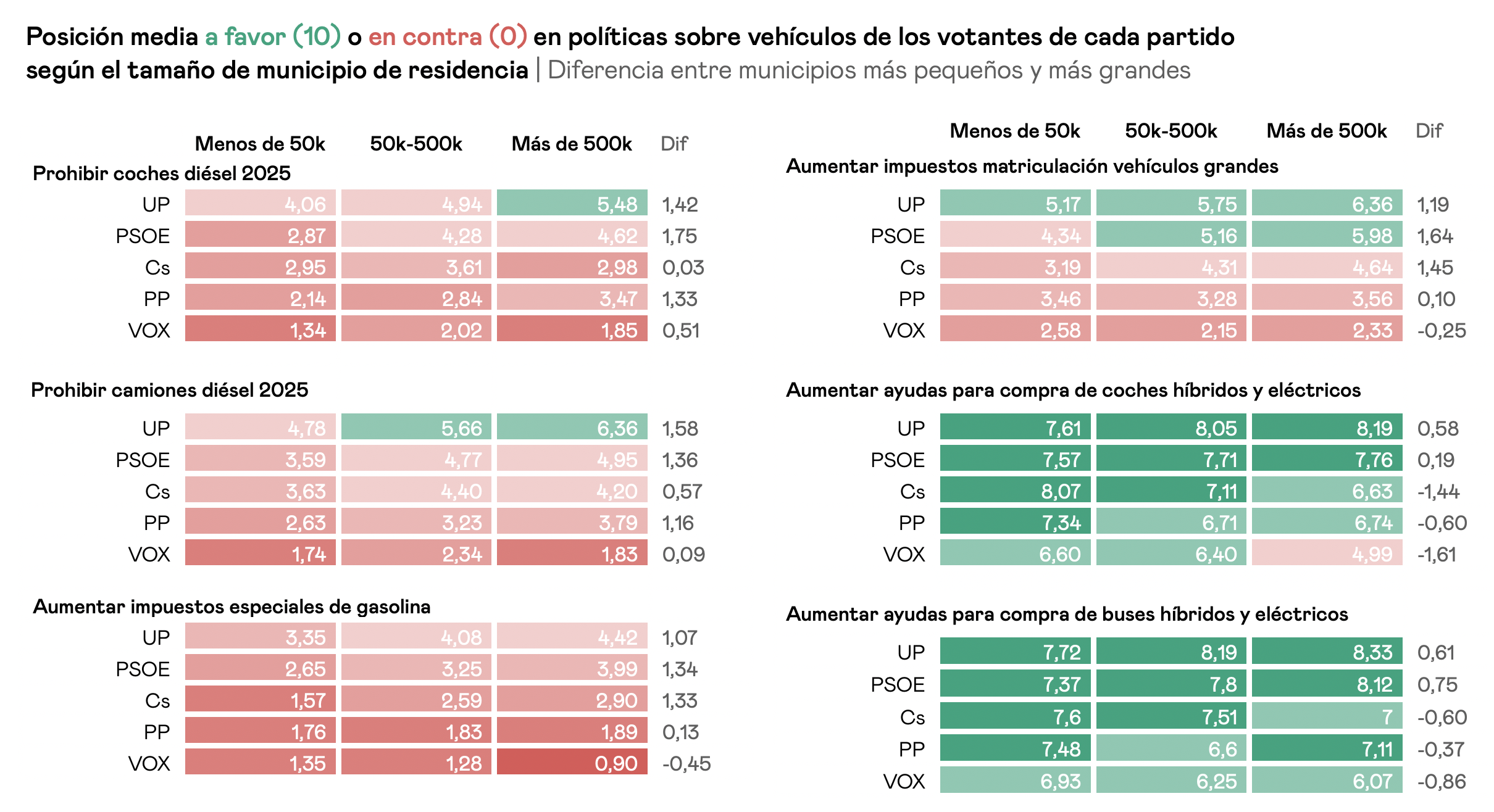
- In general, policies restricting the use of private vehicles are more accepted in larger municipalities, although they do not achieve majority consensus.
- Thus, people in the smallest municipalities have a 55% probability of being strongly against the ban on diesel cars in 2025, while this figure falls to 40% in the largest municipalities.
- Petrol taxes follow a similar logic, with the share of those “strongly in favour” increasing with the size of the municipality, while the share of those “strongly against” decreases.
- With regard to renewable energy projects, when asked about installations within their own region, most inhabitants are in favour, but the probability of maximum support rises from 44% to 63% between small and large municipalities.
- The variation in attitudes towards renewable energy projects across municipality sizes is concentrated in positive positions, although there are also some significant differences at the extremes.
- Positions on agricultural and livestock policies do not vary as much with the size of the municipality people live in, although municipality size does produce significant differences in attitudes towards VAT on meat and support for farmers with organic farms.
We also observe that, among voters of the same party:
- Those in larger areas (more than 500k) are usually more likely to support green transition policies than voters of the same party living in smaller areas (between 0 and 50k).
- The differences exist for voters of all parties, but are comparatively larger among voters of parties on the left of the spectrum, and regarding vehicle policies. Notable examples are the ban on diesel cars by 2025 and the policy of raising registration taxes on large vehicles.

Related content