Learning Quality in Math and Science in Primary in Spain and France
Paul Cahu, Lucas Gortazar
8 Oct, 2025
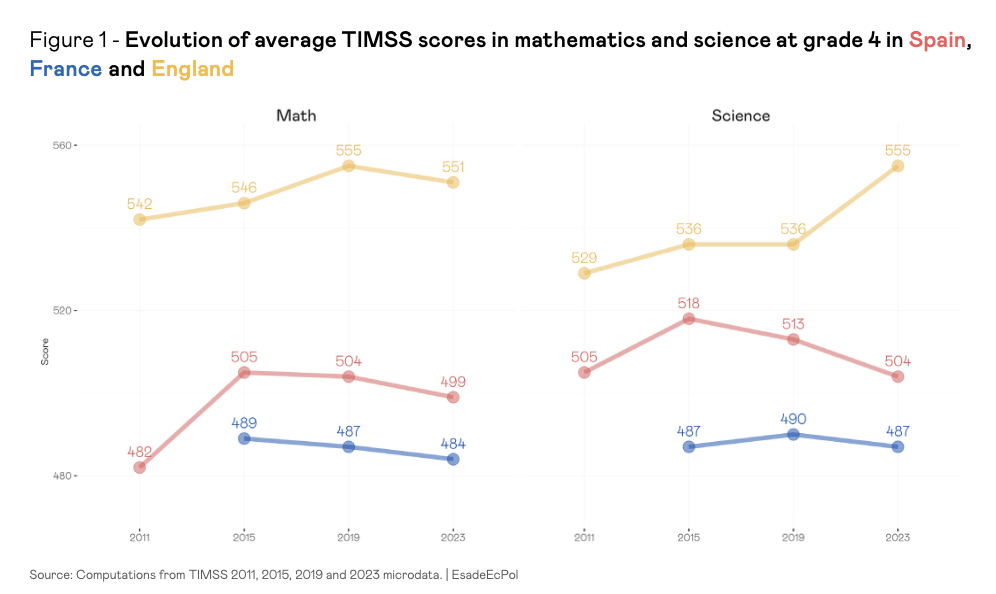
In the verge of a new technological revolution, Math and Science skills will gain its importance as critical skills for social and economic progress. Why some countries are better than others in teaching such skills? Recent results of the international assessment TIMSS 2023 displayed poor results for both Spain and France in Math and Science grade-4 exams compared with OECD countries participating in TIMSS. Moreover, results worsened in both countries relative to the previous edition of 2019.
This policy brief studies such gap through a close examination of the latest TIMSS micro-data, just released in February 2025. It addresses the evolution of key social factors that influence student learning and constructs a novel “Learning Quality Index” (LQI) that measures the net contribution of education systems to learning after discounting the social, economic, and cultural context of students and families, as well as the expectations and value they place into education. It also attempts to identify the causes of between country variation in such index. We find that:
-
LQI results show high cross-country correlation between TIMSS and PISA in Secondary and between TIMSS results in Primary and Secondary, revealing that what TIMSS captures in Primary is relevant as predictor of quality of education systems.
-
Both Spain and, especially, France, perform significantly below OECD average in Math and Science in LQI. According to our estimates, such gap implies an economic loss of 44 billion in France and 7 billion euros in Spain to each cohort that goes into Primary school.
-
LQI in Primary has not varied much since 2019 and contrasts with a positive LQI in Secondary school, according to both TIMSS and PISA data. LQI is worse for socially favored students, revealing a pro-equity approach and a system in which skills development at the top of the social ladder does not seem to matter.
-
The recent decline in TIMSS 2023 performance since 2019 for Primary can be largely attributed to worsening social conditions of children. state that they arrive at school hungry, with a 50% increase in Spain and 55% in France, with almost half of French fourth graders now reporting feeling hungry every day or almost every day. Moreover, the gap between language at home and language of instruction rose, especially in Spain, a country in which 32.1% of Primary students never or sometimes speak the language of instruction.
-
Exploring education policy factors that may explain such learning quality gap, data shows that: (i) teacher academic skills of both Primary and Secondary teachers are not an issue, with the exception of Primary teachers in Spain; (ii) classroom learning climate is near OECD average, but worsened in many countries, especially in Spain; (iii) Spain does well in school social indicators like sense of belonging and bullying, while France performs worse, in a context of global decline; (iv) uneven application of instruction time rules could be explaining part of the “learning quality” gap.
To address the learning quality gap observed for both countries, which clearly share historical similarities regarding education policy, four recommendations are made:
a) Improve the learning conditions at school to respond to the social impoverishment of students, including breakfast and food programmes, investing in more psycho-social support to children, considering additional policies to ensure the effectiveness of language of instruction policies, and developing further social programmes to improve living conditions of children.
b) Elevate the learning expectations of students and the academic skills of teachers and simplify curricula by creating a more streamlined curriculum with unambiguous learning goals and ready-to-use teaching examples.
c) Upgrade and promote effective in-service training, providing large-scale, practical teacher training focused on foundational instruction and classroom management in diverse settings, emphasizing both academic rigor and socioemotional support.
d) Invest in effective early remedial support by prioritize small group tutoring and radically applied targeted resources in Primary schools to tackle emerging skill gaps quickly, so no student is left behind before entering Secondary education.


Related content

22 May, 2025