Is the electricity social bonus reaching those who need it? An analysis of coverage rates and household characteristics
Natalia Collado Van-Baumberghen, Ángel Martínez Jorge
12 Sep, 2024
Analysis published together with Oxfam Intermón.
Key ideas
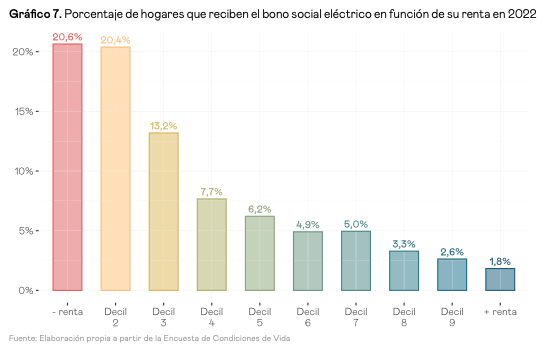
- In 2022, almost 8 out of 10 potential beneficiaries did not receive the electricity social bonus: its coverage rate stands at 24.5%, and is particularly high for large families (45.5%).
- A good share of those who do benefit from the social bonus are not vulnerable families: among large-family households with medium-high income, more than 60% receive the bonus.
- In contrast, it is only 20% for the low-income category, and barely 9.2% for retirees on the minimum pension.
- To ensure it reaches those who need it, we propose a reform of the social bonus that focuses more on vulnerable families, shifts more of the burden of applying onto the administration to improve the take-up of the aid, and achieves more effective harmonisation with other existing benefits.
Executive summary
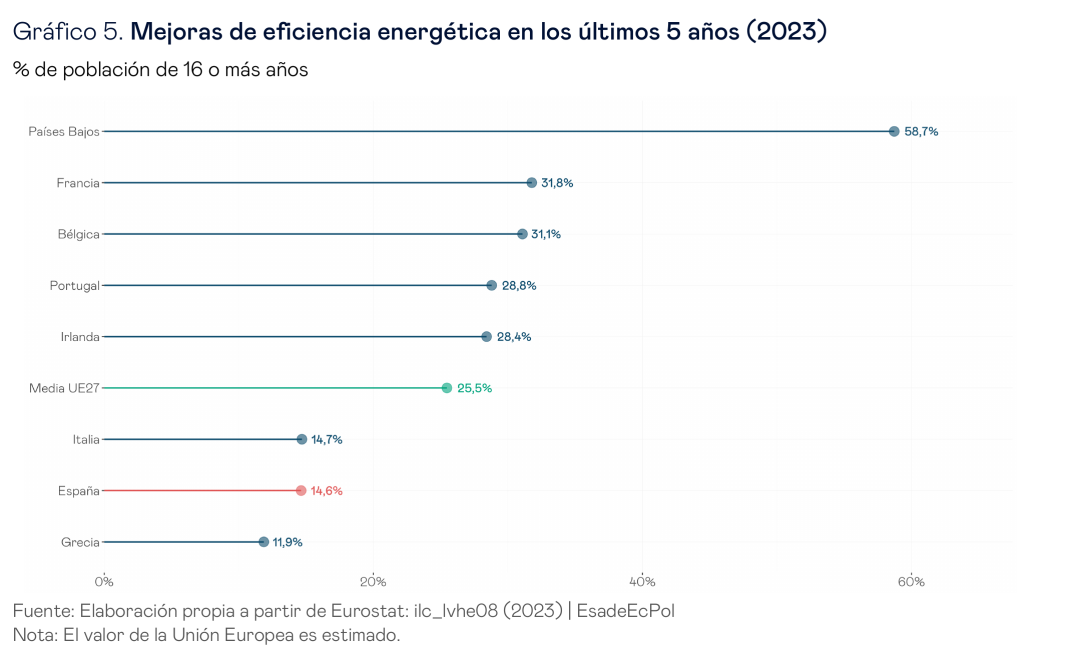
In a context marked by rising energy prices, one in five households was unable to keep their home adequately warm during 2023, the highest figure in the EU along with Portugal, and one in ten fell behind on paying bills. The number of households consuming less energy than they need because they lack the financial resources to meet the cost doubled between 2020 and 2022.
Recent studies show that the main determinants of energy poverty are household income, unemployment of the main breadwinner, low educational attainment, being born abroad, and family composition, especially for single-mother households.
The electricity social bonus is a discount on bills aimed at households that struggle to meet their energy needs. To receive it, the household must have a contracted power below 10kW, be on the regulated tariff, and meet one of the following requirements: (a) An income below €8,106 (2022 value); (b) Being a large family; (c) Being a household made up of pensioners receiving the minimum amount in force and not earning other income above €500 per year. Once granted, it guarantees a discount of between 25% and 80% depending on household characteristics. It was received by 1.4 million households in 2022.
This report measures the coverage rates of the social bonus for the first time. That is: to what extent those who should receive it because they meet the conditions actually do. To do so, it applies a multifactor statistical analysis to a question included in the Living Conditions Survey and never before used for this purpose, together with all the characteristics that define the socio-economic profile of each household.
According to our estimates:
- The bonus coverage rate in 2022 was 24.5%, up from 2021 (23.2%) and 2020 (22.6%). This means that almost 8 out of 10 potential beneficiaries do not receive the bonus.
- This coverage rate rises to 45.5% for large families, while it is only 20% for the low-income category, and barely 9.2% for retirees on the minimum pension.
- As a result, although 2 out of 3 beneficiaries were low-income, 1 in 3 is not low-income.
- In fact, among large-family households with medium-high income, more than 60% receive the bonus. For low-income ones, barely 40%.
- The coverage gap between single-mother households and two-parent households has widened over these years: while in 2020 there was a 3.5-point difference, by 2022 there were already 12 points (20% – 32%).
- In contrast, in 2022 coverage of households with all members born in Spain was double that of households with at least one person born abroad (27% vs 13%).
- For households living in rented housing, the gap has remained at 8-10 points over these three years (19% coverage in 2022 compared with 27% for owner households).
Now seeking to isolate the effect of each household characteristic while holding the rest constant:
→ Being a large family has the largest positive effect: it increases the probability of receiving the bonus by +27%. By comparison, being in a low-income household only increases it by +4%.
→ At the other extreme, the factor with the most notable negative effect on the probability of receiving the bonus is the presence of a household member born abroad: it reduces it by -12%
In light of these data, we consider that there are design problems that prevent the policy from having the reach originally intended. We therefore consider it necessary to improve the efficiency of this aid, ensuring that it actually reaches those who need it, which would multiply its effectiveness. To this end, we make the following proposals to improve, change or complement the aid:
- Reduce barriers to entry as far as possible. Currently, the household must apply to the energy retailer for the bonus, for which it at least needs to know it exists and have the required documentation. We propose shifting the responsibility to the public administrations, which could coordinate with retailers to identify which households are eligible for the bonus based on data from the Tax Agency (for income), Social Security (for minimum pension conditions) and other bodies holding the necessary information.
- A clear example is the Minimum Living Income (IMV), a benefit with which the Bonus not only coexists, but where, on paper, receiving the IMV automatically makes the household a potential beneficiary of the Bonus. Ideally, the administration would use this information to speed up the granting of the Bonus, aligning and harmonising both benefits even further.
- At the same time, it seems appropriate to reconsider the definition of criteria, introducing an income ceiling for large families, defined so as to exclude only households that clearly do not need any monetary support (high incomes).
- In any case, in the long term, consideration should be given to using more effective and unified fiscal policies (such as negative income taxes) that make it possible to address situations of poverty comprehensively, with reliable information and less red tape.
- Finally, although measures focused on spending and income have been the most widely used in Spain so far, this need not be the case: today, access to tools and equipment to improve household energy efficiency, as well as to the information needed to manage their installation, is not equitable in Spain. This would make it possible to respond not only to the challenge of energy poverty, but also effectively to decarbonisation goals through:
→ More proactive strategies by the administrations to “reach out” to vulnerable households that could particularly benefit from efficiency improvements, in terms of retrofitting, insulation or installation of renewables.
→ Targeting available resources so that the lowest-income households benefit from them, as these are precisely the ones most likely to make any investment in efficiency conditional on the availability of aid, since without it they will not be able to undertake it.

Research Economist en EsadeEcPol. Máster en Economía Industrial y Mercados regulados por la Universidad Carlos III de Madrid
View profile
Related content