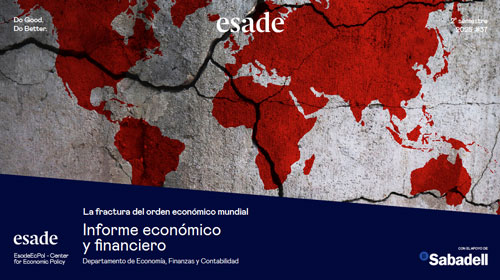
Informe Económico y Financiero #37
Toni Roldán, Manuel Hidalgo Pérez, Josep Mª Comajuncosa
15 Jul, 2025
Esade publishes every six months, with the support of Banco Sabadell, the Economic and Financial Report, which on this occasion celebrates its 37th edition. With it, Esade maintains its vocation to contribute to public debate through rigorous and plural analysis that, as a prestigious school and with the complicity of its entire academic community, reinforces its commitment to economic and social progress.
In his welcome article, the Director of the Report and of EsadeEcPol, Toni Roldán, emphasizes how 2025 marks a turning point in the global economic order after three decades of globalization under multilateral rules. He highlights the irreversible fracture of the global system—accelerated by Donald Trump’s reelection and his “America First” doctrine—and the new transactional phase of the United States, which treats the European Union as a commercial rival. At the same time, he underscores Spain’s relatively favourable position, with GDP growth estimated between 2.4 % and 2.6 % for 2025, supported by strong domestic consumption, the surge in tourism and a labour market at historic lows; he also notes the boost from immigration and renewable energies, while warning of risks such as the structural public deficit, imbalances in the housing market and exposure to new U.S. tariffs.
Next, the joint conjuncture note by Josep M. Comajuncosa and Manuel Hidalgo first examines the synchronized cooling of the global economy—with the IMF lowering its forecasts to 2.4 % for 2025—the moderation of inflation after recent geopolitical and financial tensions, and the narrow fiscal and monetary policy margins. It then analyses the evolution of the Spanish economy, which maintains robust growth (2.3 %–2.6 % projected for 2025), driven by high household savings, the private sector’s strong financial footing, export dynamism and the deployment of Next Generation EU funds, while warning of challenges such as debt sustainability and public investment.
In the “In Debate” section, four articles offer different perspectives on the new world economic scenario:
- Elina Ribakova, in “World Economic Governance in Turmoil: Decisions for Europe,” argues for deepening the Capital Markets Union, launching a digital euro, centralizing defence procurement—including for Ukraine—and completing the green transition without creating new dependencies.
- Federico Steinberg, in “The European Union Facing a Second Trump Administration,” warns of the constant need to manage transatlantic risks and proposes accelerating banking and fiscal union, issuing eurobonds for security and green transition, and unhesitatingly activating the AntiCoercion Instrument.
- Eduardo Morales, in “The New Trade Policy,” analyses the protectionist turn of the U.S. and the EU, the proliferation of tariffs and industrial subsidies, and their hidden costs and effects on productivity.
- Carolina Villegas, in “Reconfiguring Global Value Chains in Light of New Trade Tensions: Adapting in a Fragmented World,” details how firms are combining China+1, nearshoring and friendshoring strategies to diversify suppliers and mitigate geoeconomic fragmentation risks.
Finally, the report concludes with reviews by Antonio García Maldonado of two recent books:
- Abundance. How We Build a Better Future by Ezra Klein and Derek Thompson, which denounces the regulatory paralysis hindering innovation and calls for a state capable of driving transformative projects.
- The Invisible Doctrine by George Monbiot and Peter Hutchison, which explores how neoliberalism has undermined the social contract and fuelled the antipolitical discontent that propels populist leaders.



Profesor titular del Departamento de Economía,Finanzas y Contabilidad de Esade
View profile