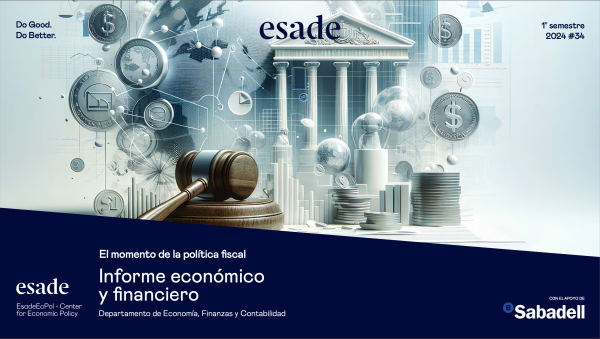
Informe Económico y Financiero #34
Toni Roldán, Josep Mª Comajuncosa, Manuel Hidalgo Pérez, Pablo de Ramón-Laca, Ángel Ubide, Judith Arnal, Omar Rachedi, Antonio García Maldonado
20 Feb, 2024
Every six months Esade publishes, with the support of Banco Sabadell, the Informe Económico y Financiero (Economic and Financial Report), which will soon turn twenty. With this report Esade seeks to stay true to its mission and contribute to society with what it does best: providing knowledge to improve public debate. The Report thus aims to offer a snapshot of the global and Spanish economic landscape and, in each edition, focuses on an issue of particular relevance to current economic affairs. This 34th edition includes an analysis of the current situation and trends of the Spanish and international economy in the first half of 2024, and in-depth articles on the new reality of fiscal policy and its implications for the global economy.
Toni Roldán, director of the Informe Económico y Financiero and of EsadeEcPol, highlights in his welcome article how, despite the resilience shown by the global economy last year, the outlook remains one of slowdown and fragility. Next, Josep Comajuncosa, associate professor in Esade’s Department of Economics, Finance and Accounting, presents the analysis of the international economic situation. According to Comajuncosa, advanced economies will grow at a slightly slower pace in 2024 than in 2023. Geopolitical risks, the situation of the Chinese economy, governments’ fiscal challenges and potential instability in capital markets are some of the risks he points to. Second, Manuel Hidalgo, professor of Economics at Pablo de Olavide University, senior fellow at EsadeEcPol and co-director of the NextGenEU Observatory, warns that, although Spain is clearly in a more favourable position than our neighbours, several factors suggest that growth for 2024 as a whole will be lower than in 2023. There are, however, certain elements that will help sustain a relatively favourable scenario: the dynamism of the labour market, the acceleration of NextGenEU Funds and strong figures for tourism and the real estate sector; although the weakness of private investment is a concern.
In the debate section, four authors analyse in detail different perspectives on fiscal policy in the new global economic environment. Pablo de Ramón-Laca opens the section with an article on the need to regain “fiscal space” in advanced economies, understood as the room for manoeuvre governments have to provide additional public resources without jeopardising stability or sustainability. Next, Ángel Ubide reflects on how fiscal policy should contribute not only to economic policy objectives, including cyclical stabilisation, but also to the components of the “new economic policy”, which include the fight against climate change, energy independence and national security. Judith Arnal, for her part, analyses the new governance framework for European Union fiscal policy agreed on 9 February, its strengths and its limitations. Omar Rachedi, from Esade, closes the section by writing about the crucial role played by the interaction between monetary and fiscal policy, which is essential to fully understand current inflation dynamics.
Finally, Antonio García Maldonado reviews two books: «Power and Progress: Our Thousand-Year Struggle Over Technology and Prosperity» by Daron Acemoglu and Simon Johnson, and «The Trade Weapon: How Weaponizing Trade Threatens Growth, Public Health, and the Climate Transition», by Ken Heydon.


Profesor titular del Departamento de Economía,Finanzas y Contabilidad de Esade
View profile


Profesor del Departamento de Economía, Finanzas y Contabilidad de Esade, senior fellow de EsadeGeo.
View profile
Profesor de sistemas políticos e institucionales comparados en el Master Global en Asuntos Públicos del IMF y la Universidad de Nebrija
View profileRelated content

24 Mar, 2026