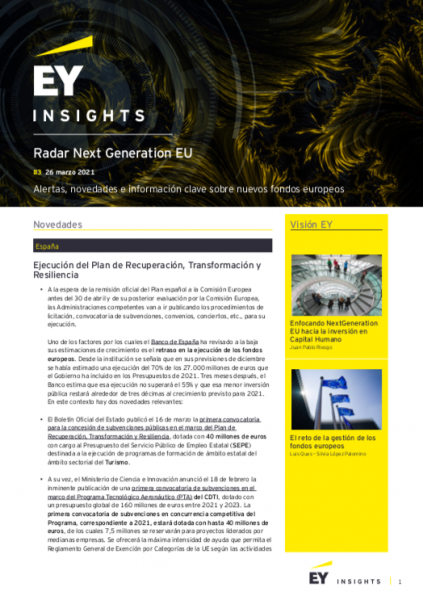
Radar NextGeneration #3: “Focusing NextGenerationEU on investment in Human Capital”
Juan Pablo Riesgo
24 Mar, 2021
Now it is the Member States’ turn. By 30 April they must submit their respective Recovery and Resilience Plans to the European Commission, setting out the reforms and investments to which they want to devote the resources allocated to them. In Spain’s case, more than 150 billion euros in non-repayable transfers and soft loans. Although until the plan is published, and above all until the calls for aid and tenders implementing it are published, we will not know in more detail how NextGenerationEU can be used to boost investment in Human Capital, the analysis of European regulations and the plans already outlined by the Government can give an idea. And in any case, there is still time to put ideas to the competent administrations so that, even once the plan has been approved, they design eligible actions implementing it that help strengthen the skills of our workforce and make it more competitive and resilient.
European regulations leave no room for doubt. Investment in human capital is, together with digital transformation and the energy transition, a priority when carrying out actions funded by NextGenerationEU. Among other reasons, because driving any transformation requires investing in the people who must lead it. This is established by the European Commission’s 2021 Annual Sustainable Growth Strategy, which includes among its priorities the reskilling and upskilling of the workforce. In line with this, the country-specific recommendations for Spain issued by the Council under the European Semester set the “development of skills and digital learning” as a priority. Finally, the Regulation establishing the Recovery and Resilience Facility itself includes among its six pillars “policies for the next generation”, including education and skills.
Consistently with this, the España Puede Plan, presented by the Government on 7 October as a first draft of Spain’s Recovery, Transformation and Resilience Plan, includes several flagship policies and components focused on investment in human capital.
Of particular relevance are the “change management” investment projects included in the SME Digitalisation Plan 2021-2025, with a budget of 656 million euros, for training managers, training experts in digital transformation and a change agents programme. The management training programme has a budget of 256 million euros and the programme to train experts as change agents in digital transformation 100 million euros. Both will be managed by the Secretary of State for Digitalisation and Artificial Intelligence, in collaboration with the School of Industrial Organisation, under the National Digital Skills Plan. Finally, the change agents programme, aimed at bringing change agents into SMEs to accelerate their digital transformation, will be managed exclusively by that Secretary of State, which will allocate 300 million euros to it. The three programmes will run between 2021 and 2023.
Within the framework of SME digitalisation, the Digital Toolkit stands out: a programme with a budget of 3 billion euros to provide SMEs with a package of digitalisation tools which, pending the details of its design, could well include an approach linked to human capital management: training, payroll or staff management, people management platforms, tools for calculating the gender pay gap or for managing immigration, labour, tax or social security compliance for internationally mobile workers, among others. All this is part of the fifth flagship policy, devoted to the modernisation and digitalisation of industry and SMEs, which will receive 17.1% of the resources (4,656 million euros).
In turn, the investment projects included in the seventh flagship policy of the España Puede Plan, on education, knowledge, lifelong learning and skills development, which accounts for 17.6% of its resources, are also particularly relevant. Specifically, component 19, devoted to “digital skills”, with a budget of 3,593 million euros to be implemented between 2021 and 2023. These projects will boost the reskilling and upskilling of workers, both in the private sector and in the public sector itself, through grants to companies to train their workers or through the administrations themselves contracting training services. We will have to wait for the publication of the final Recovery, Transformation and Resilience Plan, or of the calls for aid and tenders by the administrations, to know the details of how they will be implemented, beyond what is set out in the aforementioned National Digital Skills Plan.
The public sector reform promoted by the fourth flagship policy of the España Puede Plan, devoted to the “21st-century Administration”, also includes a specific pillar on training and digitalisation in human capital, to be developed essentially by the National Institute of Public Administration, as well as another devoted to modernising public administrations in order to improve the efficiency of human resources, make their management more flexible and improve processes. In this context, the “new generation workplace” project included in the España Digital 2025 Agenda stands out, with the aim of promoting connectivity and collaboration solutions that enable mobility and remote work for public employees.
Finally, the impact of NextGenerationEU cannot be addressed without mentioning, in addition to the investment projects, the reforms linked to them and required by the Recovery and Resilience Facility Regulation for the allocation of resources to Spain and the release of payments. The España Puede Plan therefore includes the eighth flagship policy, which contains a component, number 23 of the 30 in the plan, devoted to a “dynamic, resilient and inclusive labour market”. These include the plan to reduce the number of types of employment contract to 3 (permanent, temporary and training), reform the regulation of furlough schemes (ERTEs) to promote their use on a permanent basis, and reform the vocational training for employment system and active labour market policies. On these last two issues, it would be desirable to speed up the process, already begun by some regions such as Andalusia, of introducing statistical profiling of jobseekers and digitalising the individualised guidance process and the design of dynamic training pathways using Artificial Intelligence and Big Data, as well as the definitive introduction —thanks to these technological advances— of the training voucher. All this would help make our economy more competitive and resilient.
As we concluded more than 6 months ago, in general terms it is clear that reskilling and upskilling, in short, adapting workers’ skills to the digital economy, will be a cross-cutting element of many of the digital transformation projects funded by NextGenerationEU. In turn, change management and other services associated with corporate culture will be eligible projects, because it will be necessary to move towards new professional profiles, new skills, new cultures and new leadership styles associated with digital transformation and the energy transition. And, finally, as part of the push for digitalisation, projects to digitalise HR processes, through people management platforms and other talent management applications, could also be eligible for this aid. It is therefore necessary for the administrations responsible for channelling this aid to listen to the demands and human capital investment needs of the productive sector and to speed up the drafting of the regulations governing them in Spain, so that companies, together with expert advisers in project design and management, can start designing projects eligible for NextGenerationEU funding. There is no time to lose in driving the recovery of the Spanish economy and its energy, digital and skills transformation. And to do so, investing in human capital is essential.
Download Radar Next Generation EU #3, published on 26 March 2021, for more content of interest.