Did the metropolitan public transport subsidy get cars off city streets?
Jorge Galindo, Javier Martínez Santos, Natalia Collado Van-Baumberghen
18 Oct, 2023
Key ideas
→ With the available evidence, we cannot claim that the subsidy for metropolitan rail transport has reduced the number of cars on the streets of Madrid.
→ Nor is there any effect for the areas with the highest traffic intensity, lower (or higher) income levels, the main access roads to the city (M-30), or the areas with the best access to commuter rail or metro.
→ Instead of this type of across-the-board subsidy, to encourage the use of public transport we recommend prioritising investment in locations where a substantial improvement in access and frequency can be achieved at reasonable cost, coupled with fare reductions for lower-income households, and tolls based on income proxies (such as vehicle weight) to encourage modal shift and underpin the additional investment.
Since September 2022, the Government has made commuter rail passes practically free, in addition to an extra subsidy amounting to discounts of up to 50-60% on metro passes in Spanish cities.
In the 2023 General State Budget, these measures were allocated almost €700M. It is therefore one of the most ambitious policies undertaken in recent years to promote public transport.
The stated objective of the measure was to reduce the use of private vehicles, thereby seeking to align the goals of reducing CO2 emissions and easing the energy price shock (in this case, petrol prices) following the invasion of Ukraine.
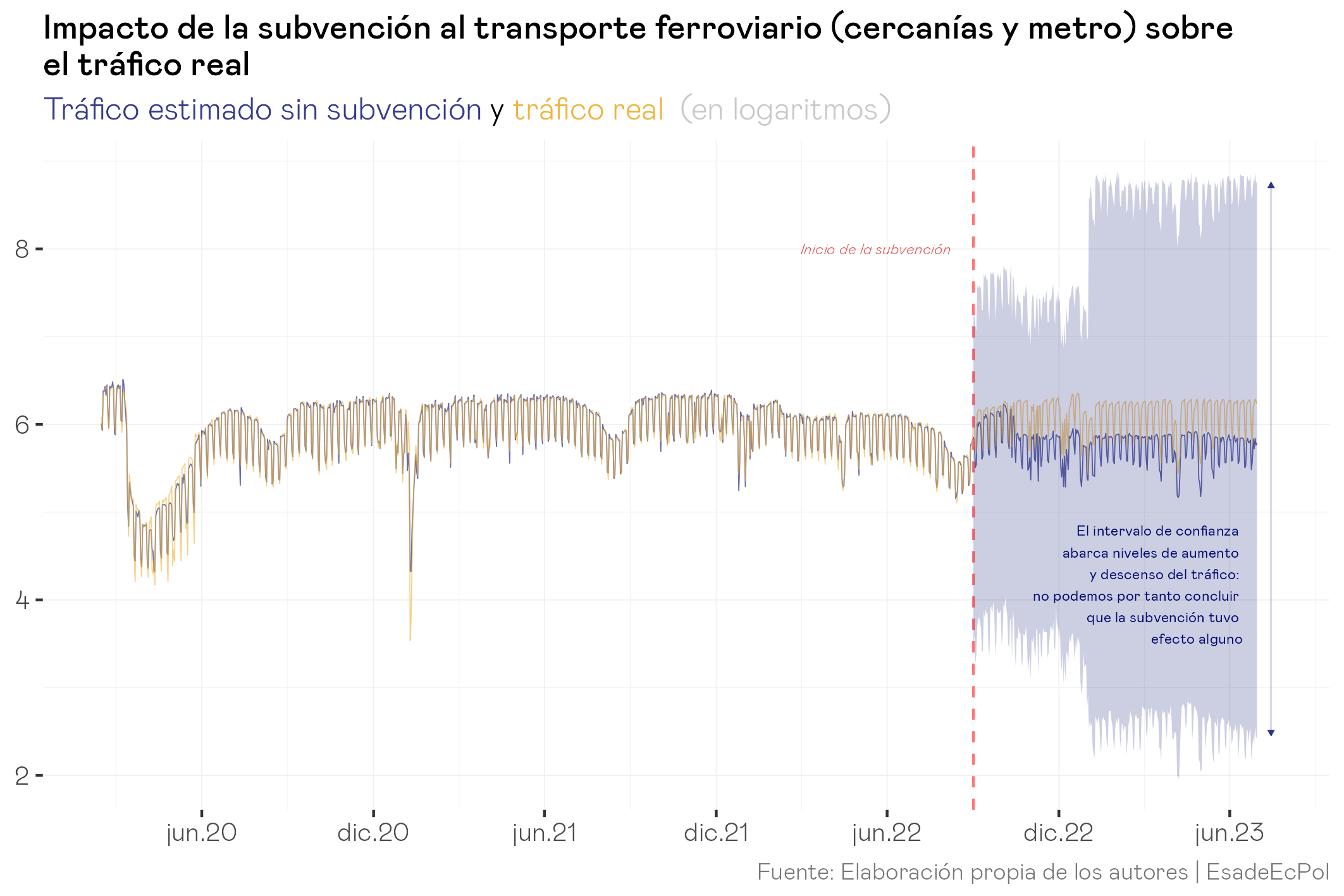
To assess whether the measure has served this purpose, we use real-time data on private vehicle traffic in Madrid. With these data we build a traffic series for the city and check whether traffic has fallen significantly since the introduction of the measure. To do so, we use a causal estimation method that compares this actual evolution with a statistical model that draws the same line, but in an alternative world without the measure.
We observe no significant difference. That is: with the available data, it cannot be claimed that the subsidy has reduced the number of cars in Madrid. This effect does not appear either in cumulative terms from 1 September 2022 to 30 June 2023, or in day-to-day averages.
We use the same method to detect any effect in specific groups, areas or periods. We find no effect whatsoever when isolating the sensors on expressways (M-30); on roads into or out of the city; in areas with more or less traffic to begin with; in high-, middle- or low-income areas; or with or without nearby access to public transport stops.
We believe these results call for a rethink of policies to promote public transport. We therefore propose:
- When the objective is to ease the burden on household incomes caused by rising prices, aid should be designed based exclusively on that criterion. Progressive fare policies or subsidies for low-income groups could be more effective than general subsidies.
- To facilitate access, we should instead prioritise investment in those locations where an improvement in frequency, speed or access can be achieved at an affordable cost, significantly lowering the entry cost of public transport compared with private vehicles.
- Finally, if the aim is to complement this push with additional incentive and financing mechanisms, we recommend considering urban tolls, which have proven more effective than the (more popular) Low Emission Zones in reducing congestion and emissions. These tolls should be designed according to emissions and income criteria, such as vehicle weight.
Cite this content as:
Galindo, J.; Martínez, J.; Collado, N. (2023). ¿Logró la subvención al transporte público metropolitano sacar coches de las ciudades? Un análisis con datos de tráfico en tiempo real de la ciudad de Madrid. EsadeEcPol Policy Brief, No.44, Esade. https://doi.org/10.56269/20231016/JGA


Economista enfocado en el análisis y la visualización de datos. Grado en Administración de Empresas y Economía Laboral por la Universidad de A Coruña y Master en Economía por la Universidad de Santiago.
View profile
Research Economist en EsadeEcPol. Máster en Economía Industrial y Mercados regulados por la Universidad Carlos III de Madrid
View profile