Student-teacher ratios in Spain: seeking more efficient and equitable investment
Lucas Gortazar, Ángel Martínez Jorge
6 Jul, 2021
During the 2020/21 school year, the Government and the regions decided to reduce student-teacher ratios in order to maintain the social distancing recommended by epidemiological criteria. For the next school year, 2021/22, several regions have already announced a return to previous ratios, which has sparked a broad debate among teachers, most of whom have come out against it. Below, we look at the adequacy and equity of student-teacher ratios in secondary education in Spain, based on PISA data collected in 2018.
The effect of education spending on students’ academic performance and attainment has always been a question as relevant as it is controversial in education research. One of the reasons this question has been so debated is that increased spending can go to a wide range of items and therefore have very different effects; more importantly, until 15 years ago, there was a lack of solid scientific evidence on the causal relationship between education spending and academic results. Within this literature, during the 1980s, 1990s and 2000s, the first data and studies focused on multivariate analysis by country, region or district, trying to correlate spending per student with the results of standardised tests, whether national or international (as is the case with the PISA tests).
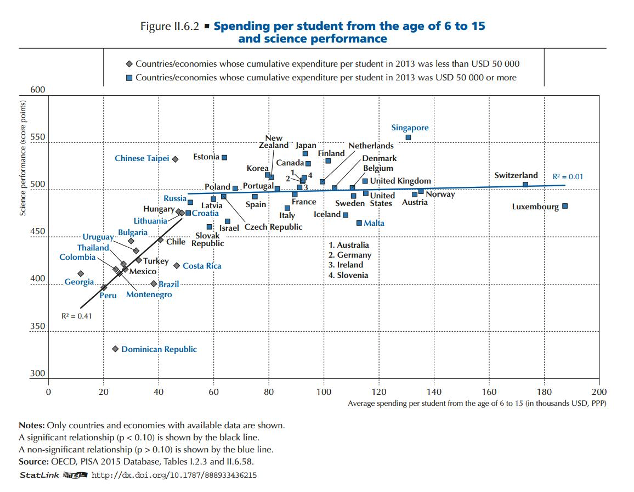
For example, the 2015 edition of Education at a Glance published by the OECD using PISA data usually presents a chart relating cumulative spending per student between the ages of 6 and 15 to the country’s PISA score. The work documents a positive relationship between the two variables that disappears beyond $50,000 of cumulative spending. In other words: education spending beyond that point would be inefficient insofar as it would not improve learning outcomes on average.
However, these analyses are still correlations, so they do not necessarily imply a causal relationship: to identify more precisely the effect of an increase or cut in spending on educational outcomes, it is much more appropriate to analyse data from a single country at different points in time using a valid identification strategy (separating two groups of very similar regions, municipalities or districts that differ only in funding) that makes it possible to isolate the effect of that change in spending. Unfortunately, the scarcity of administrative education data for scientific purposes has long made it difficult for researchers to access them, for confidentiality reasons, until a few years ago.
The most recent literature has begun to identify, for advanced countries and especially for the US, a positive effect of increased education spending on the academic performance of the students affected. The literature review by Kirabo Jackson (2018)* is proof of this. Presenting evidence from studies that exploit quasi-experimental variation in education spending to evaluate its causal effect on student performance, Jackson finds positive effects in the vast majority of cases, significant and relevant in educational terms. It should also be stressed that many of these studies examine the effect of education spending targeted at schools serving vulnerable students, so it is reasonable to think that the effects found depend to a large extent on the type of students targeted: the more socio-economically vulnerable the students, the greater the impact of funding on results tends to be.
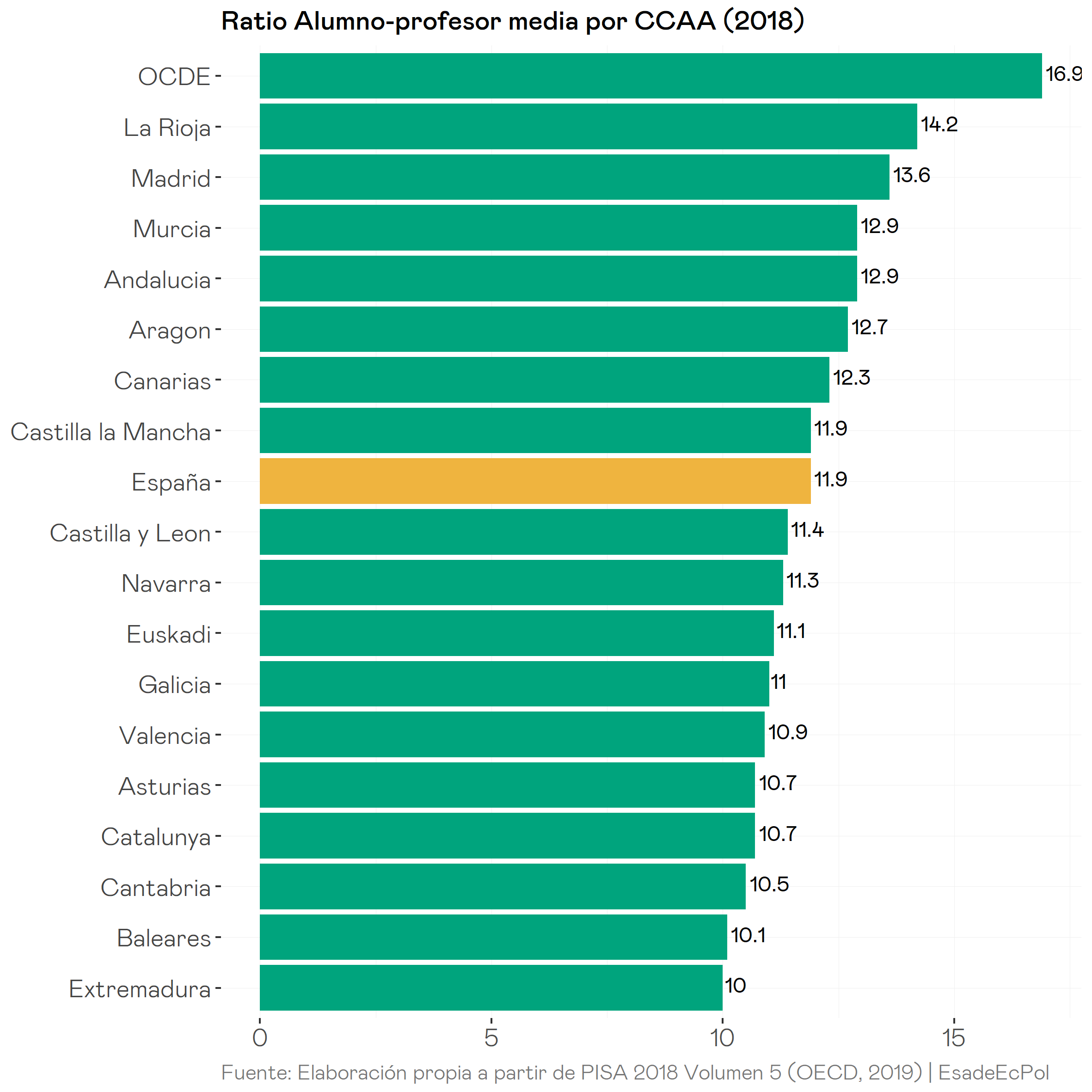
What is the situation in Spain regarding one of the most relevant education indicators? According to PISA data (2018), Spain has a student-teacher ratio significantly lower than that observed for the OECD, which is good news; however, there is great heterogeneity within Spain. For example, there is a difference of more than 30% between the ratios of certain regions: Extremadura and the Balearic Islands have a ratio of 10, while Madrid and La Rioja are close to 14.
It is interesting to look at ratio data broken down by the socio-economic level of a school’s students. To do so, students are divided into quartiles according to an OECD socio-economic index that takes into account the socio-cultural and economic situation of the child’s household. Vulnerable students are identified as those in the first quartile of this index (the 25% of students with the lowest scores), and the non-vulnerable group as those in the last quartile (the 25% of students with the highest scores).
As a general rule, the student-teacher ratio is progressive, that is, it is lower in schools with a higher share of students from low socio-economic backgrounds and rises in schools where that share is smaller. Two things stand out: in other countries this progressivity is greater, and it makes sense for it to be so, if we go by what the most recent studies say. And second, only in Madrid is the ratio regressive: the higher the socio-economic level, the more teachers per student, and therefore the lower the ratio.
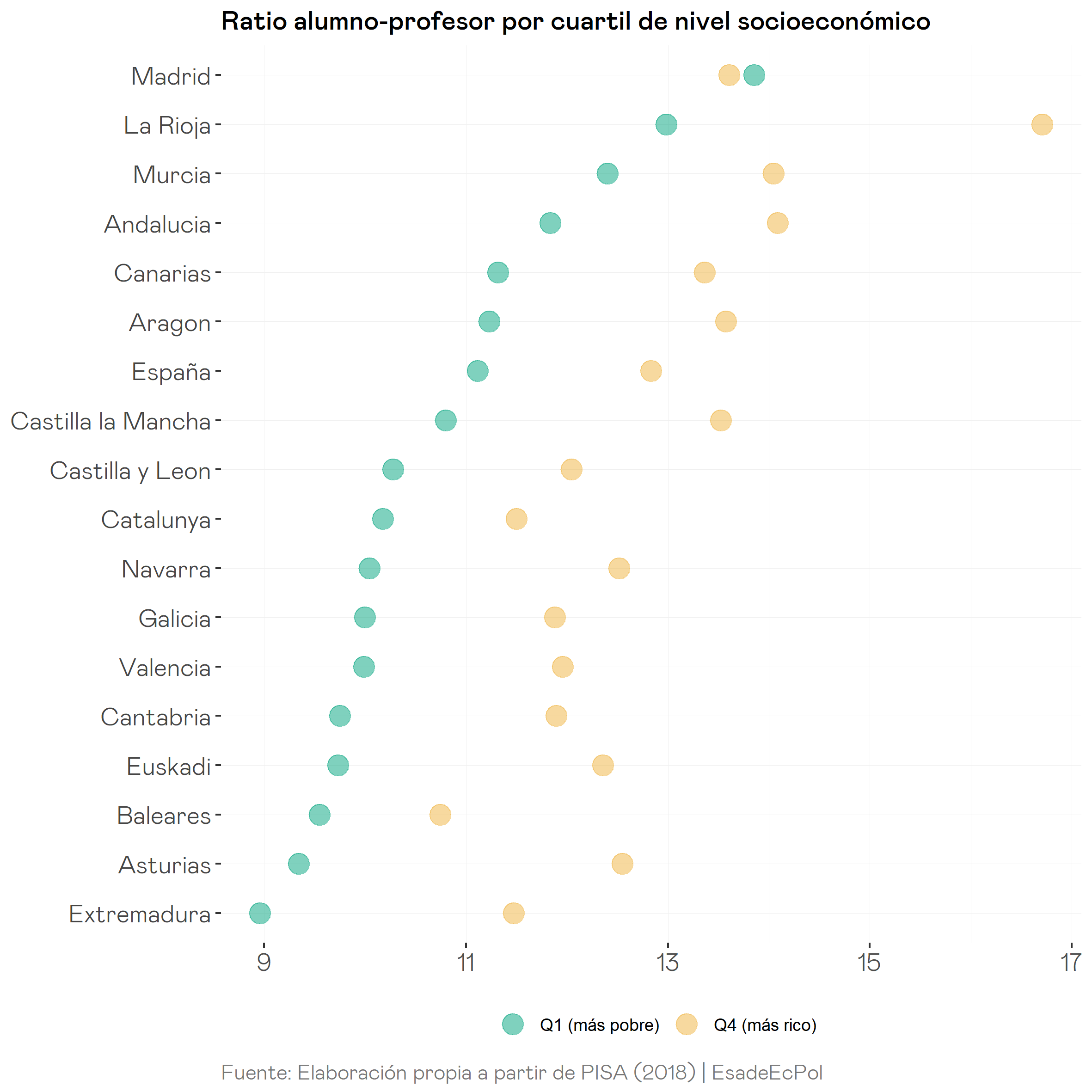
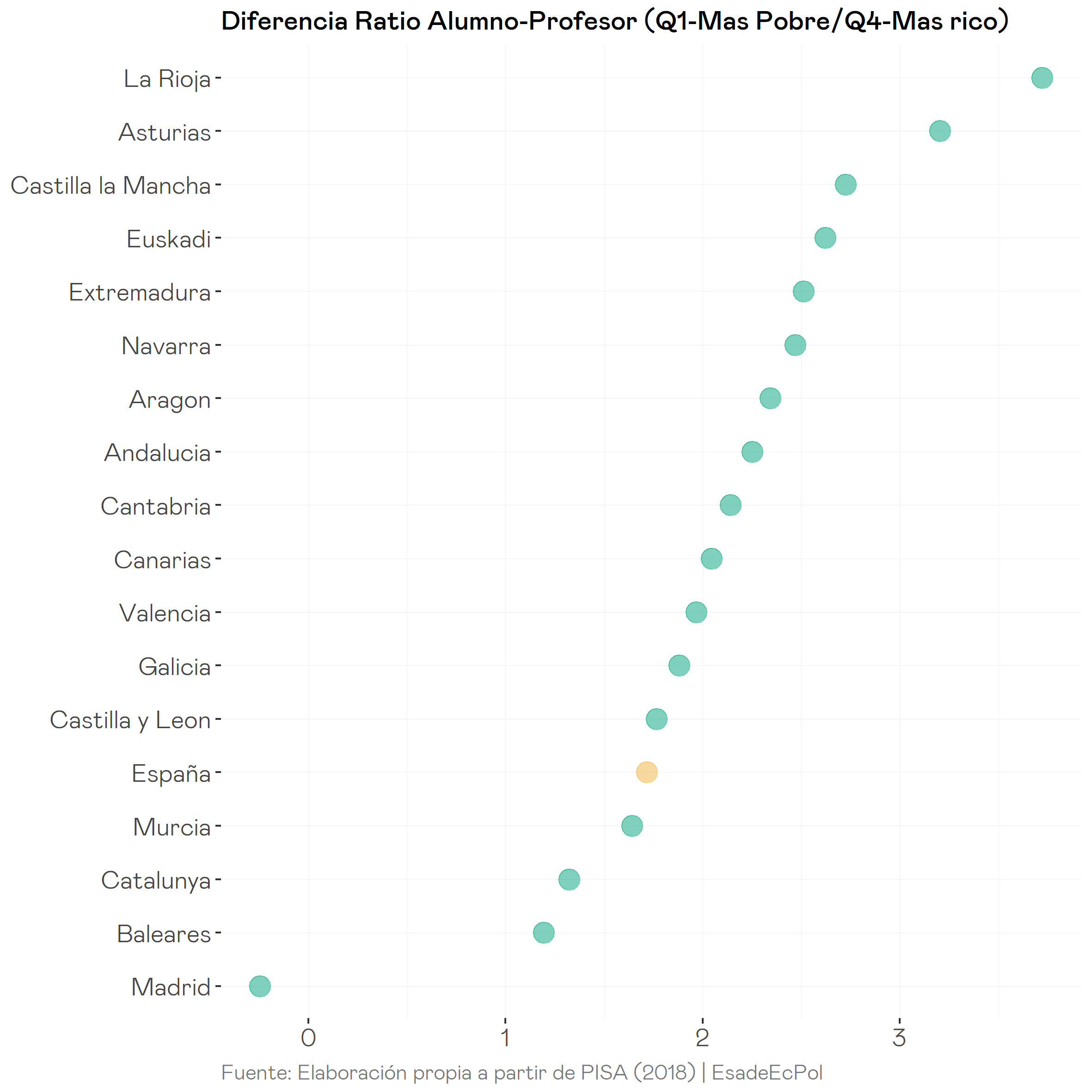
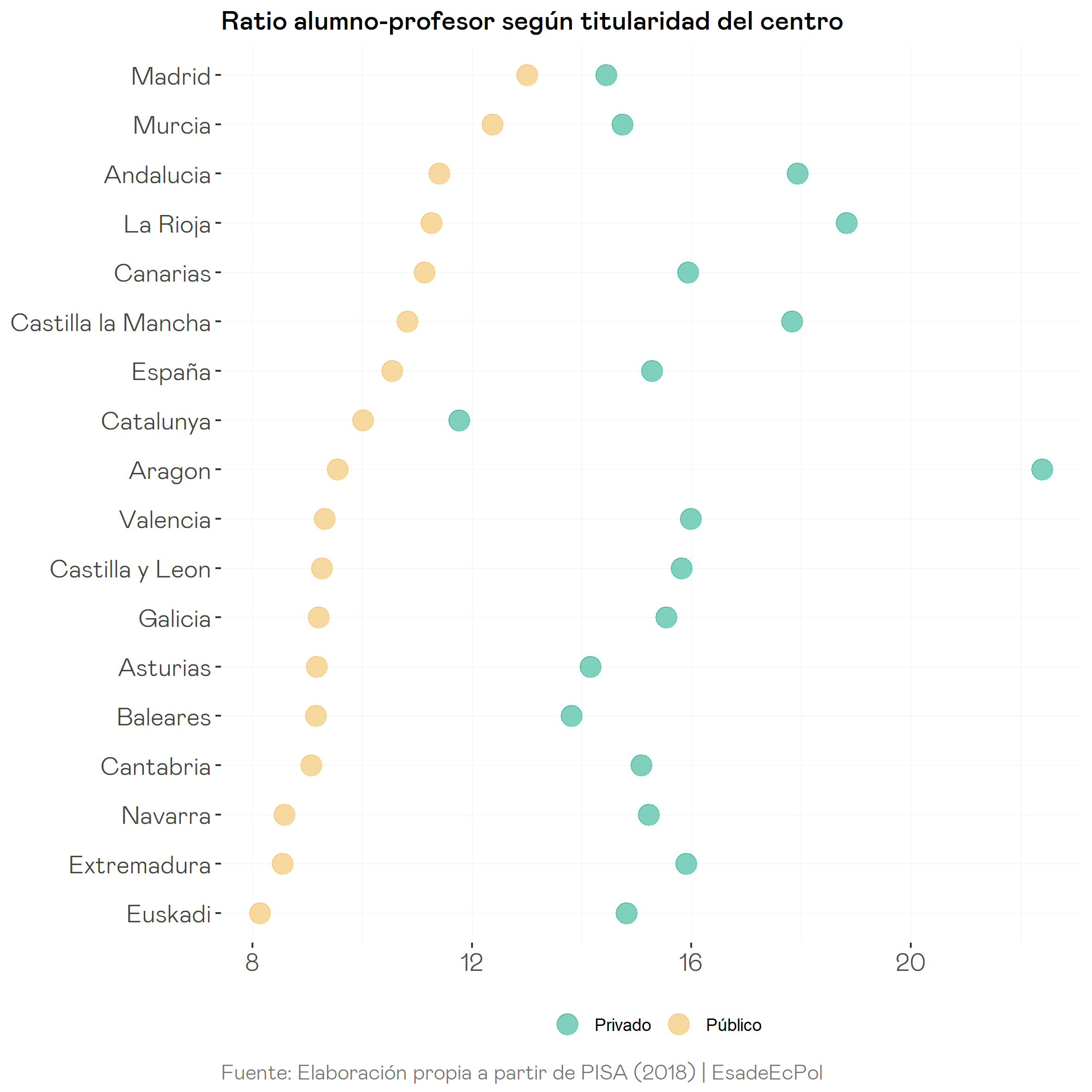
If we now look at school ownership, we see that in all regions public schools usually have lower ratios than private schools in the same region, which can be explained, at least in part, by a composition effect: public schools serve a larger proportion of vulnerable students. However, this difference in ratios by school ownership is also heterogeneous across regions: while in some it is very large (Extremadura, Aragon), in others there is practically no difference (Madrid, Catalonia). This smaller difference may be explained by several factors (for example, fewer rural schools, which are generally public and have very low ratios), but also by the composition effect of vulnerable students: these are the regions where the ratio fell least as the share of vulnerable students rose (in Madrid, it actually increases), so it is to be expected that, even though these students are concentrated in public schools, these schools still show no appreciable difference compared with privately owned ones.
In short, Spain does not generally have low ratios, although in some regions this figure could fall across the board. The key to the debate lies rather in the fact that the progressivity of ratios is not particularly high, especially in Madrid, where it is outright regressive. It is no surprise that this is the region that dominates most of the debate on ratios. Now that the debate on ratios is back, after the reduction in 2020/21, and in a context of potentially limited budgetary room, reducing ratios (or maintaining the current level) equally for all schools should not be the solution. Doing so where students benefit most (schools serving vulnerable students, mostly public ones) is, by contrast, a very efficient (and equitable) investment: that is where we should start.