Key ideas
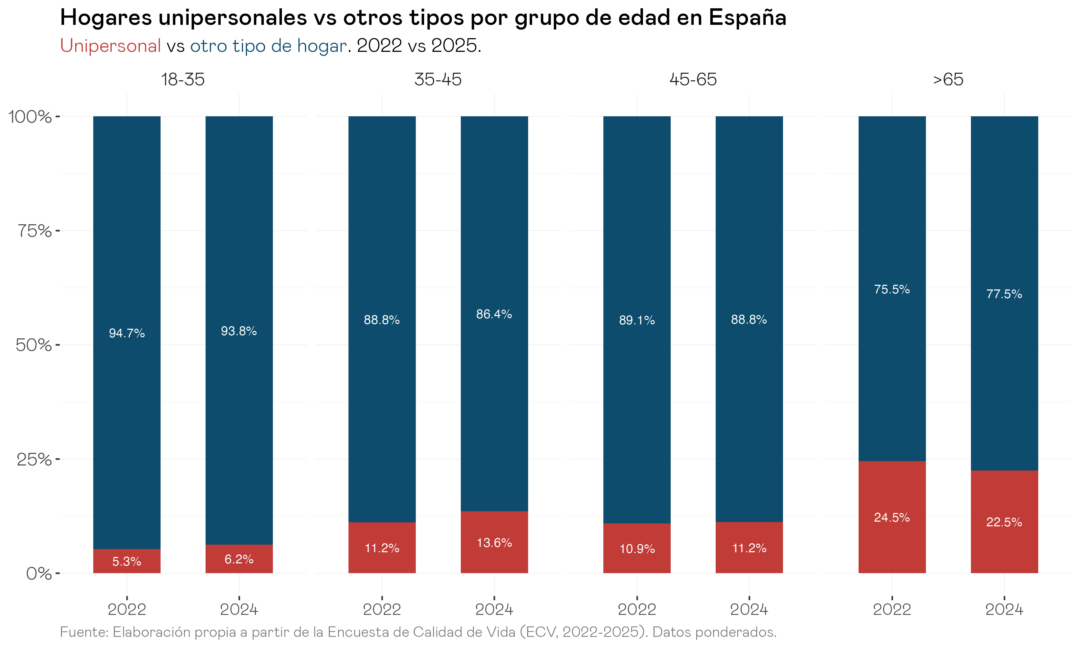
→ In Spain, 29% of households are single-person households, somewhat below the European average (37%) but with an upward trend in one specific group: growth is concentrated among those under 65, especially in the 35 to 45 age band, which rises from 11.2% to 13.1% between 2022 and 2025.
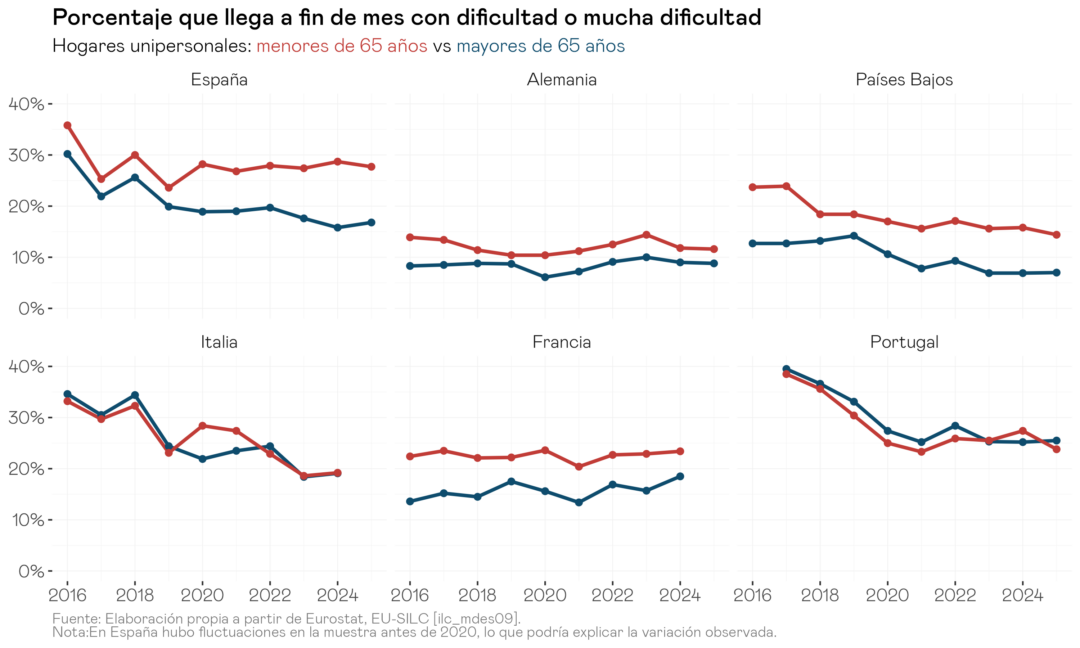
→ The share of single-person households under 65 that have difficulty making ends meet has climbed to 30% since 2020, while those over 65 remain below 20%.
→ For low-income single-person households under 65, housing costs approach or exceed 60% of income in the large European countries, well above the 40% overburden threshold: this is the “solitude premium”.
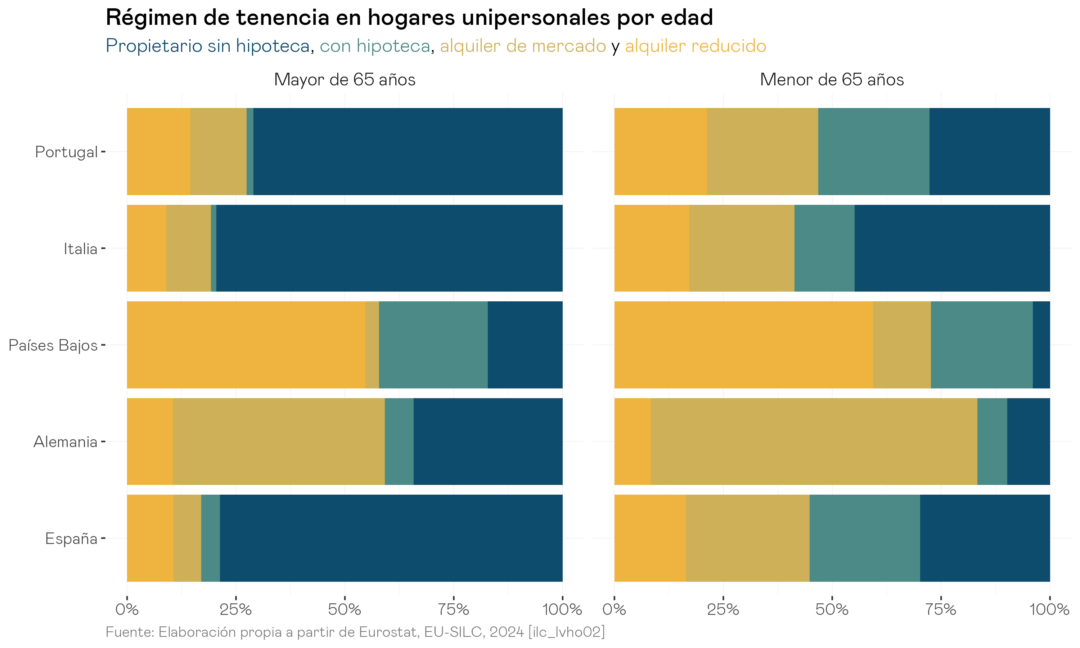
→ The generational asymmetry is reinforced by tenure: in Spain (and in Italy and Portugal) a very high share of those over 65 are outright owners, while younger people are split between renting and owning with a mortgage. By contrast, in Germany or the Netherlands renting is the majority tenure uniformly across generations.
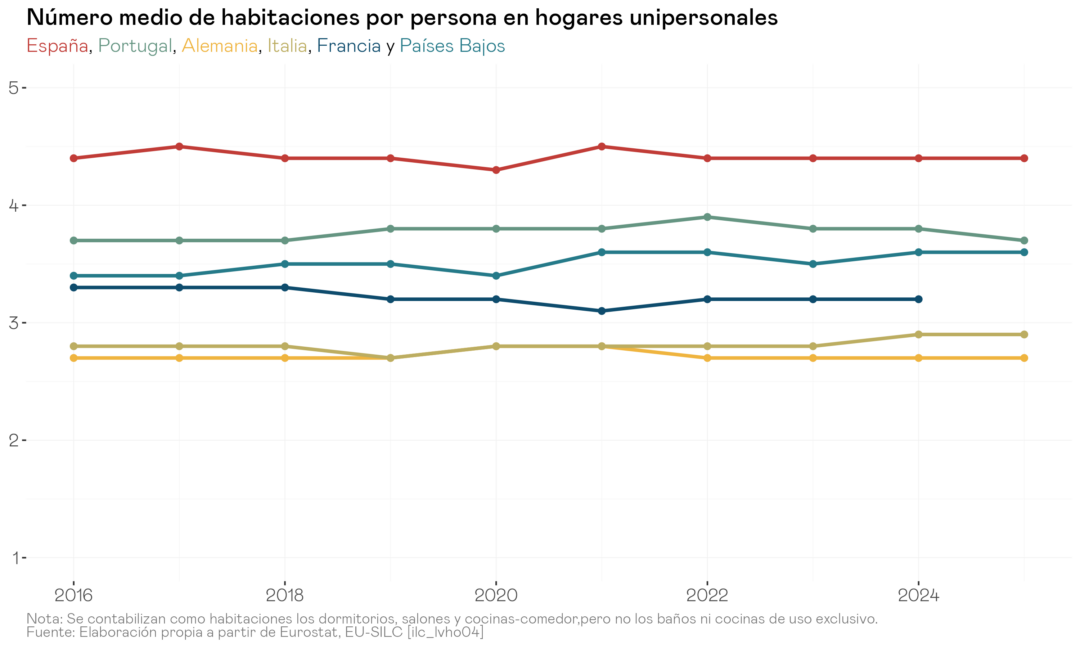
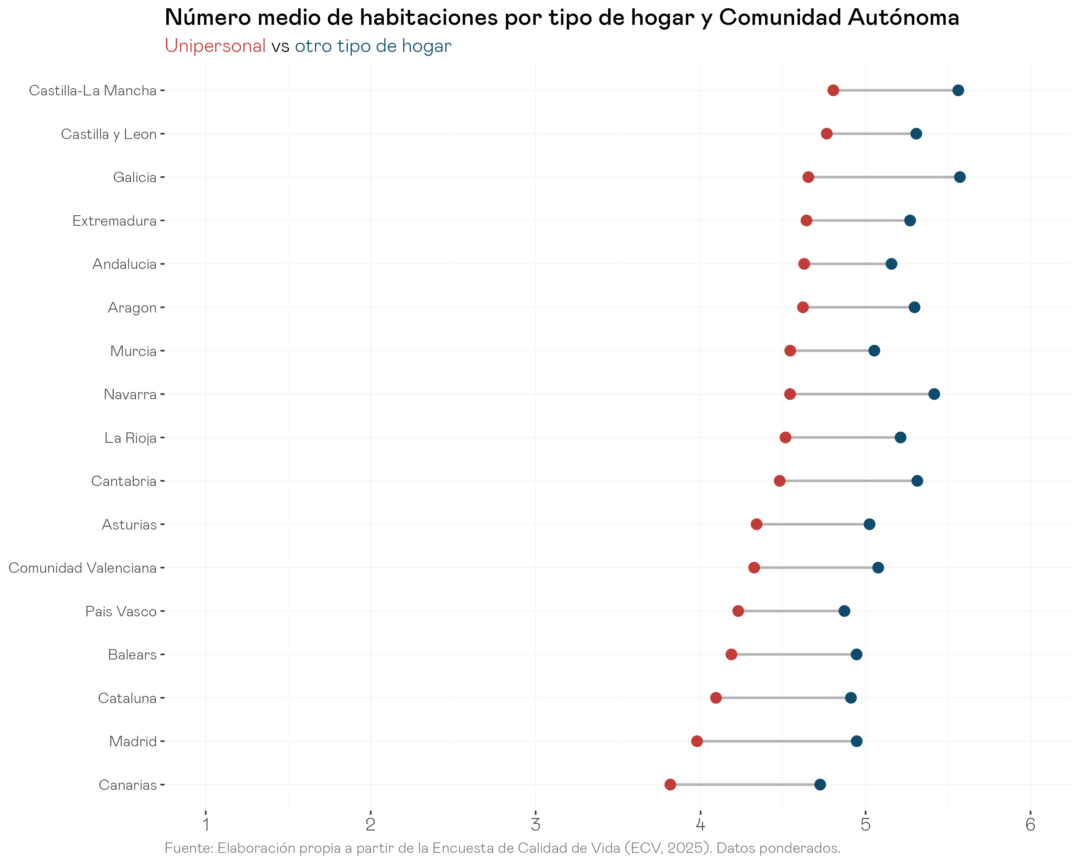
→ In Spain, moreover, the average number of rooms in single-person households exceeds 4, compared with 3 in the other European countries analysed, and the pattern is repeated in every autonomous community.
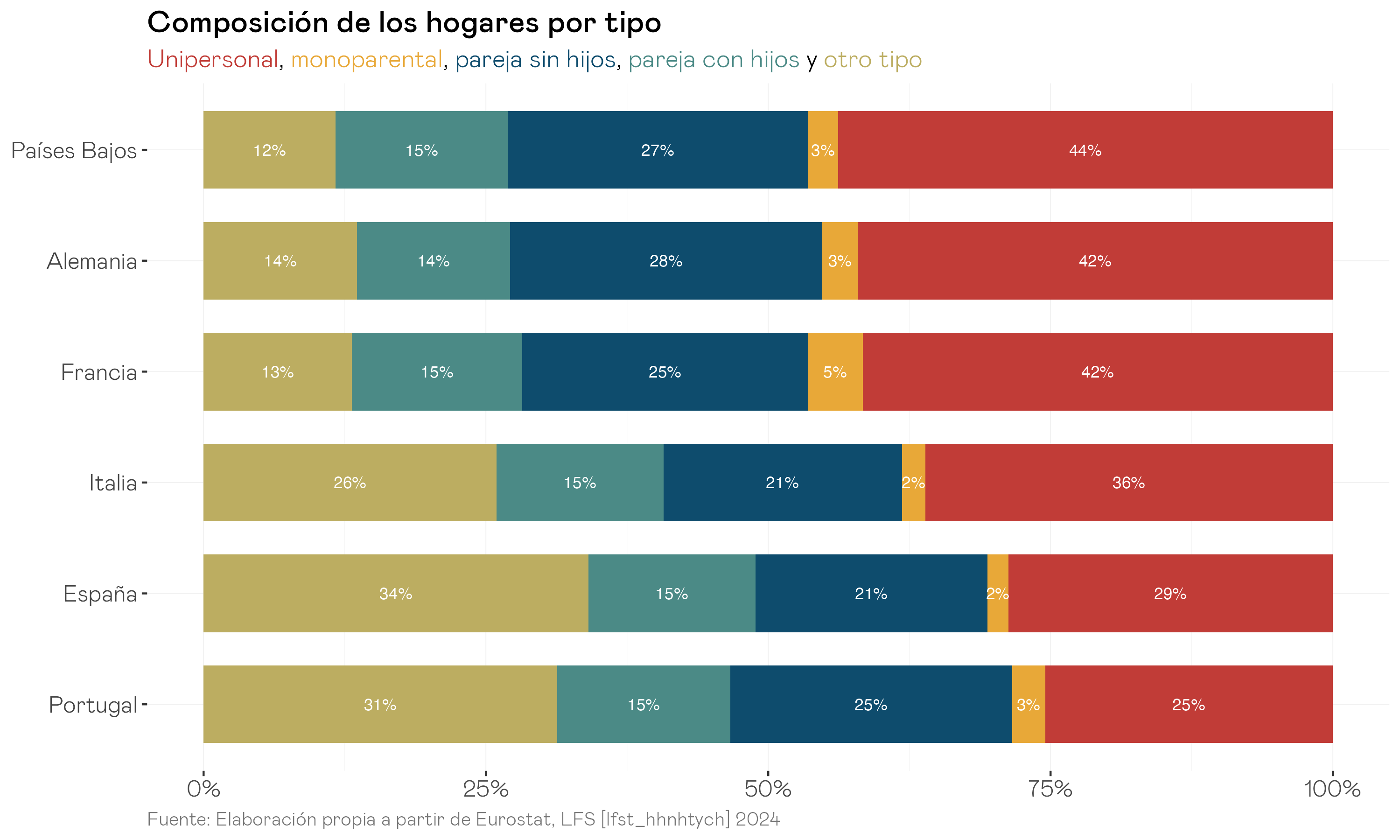
Living alone is no longer the exception. In 2024, around 37% of households in the European Union were people living alone without children, the most numerous household type in the whole Union. As the chart shows, Spain comes close to that average with 29% of single-person households, but has a gap of 13 percentage points with respect to Germany or France. In Spain, by contrast, the most frequent household type is the one Eurostat classifies as “other types”, which groups two or more adults who do not form a couple (adult children living with their parents or people sharing a dwelling), a reflection of the difficulties in leaving the parental home. Even so, 29% is a considerable figure and it is rising.
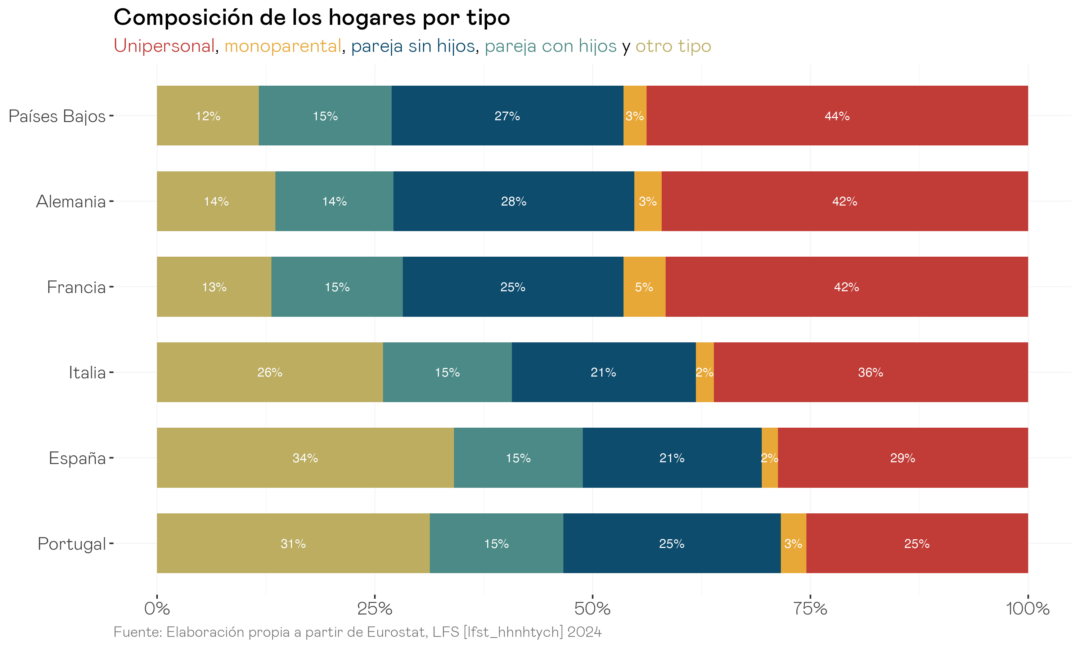
As the chart below illustrates, in five of the six countries analysed those under 65 are the majority among single-person households, and Spain stands out as the only one where their weight has grown steadily over the last three years. This is neither a marginal nor a recent phenomenon: between 2015 and 2024, single-person households without children grew by 16.9% in Europe, almost three times as much as the other household types (Eurostat, 2025). In Spain, the INE projects that by 2039 one in three households will be a single-person household (INE, 2024).
Broken down by age group, the growth in single-person households is concentrated mainly in the 35 to 45 age band, which rises from 11.2% to 13.1% between 2022 and 2025. Among the youngest, aged 18 to 35, the increase is smaller —from 5.3% to 6.4%—, but it must be read in the context of the difficulties this group faces in leaving the parental home in Spain. In fact, only a third of young Spaniards had left the parental home in 2025, the lowest level in the series of the Living Conditions Survey itself. It could therefore be said that, of the few who manage to leave home, a growing share do so to form a single-person household.
Being alone multiplies the cost of housing
Breaking the data down into those over and under 65 reveals a divide that is repeated in all these European countries: in Spain, Germany, the Netherlands and France, single-person households under 65 systematically have more difficulty making ends meet than older ones. In the case of Spain, this gap also follows a worrying path: since 2020, the share of single-person households under 65 in difficulty has climbed to close to 30%, while that of those over 65 has remained below 20%. This pattern does not imply that older people are free from economic vulnerability, but rather that younger ones face a disproportionate difficulty that deserves specific attention.
A large part of this difficulty can be explained by the weight of housing on income. As the following chart shows, for single-person households under 65 with low incomes —below 60% of the median—, the cost of housing approaches or exceeds 60% of their income in the six countries analysed, well above the 40% threshold beyond which Eurostat considers there to be overburden. Even among those on high incomes, the burden is around 20-25%. A structural feature of single-person households explains the difference: the fixed costs of the household —rent, utilities, building service charges— fall entirely on one person, with no possibility of sharing them. The literature calls this phenomenon the “solitude premium”.
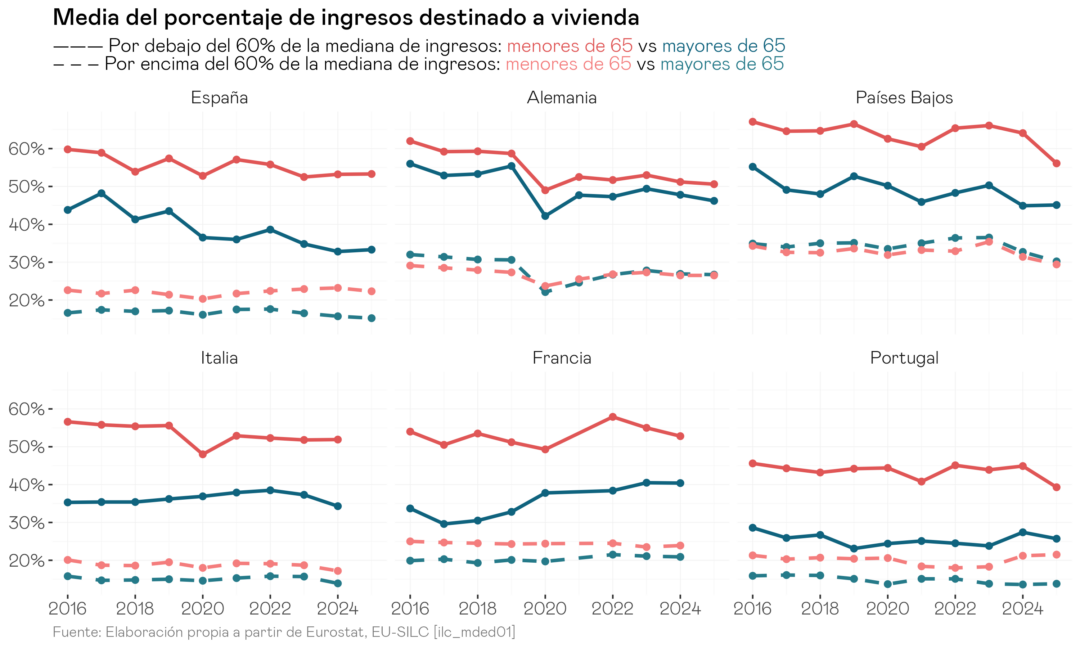
However, in all the countries analysed, low-income households under 65 devote a considerably larger share of their income to housing than older ones, which shows that the generational gap is not an exclusively Spanish phenomenon. In Spain this difference is especially marked, which points to two mutually reinforcing factors. On the one hand, the pension system acts as an income stabiliser for older households, reducing their relative vulnerability to housing costs. On the other, as the tenure chart shows, in Spain a very high share of older households are outright owners (the highest among the countries analysed, together with Italy and Portugal), which reduces or directly eliminates their housing expenditure. Young households, by contrast, are split between market renting and owning with a mortgage, bearing high running costs in a context of rising prices and without the wealth cushion that characterises older cohorts. This asymmetry is not only a snapshot of the present: those who are young adults in rented housing today accumulate years of effort without building up housing wealth, while those who became owners in earlier decades see their asset appreciate: an “intergenerational housing trap” (EsadeEcPol, 2025). It should be made clear, however, that this trap does not affect everyone equally: those with family support or higher incomes can become owners and escape it, which adds a dimension of internal inequality within the under-65 group itself.
Oversized dwellings
The shortage of housing supply aggravates the penalty for low-income households, in so far as it forces many single-person households to pay for ever more expensive dwellings. But the problem is not only one of price: it is also one of design. The European housing stock was mostly built when the standard household was a family of several members, and that legacy continues to shape what is available on the market today. Single-person households do not only pay more per person; in many cases they pay for space they do not need, because the supply of small, affordable dwellings is structurally insufficient.
The data on the size of the dwellings occupied by single-person households illustrate precisely that mismatch between supply and demand. As the following chart shows, the average number of rooms —defined by Eurostat as rooms for exclusively residential use, excluding kitchens and bathrooms— is around 3 in most of the countries analysed. Spain is a notable exception, with an average of more than 4 rooms, which suggests that a large share of Spanish single-person households live in dwellings that are oversized relative to the needs a single-person household might have.
The breakdown by autonomous community confirms that oversizing is a structural pattern repeated across the whole country: in no autonomous community does the average for single-person households fall below 4 rooms. The gap with respect to other household types is also relatively constant across all regions, which points to a mismatch in the Spanish housing stock rather than to specific local dynamics. Castilla-La Mancha, Galicia and Castilla y León have the highest averages, while the Canary Islands and Madrid are at the lower end, although even there the value is around 4 rooms.
Living alone entails, under current conditions, a disproportionate economic burden. The weight of housing costs on income, the growing concentration in renting, a housing stock that does not match demand and the barriers to home ownership make up a structural problem that goes beyond individual decisions. Addressing it requires acting on supply:
- Steering new construction towards dwelling types that match actual demand. As long as the housing stock remains dominated by dwellings designed for family households, single-person households will continue to pay for space they do not need.
- Making it easier to subdivide large dwellings in high-demand areas. Fiscal or administrative incentives for dividing large dwellings (especially those of more than 150 m² in urban centres) would make it possible to expand the supply of small units without the need for new construction.
- Increasing the supply of social or affordable rental housing specifically aimed at single-person households.
References
Eurostat. (2025). Household composition statistics. Statistics Explained. European Commission.
Eurostat. (2025). Living conditions in Europe – housing. Statistics Explained. European Commission.
EsadeEcPol. (2024). Radiografía de la evolución de los patrimonios de los hogares en España. EsadeEcPol Brief.
Instituto Nacional de Estadística. (2024, 24 June). Proyección de hogares. Años 2024-2039 [Press release]
Related content
22 July 2026