Facing a new energy and inflation shock, what did we learn from 2022 about which measures to activate?
Jorge Galindo
14 March 2026
The (obvious) energy channel
The coordinated attack by the United States and Israel on Iran on 28 February has triggered the largest disruption to the oil market in decades. Given current and expected shortages, Brent has climbed at its daily close from €72 to almost €100. In parallel, Qatar (which supplies between 12%-14% of Europe’s liquefied natural gas, and close to 20% of the world’s) halted all its gas production and declared force majeure on its ongoing contracts.
And, although Spain imports relatively little crude directly from the Gulf, the price of oil is global: when millions of barrels a day are missing, it rises for everyone. We have already seen increases in petrol: it has become 13 cents per litre more expensive from the start of the conflict to Monday 9, and diesel by almost twice as much, 22 cents. It is worth noting here, as Javier Jorrín did, that refined products rise faster than crude because the closure of Hormuz is compounded by the shutdown of Gulf refineries, the halt to China’s fuel exports and the surge in freight costs. And, at the same time, European gas (TTF) has shot up by 90%, to €60/MWh, with storage levels at their lowest in years.
Faced with this situation, the Government has begun to signal (cautiously) that it will act. It is therefore the moment to recall what we already know from the evidence we have generated over these years:
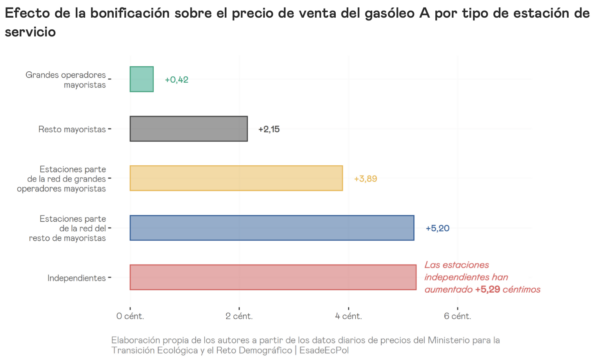
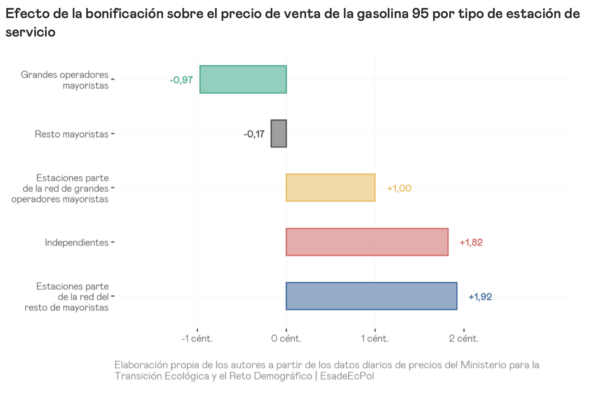
- The fuel discount of 20 cents per litre benefited those who consumed the most fuel, who are the higher-income households. And, more seriously still, it was partly captured by the supply side: our causal study showed that the cheapest stations raised their diesel prices by between five and eight cents per litre after the discount was introduced, compressing the price distribution. In addition, the measure subsidised consumption of the resource we need to reduce for decarbonisation. Its removal was the right call, although slow. The advisable course is not to bring it back.
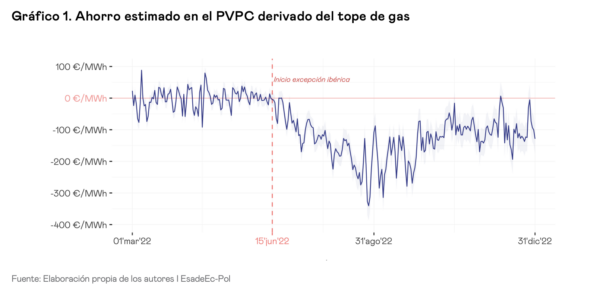
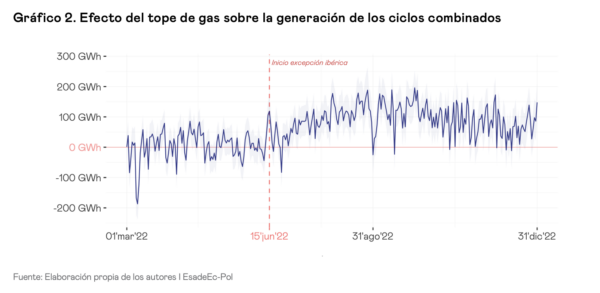
- The Iberian exception (the cap on the price of gas for electricity generation) was effective as a firewall, but with a specific side effect. According to our causal estimate, households on the regulated tariff saved around 209 euros in the first six months. But it did so at the cost of increasing gas consumption, damaging the energy-saving signal. This illustrates the central dilemma facing this policy, which may well come into consideration if the gas situation approaches that of 2022 (when the TTF went above €200/MWh in a few days).
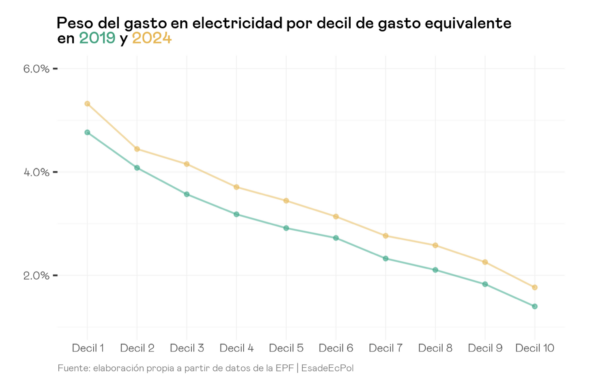
- The VAT cut on electricity deserves a different assessment. We saw descriptively that, while it was in force, it had a favourable distributional profile: it took 1.59 points off the CPI of the first decile compared with 0.76 for the last, thanks to the much greater weight of electricity in the spending of poor households (more than 5%) than in that of rich ones (less than 2%). But in addition, and this is important, making electricity cheaper relative to fossil fuels improves the relative price signal for gaining efficiency and energy independence in the long term. In a context where we want households to shift from gas heating and fossil-fuel transport towards electricity, reducing taxation on electricity can be a useful tool.
The (potential) food channel
The crisis carries risks that go beyond energy. Close to a third of world fertiliser exports pass through the Strait of Hormuz. Qatar, Saudi Arabia, the Emirates and Iran are central suppliers of urea (the most widely used nitrogen fertiliser in the world: the Gulf accounts for almost half of its global exports) and of the chemical precursors the industry needs. In the first week after the escalation, FOB urea prices rose by 37%. In addition, natural gas accounts for around 70% of the production cost of nitrogen fertilisers, so each rise in gas is passed directly on to agricultural costs. The timing also matters: the spring sowing window in the northern hemisphere, when demand for nitrogen reaches its annual peak.
The government has for now ruled out a VAT cut on food, arguing that “we are not yet observing this transmission channel”. It is true that any impact on food would arrive with a lag relative to energy. But it is advisable to have the response ready for when it does. In fact, at the end of 2025 the PP already promoted a broad cut (VAT at 0% for milk, eggs, fruit, vegetables and pulses, and at 4% for meat and fish), which the Government vetoed, citing a cost of 3,780 million euros. The temporary cut in force between 2023 and 2024 expired on 1 January 2025: basic foodstuffs are once again taxed at 4% (the usual super-reduced rate), while pasta and seed oils returned to 10%. Only olive oil was permanently reclassified at 4%.
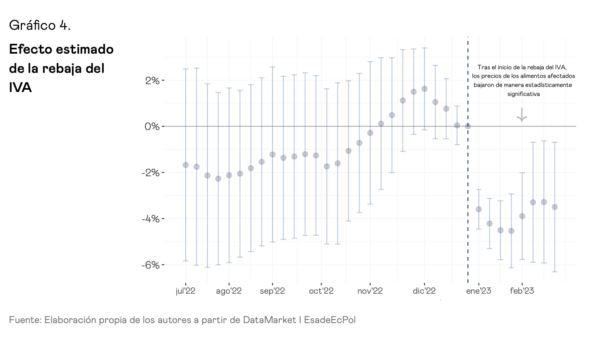
If food inflation picks up again, so will the pressure to cut VAT once more. It is therefore worth recalling what we already know. Our causal evaluation of that measure showed that in large retailers the cut was passed on almost entirely to final prices (more than 90% pass-through in the first weeks).
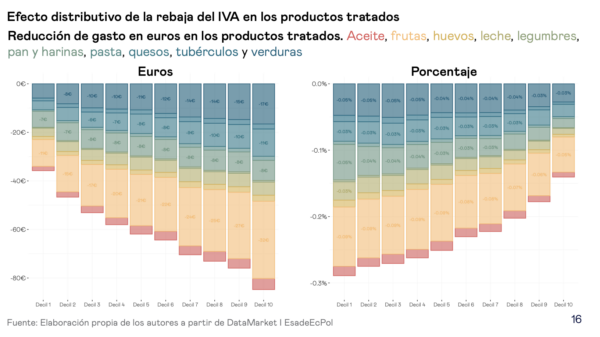
That said, this good initial pass-through did not make the measure an efficient instrument. The saving amounted to barely 0.3% of the annual spending of the poorest decile and 0.13% of the richest: a tiny fraction of the cumulative food inflation of 13% between 2021 and 2023. And, above all, five out of every ten euros of forgone revenue went to the 40% of households with the greatest economic capacity. In absolute terms, the saving was around 35 euros a year for households in the first decile and 85 euros for those in the last.
Transfers as an alternative cushion
The conclusion we put forward at the time is that a direct transfer to low-income households would have been more effective in distributional terms and cheaper for the public purse as a mechanism for cushioning price shocks: targeting spending on the most exposed households would have achieved more protection at lower cost and with less distortion. The problem is that Spain does not have transfers that work at the scale and speed a shock demands.
The instruments that on paper come close to this logic are the energy social bonuses. The electricity one applies a direct discount on the electricity bill for households on the regulated tariff that meet vulnerability criteria; the thermal one is a single annual payment to cover heating costs. They are, conceptually, a targeted and progressive instrument. During the 2022 crisis the discounts of the first type were raised to 65% of the bill for vulnerable consumers and 80% for the severely vulnerable; at present they remain reinforced, although less so (42.5% and 57.5% respectively, until the end of 2026).
But their reach remains insufficient. Our 2024 report described for the first time the coverage rates of the electricity social bonus: our overall estimate is that only 24.5% of potential beneficiaries accessed the aid, falling to 9.2% among retirees on the minimum pension, while 60% of upper-middle-income large families have it. Because it turns out that one of the access channels is not progressive: the bonus can be requested simply by proving large-family status.
The National Strategy against Energy Poverty 2026-2030, approved last February, takes a step in the right direction by proposing income criteria for all groups eligible for the social bonus, including the almost 285,000 large families that until now gained access without proving them. But the measures to close the coverage gap remain timid: removal of penalties for switching supplier, protections against rebilling, a requirement for written confirmation when a consumer leaves the PVPC with a social bonus. These are procedural improvements at the margin. It is telling that, three years after we recommended automating the bonus by cross-checking the databases of the tax authorities and Social Security, the logic remains the same: the household must apply, prove and wait.
And there is an underlying question: does a specific transfer or discount against energy poverty really make more sense if there are channels for poverty in general? After all, the household as a unit of consumption suffers the inflationary shock and the resulting deprivation across its whole budget, even if it affects only one part of the shopping basket. Having a Minimum Living Income with greater reach would make it possible to use it as a channel for stabilising incomes in situations such as the current one or that of 2022. But the fourth opinion of AIReF (July 2025) finds that the IMV has not undergone significant structural changes since its creation: the non take-up rate remains at 55% (72% for the child support supplement), median processing times are still 203 days and at the end of 2024 the benefit reached barely 392,000 households. The diagnosis is the same as for the social bonus: the opt-in logic, the complexity of the procedure and the lack of automatic mechanisms prevent the transfer from reaching those who need it.
Is our public spending too exposed to inflation?
The largest item of State transfers to households is pensions. And perhaps the way they are updated is not neutral for the rest of economic policy: automatic indexation to the CPI introduces a bias into the government’s decision-making in the face of each price shock. When each point of inflation translates directly into thousands of millions in additional pension spending, any government would have an added incentive to intervene in prices: it wants not only to cushion the impact on the consumer, but also to slow the uprating meter.
Because, with automatic indexation to the CPI, each point of inflation translates into additional public spending. In 2023, the uprating of ~8.5% cost more than 12,000 million euros: half of the new social spending planned in the Budget. Analysing it, we showed that the universal uprating was practically neutral in distributional terms: it reduced the Gini index by 0.02%. 21.2% of the cost went to the highest-income decile, and only 13% to the poorest 30%.
Our emergency proposal at the time was an uprating by bands, full for the first three deciles and decreasing up to the last, which achieved a distributional impact of 0.67% on the Gini using barely 55% of the resources: less than 7,000 million. But the conflict and its possible ramifications force us to ask a deeper question. If inflationary shocks of geopolitical origin are going to become a recurring feature of the economic outlook, then mechanisms such as the automatic indexation of pensions to the headline CPI turn every external disturbance into a potential fiscal shock. The government is trapped in a cycle: intervening in prices to curb inflation, to curb the uprating, to contain the deficit. And price interventions have the distributional and efficiency problems we have documented. This is a secondary reason that adds to those central to the system which make it advisable to review the model for calculating the value of pensions.

Related content
14 July 2026