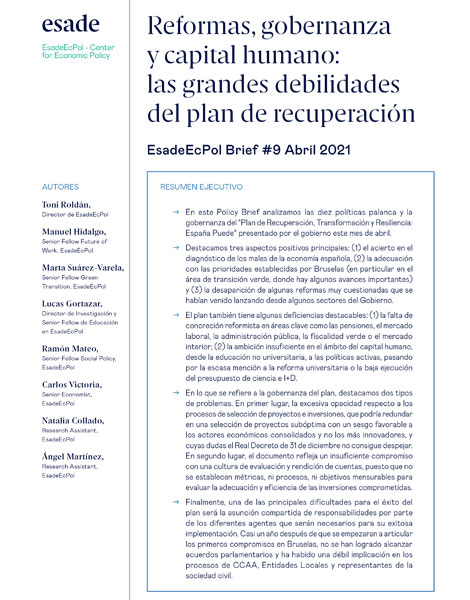
Reforms, governance and human capital: the major weaknesses of the recovery plan
Toni Roldán, Manuel Hidalgo Pérez, Marta Suárez-Varela, Lucas Gortazar, Ramón Mateo Escobar, Carlos Victoria, Natalia Collado Van-Baumberghen, Ángel Martínez Jorge
27 Apr, 2021
- In this Policy Brief we analyse the ten flagship policies and the governance of the “Recovery, Transformation and Resilience Plan: España Puede” presented by the government this April.
- We highlight three main positive aspects: (1) the accurate diagnosis of the ills of the Spanish economy, (2) its alignment with the priorities set by Brussels (particularly in the area of the green transition, where there are some important advances) and (3) the disappearance of some highly questioned reforms that had been floated by some parts of the Government.
- The plan also has some notable shortcomings: (1) the lack of specific reforms in key areas such as pensions, the labour market, public administration, green taxation or the internal market; (2) insufficient ambition in the area of human capital, from non-university education to active labour market policies, including the scant mention of university reform and the low execution of the science and R&D budget.
- With regard to the governance of the plan, we highlight two types of problems. First, the excessive opacity of the processes for selecting projects and investments, which could result in a suboptimal selection of projects biased towards established economic actors rather than the most innovative ones, doubts that the Royal Decree of 31 December fails to dispel. Second, the document reflects an insufficient commitment to a culture of evaluation and accountability, since no metrics, processes or measurable targets are set to assess the suitability and efficiency of the investments committed.
- Finally, one of the main challenges for the success of the plan will be the shared assumption of responsibilities by the different actors needed for its successful implementation. Almost a year after the first commitments began to be set out in Brussels, no parliamentary agreements have been reached and the regions, local authorities and civil society representatives have been only weakly involved in the processes.
Read the full article:







Natalia Collado Van-Baumberghen
Research Economist en EsadeEcPol. Máster en Economía Industrial y Mercados regulados por la Universidad Carlos III de Madrid
View profile
Related content

Informe Económico y Financiero
Informe Económico y Financiero # 38 · Europe, capabilities for a hostile world