NextGenEU Tracker: Evolution of NextGen EU Funds in Spain
Manuel Hidalgo Pérez, Jorge Galindo, Javier Martínez Santos
3 Apr, 2025
Since the launch of the European Recovery and Resilience Facility (RRF), analyzing and tracking the execution of funds allocated to Spain has been essential to evaluate not only economic absorption but also their capacity to drive significant transformations in the Spanish economy, as outlined in the Recovery, Transformation, and Resilience Plan. At EsadeEcPol, we have led this tracking through our database, which monthly records all tenders and subsidies associated with these funds.
Now, the data from this database is compiled into a real-time monitoring dashboard: the NextGenEU Tracker. This tool provides segmented data on funds related to tenders and subsidies announced and awarded since the program’s inception. It categorizes the data by type of call and issuer, type of recipient, sector, and autonomous community, offering an unprecedented level of detail complementary to tools like the Ministry of Economy’s ELISA panel, which focuses on the PRTR levers. This detail allows the identification of trends and patterns, some of which we highlight in the report accompanying the launch of the dashboard.
Of the €80 billion committed by the EU during the initial phase of European agreements (excluding more recent tranches that focus mainly on repayable loans), nearly €75 billion had been announced, and slightly more than €49 billion awarded by January 31, 2025. This means that approximately 94% of the initially committed funds have been announced and around 61% awarded. Considering that slightly less than three-quarters of the initially agreed spending period (January 2021 – August 2026) had elapsed, the pace is slightly slower than required.
This gap can be attributed to several factors, notably: (1) delays in publishing and resolving calls, (2) complex administrative procedures, and (3) insufficient absorption capacity among some potential beneficiaries.
However, the recent slowdown in awards to the private sector could indicate difficulties in its absorption capacity.
Catalonia leads in absolute terms, followed by Andalusia, with the Basque Country and the Community of Madrid trailing significantly behind. However, on a per capita basis, the Basque Country, Aragón, and Castilla-La Mancha show a higher pace.
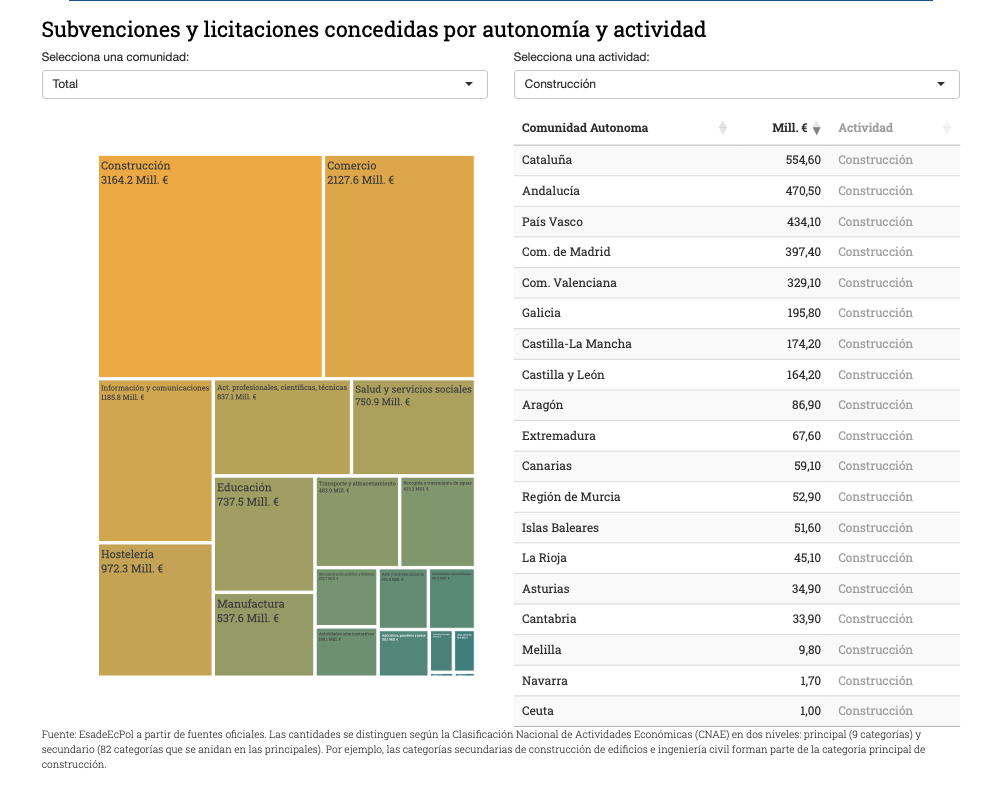
By sector, construction (including all forms of development, notably infrastructure) leads with over €3 billion, followed at considerable distance by commerce. The intersection of autonomous communities and sectors reveals notable intensity in construction across several regions, especially Catalonia, Andalusia, and the Basque Country.
The sectoral and territorial analysis suggests that funds might be following paths of least resistance, reinforcing existing sectors. Nevertheless, there is also potential for transformative impacts within these established and often significant sectors. In any case, the observed distribution underscores the need eventually to transition towards concrete impact evaluations to determine whether investments effectively contribute to economic transformation goals or whether they are reinforcing existing conditions.
Based on this evidence, we recommend:
→ Accelerating award processes to reduce the current gap, simplifying administrative procedures.
→ Preventing regional or local capacity issues from becoming bottlenecks by developing specific support mechanisms for areas with lower capacity, strengthening technical teams, and establishing more efficient multi-level coordination mechanisms.
→ Reviewing sectoral concentration and considering priority recalibrations, especially evaluating areas where increased effort might be beneficial, particularly in human capital development or housing access.



Economista enfocado en el análisis y la visualización de datos. Grado en Administración de Empresas y Economía Laboral por la Universidad de A Coruña y Master en Economía por la Universidad de Santiago.
View profileRelated content